Wize University Chemistry Textbook > Chemical Bonding
Types of Bonds
Popular Courses
MCAT
General Course
CHEM 1301A/B
Western University
CHEM 201
University of Calgary
General Chemistry
University Study Guides
AP Chemistry Exam Prep Course
AP Exam Prep
CHEM 1A03
McMaster University
CHEM 101
University of Alberta
CHEM 112
Queen's University
CHEM 121
University of British Columbia
DAT
General Course
Chemistry
General Course
General Chemistry
University Study Guides
CHEM 103
University of Alberta
CHEM 110
McGill University
CHEM 1E03
McMaster University
ENGG 204
University of Calgary
CHM135H1
University of Toronto
CHEM 154
University of British Columbia
CHEM 101
University of Victoria
CHEM 120
University of Waterloo
0:00 / 0:00
Introduction to Intramolecular Bonds
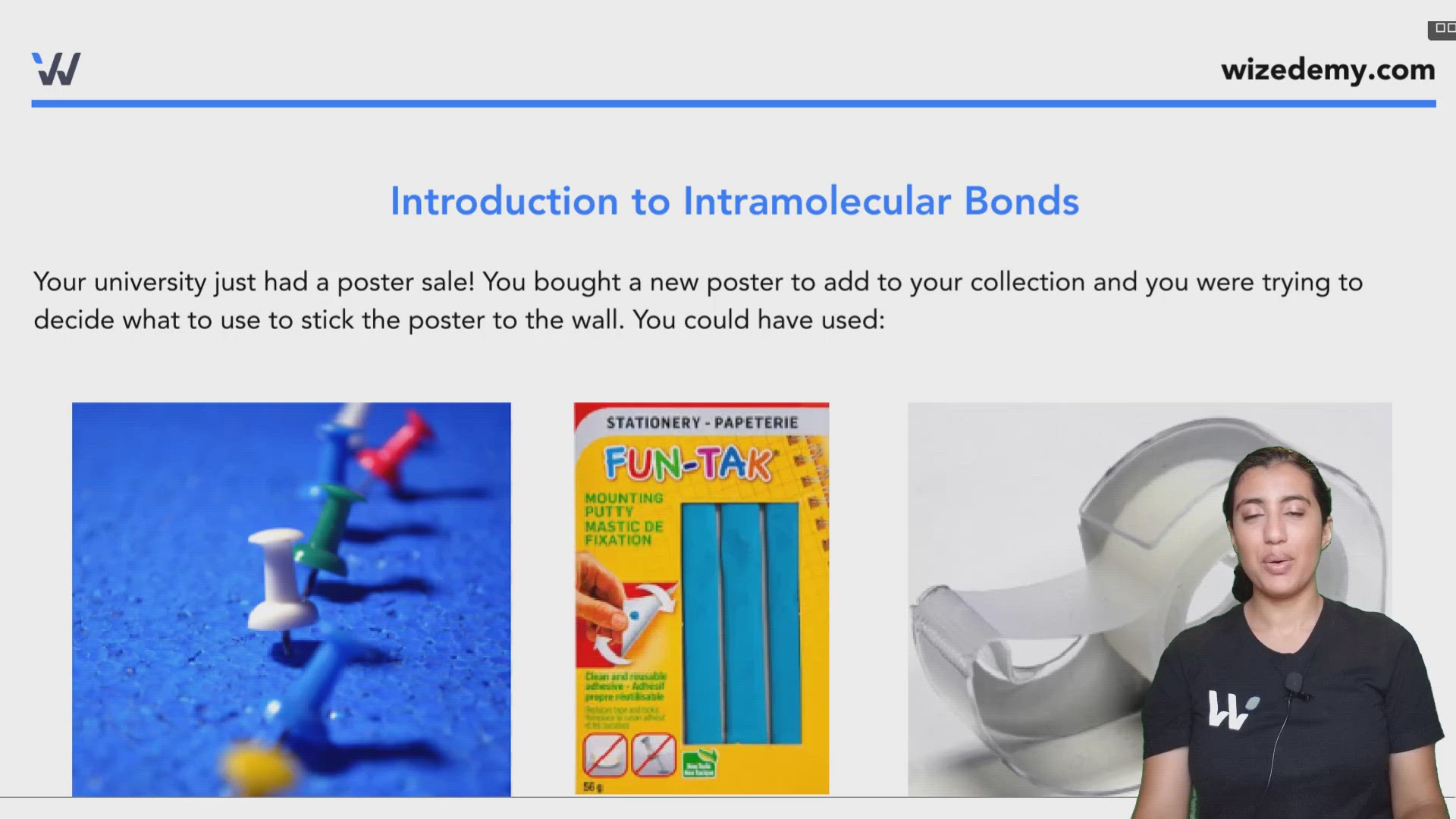
Your university just had a poster sale! You bought a new poster to add to your collection and you were trying to decide what to use to stick the poster to the wall. You could have used:

Just like how we can use different things to stick the poster to the wall, there are different bonds that connect different atoms together.
Intramolecular bond: a bond that connects two atoms within a molecule together
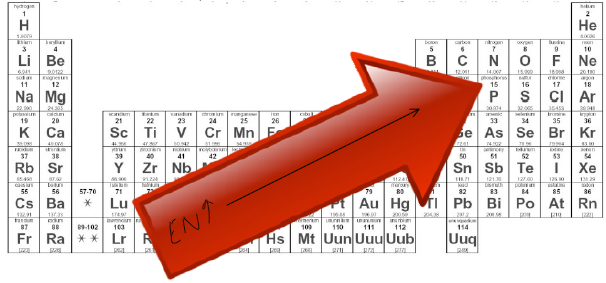
Before we take a look at the different types of intramolecular bonds, we will review electronegativity.
Electronegativity: is the tendency of an atom to pull bonding electrons towards itself
- Valence electrons are involved in chemical bonding
- The type of bond depends on the difference in electronegativity between the two atoms in the bond
Watch Out!
This is similar to electron affinity but not the same!
Electron affinity involves a single atom/ion, whereas electronegativity involves two bonded atoms.

0:00 / 0:00
Types of Intramolecular Bonds
We will be discussing ionic bonds, covalent bonds (polar covalent bonds, non-polar covalent bonds, and coordination covalent bonds), as well as metallic bonds, which are tested on the least.
Ionic Bonds:
- Are between a metal and a non-metal
- You might see ionic compounds called salts like NaCl
- There is a large difference in EN (ΔEN > 1.7) in these bonds
- The metal gives electrons to the non-metal (no sharing of electrons)
Example:
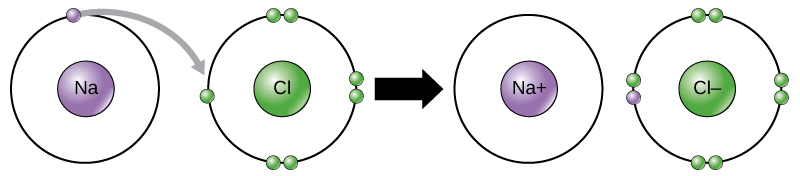
The charges that result are what allow ionic compounds to conduct electric current
Covalent Bonds:
- Bonds where electrons are shared between two non-metals
- We will consider 3 types of covalent bonds: i) Non-polar covalent bonds, ii) Polar covalent bonds iii) Coordination covalent bonds
Non-polar Covalent Bonds:
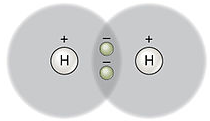
- Electrons are shared equally between 2 of the same non-metals
- As a result there is a very small difference in EN, 0 < ΔEN < 0.4
Examples: H2, O2, N2, Cl2, *S8, *P4
Example: Shown below is an example of two hydrogen atoms sharing their single electron to form a covalent bond. This is specifically a non-polar covalent bond!
Polar Covalent Bonds:
- Electrons are shared unequally between 2 different non-metals
- There is a difference in EN, 0.4 < ΔEN < 1.7
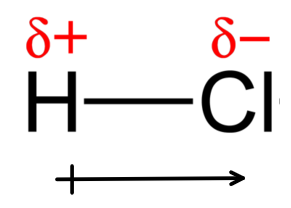
Since electrons are shared unequally in this bond, we say that there is a "dipole moment"
- The dipole moment is a vector with both magnitude and direction (more on this later!)
- Partial negative charge (δ-) is assigned to the atom with the higher EN
- Partial positive charge (δ+) is assigned to the atom with the lower EN
- The greater the difference in electronegativity (EN), the greater the dipole moment!
Wize Tip
You can think of the dipole moment as a tug of war. The dipole moment (arrow) points towards the winner that is able to pull electrons more towards itself (is more electronegative!)
Coordination Covalent Bonds:
- These are covalent bonds (between 2 non-metals) where both electrons in the bond are donated by one of the non-metals Example: NH3 reacting with BF3
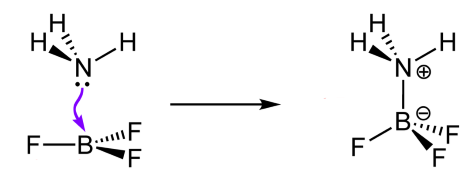
- The charges we see here as a result of the bond forming help the product weakly conduct in solution
- Note: Ionic bonds conduct a much stronger electric current!
Metallic bond
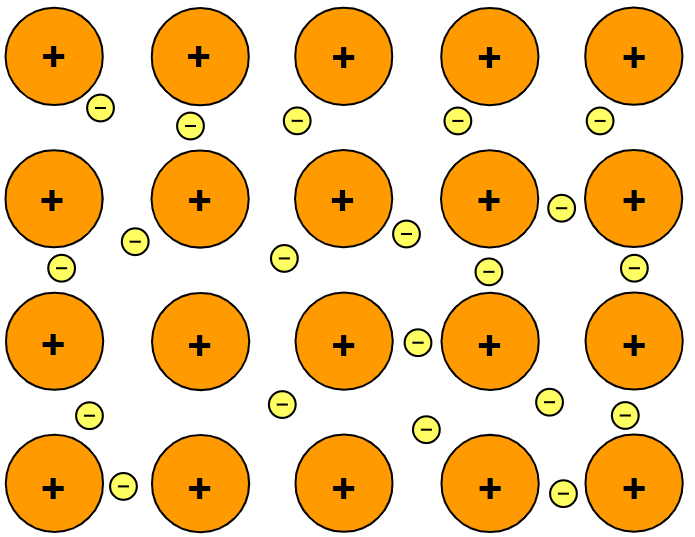
- The diagram is showing many atoms of a metal element and their inner shell electrons are surrounded by a sea of electrons that are free to move around (aka are delocalized)
- The circles with a "+" inside of them represent a metal atom + inner shell electrons (recall nuclei are positively charged)
- The smaller circles with a "-" inside of them represent valence electrons
- At least 1 VE/atom is free=conduction electrons
- These conduction electrons are what give the metal their properties!
- Ductile, malleable, conduct thermal energy, conduct electricity, have lustre/shine
Examples: Aluminum metal, Iron, Zinc etc.
0:00 / 0:00
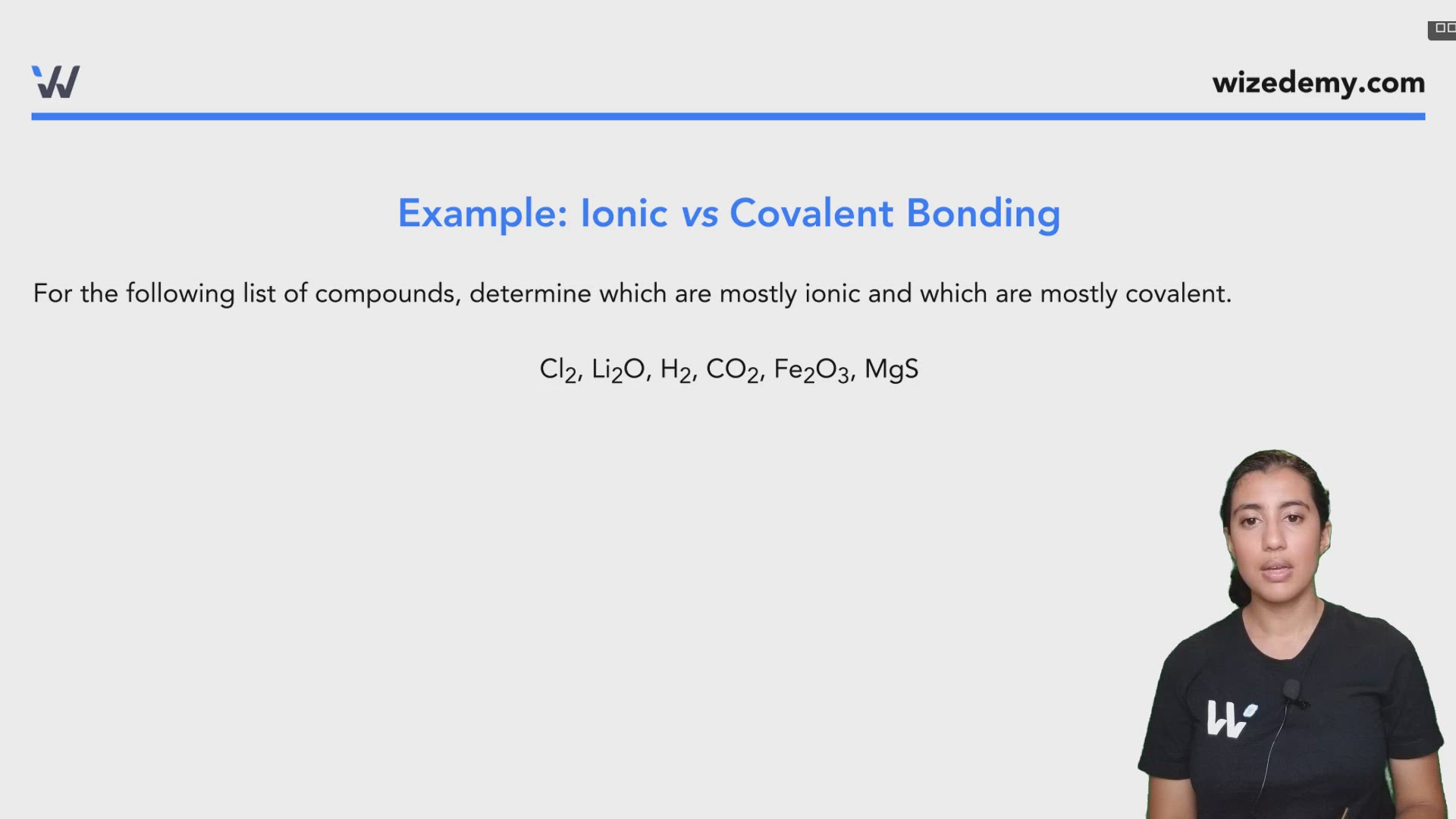
Example: Ionic vs Covalent Bonding
For the following list of compounds, determine which are mostly ionic and which are mostly covalent.
Cl2, Li2O, H2, CO2, Fe2O3, MgS
Mostly Ionic: Li2O, Fe2O3, MgS
Mostly Covalent: Cl2, H2, CO2
Wize Concept
Recall:
Ionic bonds are between metals and non-metals.
Covalent bonds are between two non-metals.
That is all you needed to know to get this question right :)
0:00 / 0:00
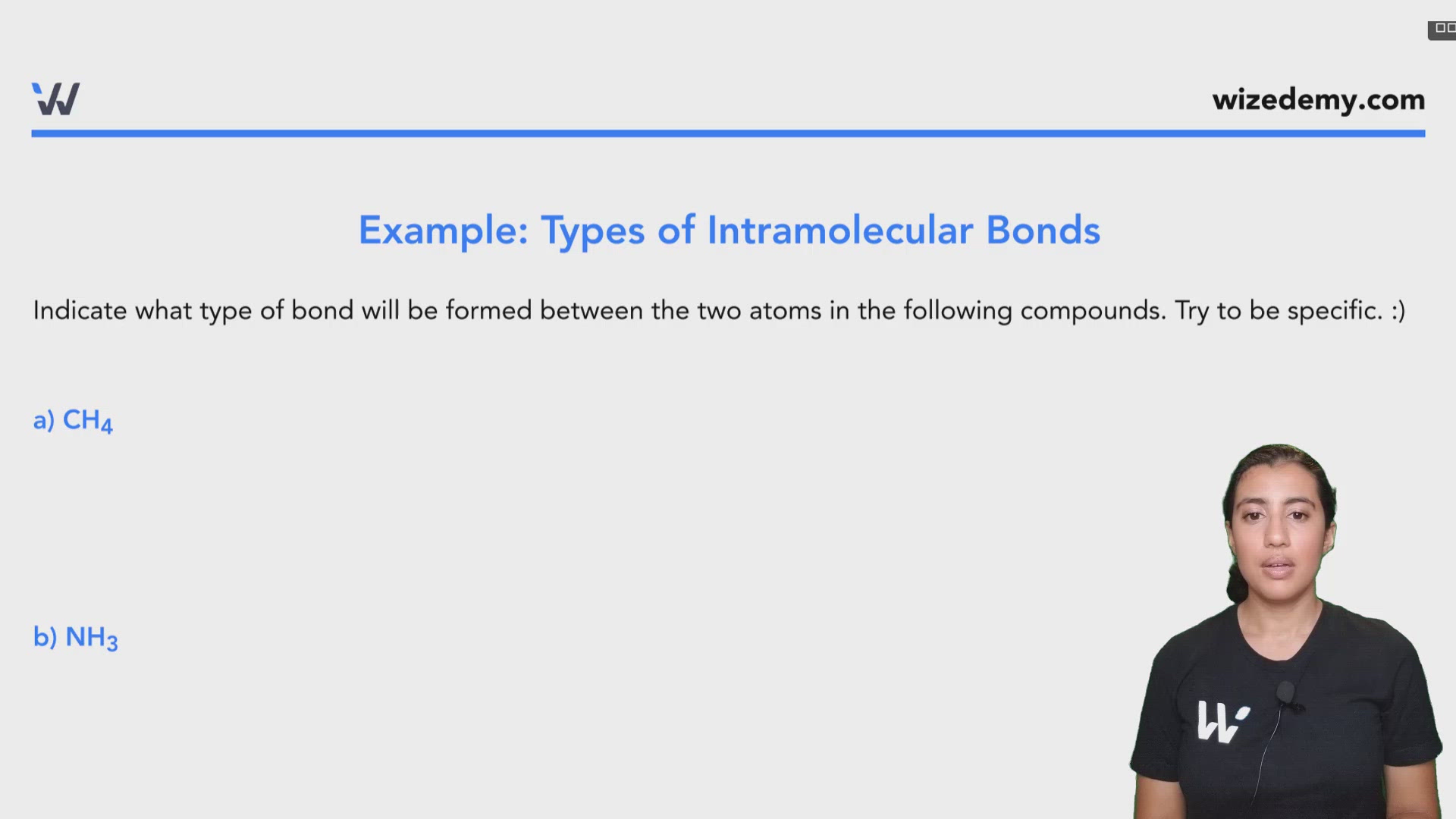
Example: Types of Intramolecular Bonds
Indicate what type of bond will be formed between the two atoms in the following compounds. Try to be specific.
a) CH4
Non-polar covalent
b) NH3
Polar Covalent
c) LiBr
Ionic
d) Br2
Non-polar Covalent
e) Na2SO4
The molecule is held together by an ionic interaction (between Na+ and the sulfate ion, SO42- )
Note: there are covalent bonds within the sulfate ion, between the S and O.
What type of bonding would be expected in the following compounds?
Table salt (NaCl)
Practice: Types of Intramolecular Bonds
For the three compounds: H2, CCl4 and MgF2, indicate which types of bonds each molecule has.
A.
polar covalent bond(s)
B.
non-polar covalent bond(s)
C.
ionic bond(s)
H2
CCl4
MgF2