IR Spectroscopy
Since we measure absorptions characteristic to certain bonds, IR spectroscopy is a great way to determine which functional groups are present in a molecule.

General Trends in IR Peaks
Hybridization affects bond strength! Stronger bonds have vibrate at higher frequencies (they have higher wavenumbers).
Vibrations of bonds involving heavier atoms have lower vibrational frequencies (they have lower wavenumbers).
- We often use a unit called wavenumber () to represent the energy of vibrational absorbances
- IR spectroscopy generally covers the 500-4000 range.

Example: IR Spectra
The IR spectrum for cyclohexanone is given below. Which functional groups can you identify from this data? How?

There are sp3 C-H bonds which we can see for the peak(s) around 2900cm-1.
There is a C=O which we can see by the peak at 1700 cm-1
IR Spectra Cheatsheet
O-H vs C-H vs COOH
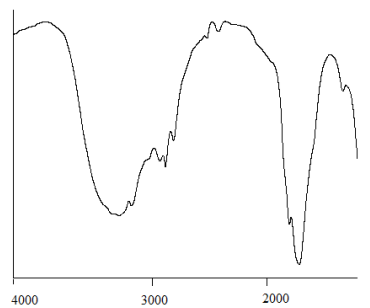
OH is broad and to the left of 3000 cm-1
C-H is the sharp band just right of 3000 cm-1

COOH is much more broad than an O-H and overlaps all of the C-H stretch,
We can also see the C=O stretch at ~1800 cm-1 . This is a key feature of all carbonyl compounds.
Do not mistake this for C=C which are small and subtle (and easier to identify using NMR anyway)