Introduction to Titrations
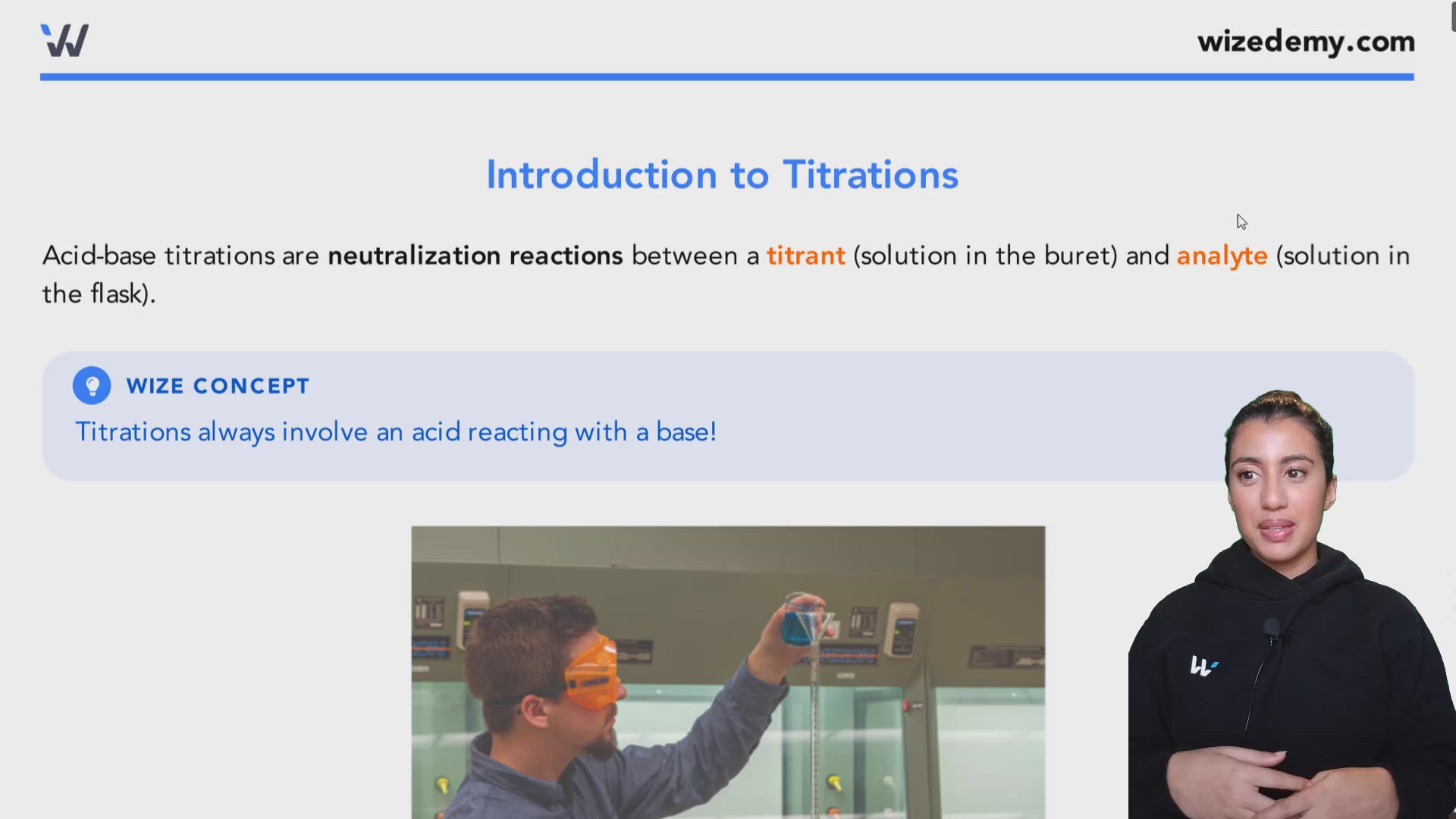
Acid-base titrations are neutralization reactions between a titrant (solution in the buret) and analyte (solution in the flask).
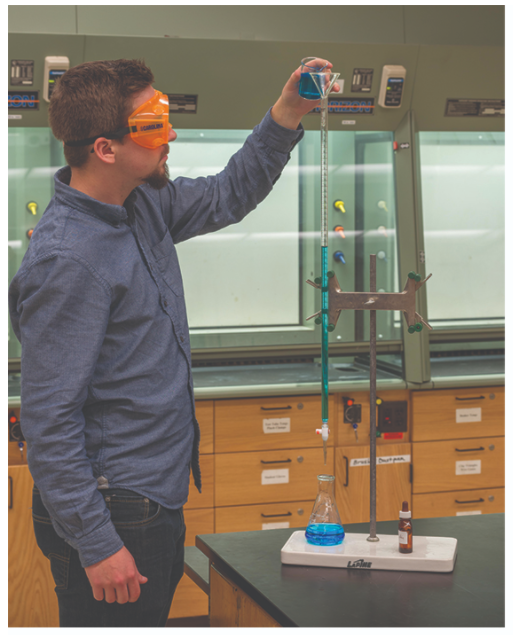
Photo by Rice University / CC BY
Titrant
- Solution in the buret
- We control the amount we add of the titrant to the flask
- We know its volume, concentration, and identity Example: 1M 100mL NaOH
- It is usually a strong acid or base
Analyte
- Solution in the flask
- It is the unknown (we don't know its concentration, identity, or if it is weak or strong)
- We do know it's volume (can easily measure its volume in the flask) and its pH (we can simply use a pH meter to measure this in the flask)
- The other way to know if there's a pH change in the flask is if we see a visual change in color
- Indicators help to indicate this pH change by changing the color inside the flask
- When the color changes, we call this an end-point.
Labeling a Titration Curve
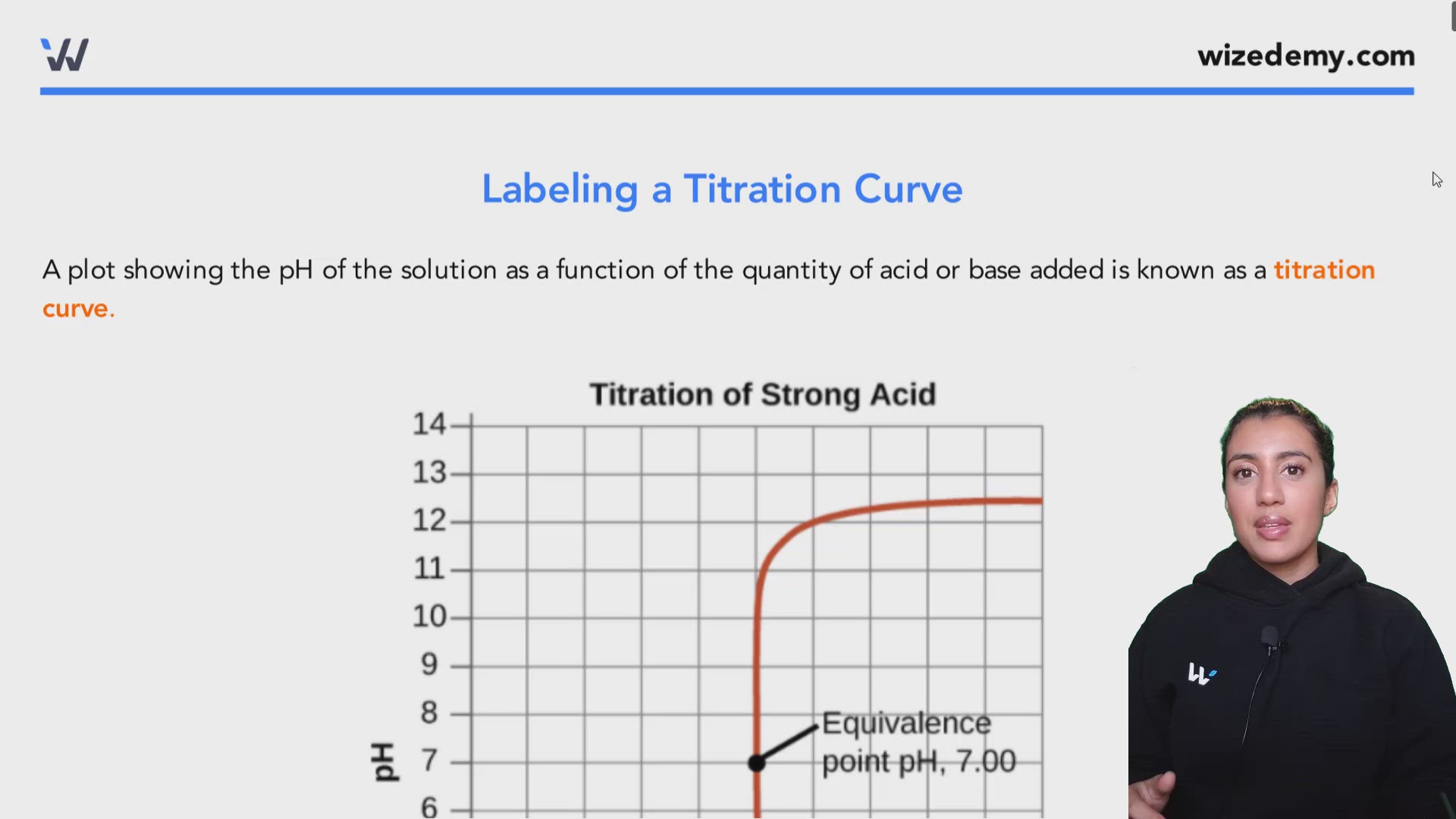
A plot showing the pH of the solution as a function of the quantity of acid or base added is known as a titration curve.

Photo by Rice University / CC BY
The titrant (substance in the buret that is being added to the analyte in the flask slowly overtime) is: ________
What is the volume for the equivalence point? ________
What is the volume for the half equivalence point? ________
Titration Curves
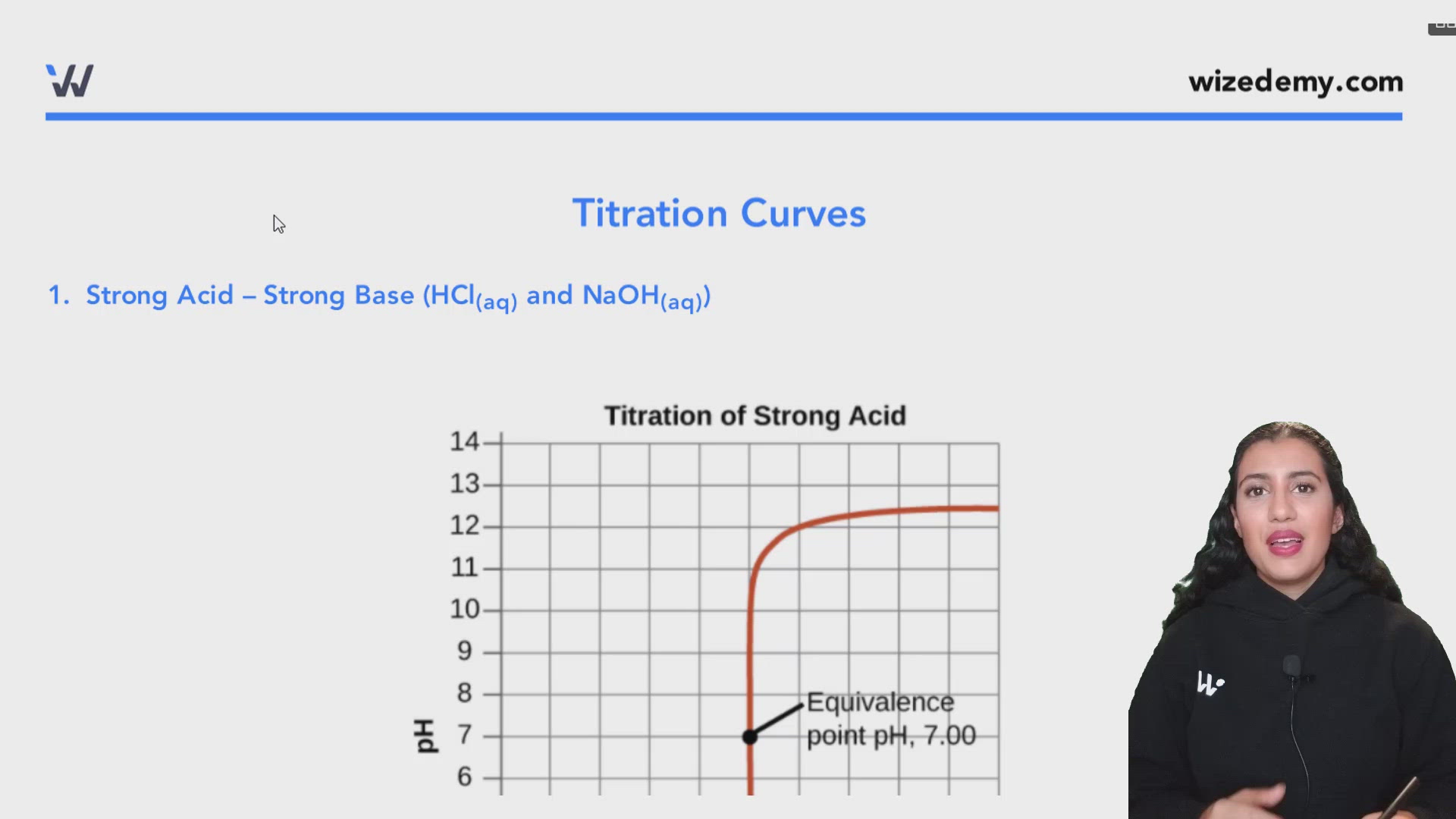
1. Strong Acid – Strong Base (HCl(aq) and NaOH(aq))
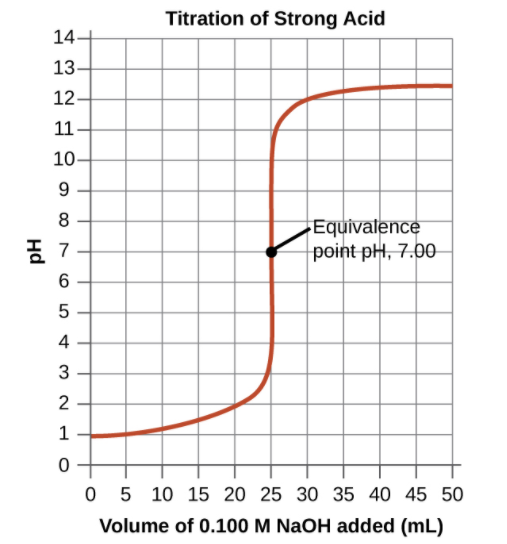
Photo by Rice University / CC BY
- pH is low initially
- As base is added, the pH increases slowly.
- The pH rises steeply when the moles of OH- nearly equals the moles of H3O+
- pH ________ 7 at equivalence point
- The additional drop of base neutralizes the tiny excess acid and introduces a tiny excess of base
- Then, pH increases smoothly as more base is added.
2. Weak acid – Strong base Titration (CH3COOH(aq) with NaOH(aq))
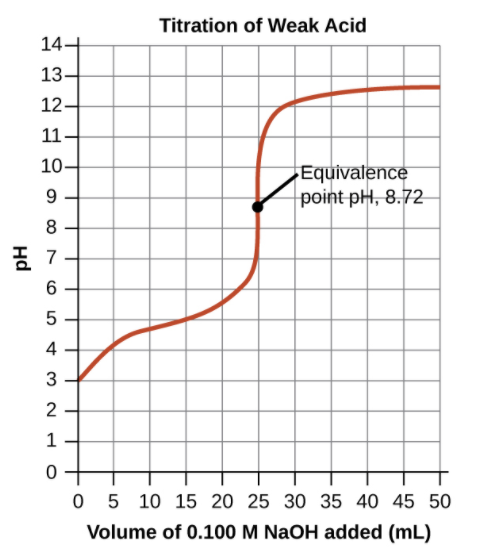
Photo by Rice University / CC BY
- In a weak acid – strong base titration: pH ________ 7 at the equivalence point
- Past the equivalence point: pH determined by the [OH-] from the excess strong base. You need the total volume of the solution to determine [OH-]
Calculating pH at different points in the titration
At the start: solution of the weak acid, CH3COOH; use ICE table and Ka to determine pH
Between the start and equivalence point: buffer region due to presence of both CH3COOH and CH3COO-; determine moles of acid left unreacted and moles of base produced. Use Henderson – Hasselbach equation to solve for pH.
At half equivalence point: pH = pKa
At equivalence point: all CH3COOH has been converted to CH3COO-; the pH is controlled by the acetate ion, and is thus basic.
Past the equivalence point: pH determined by the [OH-] from the excess strong base. You need the total volume of the solution to determine [OH-]
3. Weak base –Srong acid Titration: (NH3 and HCl)
Draw the titration curve where HCl(aq) is the titrant and being added in gradually.
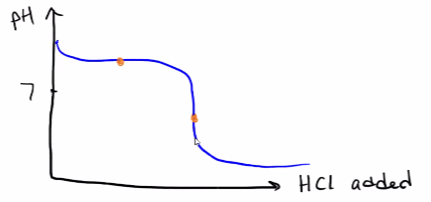
- In a weak base – strong acid titration: pH ________ 7 at the equivalence point
- Past the equivalence point: pH determined by the [H3O+] from the excess strong acid
Calculating pH at different points in the titration
At the start: solution of the weak base, NH3; use ICE table and Kb to determine pH
Between the start and equivalence point: buffer region due to presence of both NH3 and NH4+ determine [NH3] left unreacted and [NH4+] produced; use Henderson-Hasselbach equation to determine pH
At half equivalence point: pH = pKa of NH4+
At equivalence point: all NH3 has been converted to NH4+; use Ka of NH4+ to determine [H3O+]
Past the equivalence point: pH determined by the [H3O+] from the excess strong acid