Wize University Chemistry Textbook > Early Atomic Theory to Quantum Theory
Bohr Model Equations
Popular Courses
MCAT
General Course
CHEM 1301A/B
Western University
General Chemistry
University Study Guides
CHEM 101
University of Alberta
CHEM 112
Queen's University
CHEM 121
University of British Columbia
DAT
General Course
Chemistry
General Course
General Chemistry
University Study Guides
CHEM 103
University of Alberta
CHEM 110
McGill University
CHEM 1E03
McMaster University
CHM135H1
University of Toronto
CHEM 120
University of Waterloo
CHEM 205
Concordia University
CHEM 121
Simon Fraser University
APSC 131
Queen's University
CHEM 1100
University of Manitoba
CHEM 1481
Texas A & M University
CEM 141
Michigan State University

0:00 / 0:00
Bohr Model Equations
There are a few important equations we should be familiar with that are related to the Bohr model. These equations can only be used for one electron systems! Recall that Bohr's model was only able to explain species with 1 electron.
Calculating the Energy of a Specific n Level
where n is the shell # and it can be 1, 2, 3...etc
E represents the energy of a specific n level
Z=atomic # (# of protons) in an atom (ex. Hydrogen has 1 proton, Z=1, He+ has 2 protons, Z=2)
Calculating the Energy Difference Between n Levels
where ΔE represents the difference in energy between 2 energy levels
Z=atomic # (# of protons) in an atom
nf is referring to the final energy level
ni is referring to the initial energy level
- If ΔE is positive, energy was (absorbed/released)absorbedand the electron should go to a (higher/lower)higherenergy level
- If ΔE is negative, energy was (absorbed/released)releasedand the electron should go to a (higher/lower)lowerenergy level
Watch Out!
Be very careful when entering nf and ni values into this equation!
Example: If we are told energy is absorbed and an electron goes from n=1 to n=2
- n=1 is the initial energy level, n=2 is the final energy level.
Example: If we are told energy is released as an electron goes from n=3 to n=2
- n=3 is the initial energy level, n=2 is the final energy level.
Calculating the Wavelength of the Photon Absorbed or Emitted
Method 1:
- Use the above equation to solve for ΔE.
- Then use to solve for the wavelength of the photon
- Even if ΔE is negative, use the positive value to solve for the wavelength so you get a positive answer for wavelength (negative wavelength doesn't make sense)
Method 2:
- Use the following equation and then take the inverse to solve for λ
λ=wavelength of the photon (m) -always enter answer as a positive value!
RH=Rydberg constant=1.097x10⁷m−1
ni=initial energy level, nf=final energy level
0:00 / 0:00
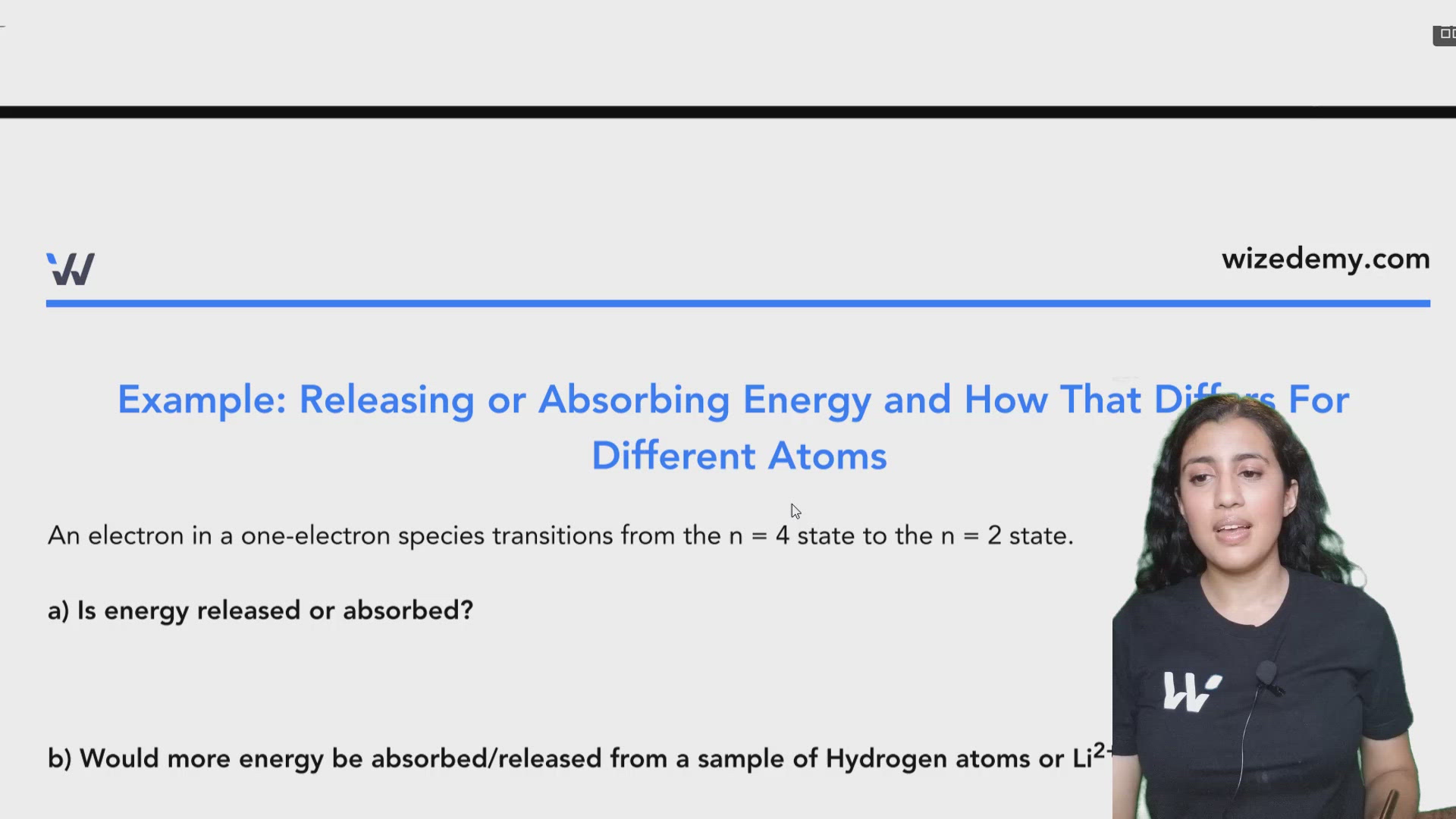
Example: Releasing or Absorbing Energy and How That Differs For Different Atoms
An electron in a one-electron species transitions from the n = 4 state to the n = 2 state.
a) Is energy released or absorbed?
Energy (light) is released since the electron came to a lower energy level.
b) Would more energy be absorbed/released from a sample of Hydrogen atoms or Li2+ ions?
Consider the equation for the energy difference between energy levels:
If we consider the equation for a hydrogen atom vs a Li2+ ion, the only thing that would be different is Z (atomic #).
Z for H: 1, Z2=1
Z for Li2+: 3, Z2=9
In the equation, some number would be multiplied by 1 for H and would be multiplied by 9 for Li2+.
The energy released will be 9 times greater for Li2+ than H based on the equation shown above.
0:00 / 0:00
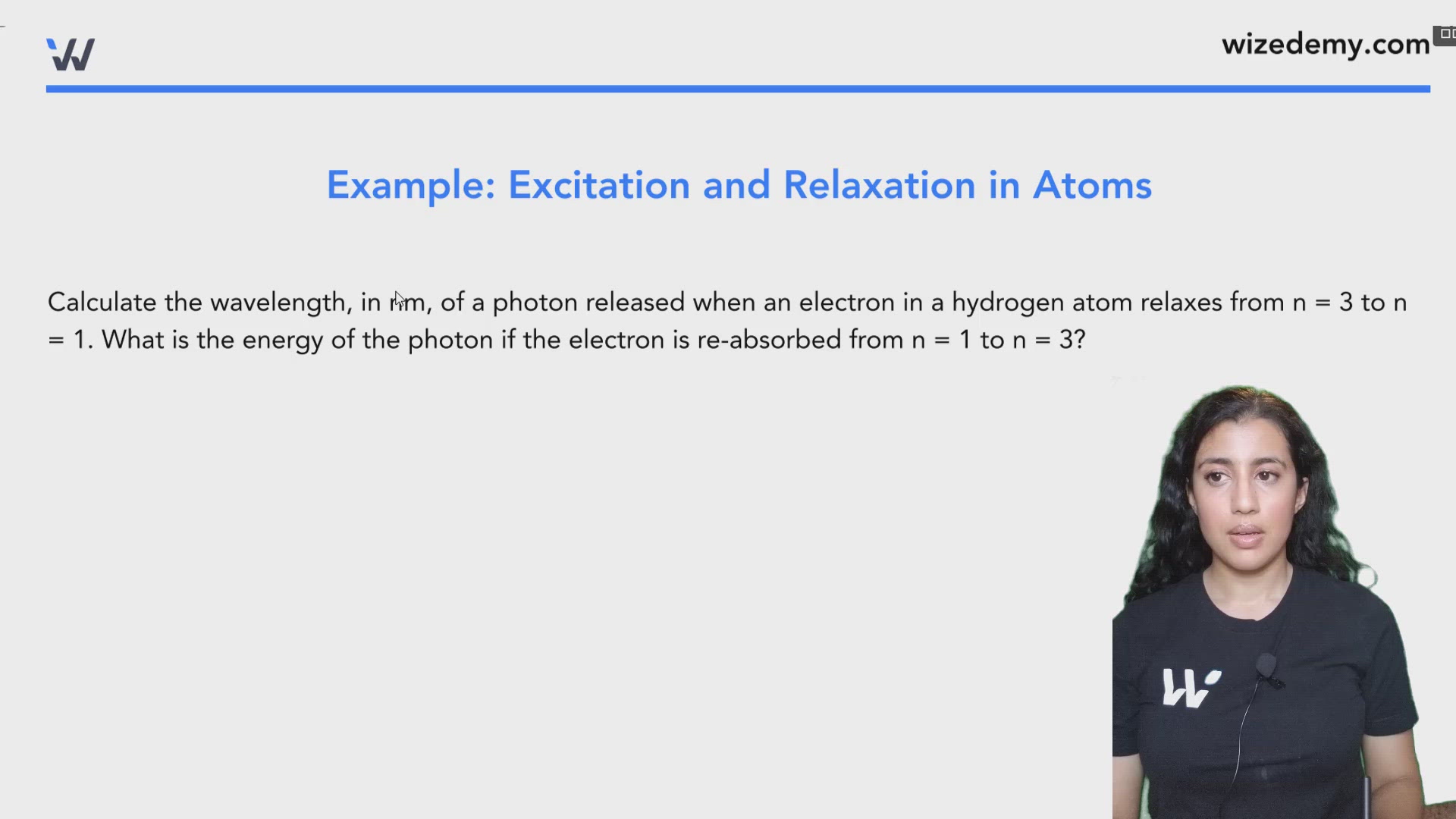
Example: Excitation and Relaxation in Atoms
Calculate the wavelength, in nm, of a photon released when an electron in a hydrogen atom relaxes from n = 3 to n = 1. What is the energy of the photon if the electron is re-absorbed from n = 1 to n = 3?
Part 1: Solve for the energy difference between the energy levels, then solve for the wavelength of the photon
Z=1 for hydrogen
Recall 1nm=1x10⁻⁹m if we have m and want to solve for nm:
m/1x10-9=nm
Part 2: Change the sign of the energy difference
If the photon is re-absorbed by the electron to move from the n = 1 state to the n = 3 state, this photon must have the same energy as the photon released to go from n = 3 to n = 1, except with OPPOSITE SIGN.
Practice: Using Bohr Model Equations to Determine an Energy Level
A photon of light was released by a hydrogen atom with an energy of 1.94 x 10⁻¹⁸ J. If this transition ended at n=1, from which level did this transition begin?