
Effective Buffer Range
Effective buffer range: is the range of pH values where a buffer has the capacity to act as a buffer

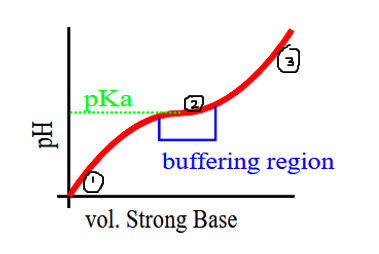
Just focus on understanding 💡 the diagram, we will cover this in more detail when we talk about titrations :)
- Only weak acid is present. We cannot form a buffer with only weak acid present
- More and more strong base is added. We will eventually have added enough strong base to form a buffer:
- If we keep adding strong base (and raising the pH), eventually we will run out of weak acid. There will no longer be a buffer and the pH shoots up!
To calculate the effective buffer range (in pH), use this equation:
Example:
What is the effective buffer range for a buffer that has a pKa of 2?
pKa+1=2+1=3
pKa-1=2-1=1
Therefore, between pH=1 and pH=3, this buffer will have the capacity to act as a buffer!
What about if you are given a pKb and asked for the buffer range?
You can use the same equation (pKa +/- 1), just solve for pKa first.
These other equations may come in handy as well: