
Gas Mixtures & Partial Pressures
When dealing with mixtures of gases, the total pressure of the gases is equal to the sum of the partial pressure of each component.

Dalton’s Law of Partial Pressures:
PTotal is the single measured pressure of the mixture
P1 is the partial pressure of gas 1, and so on
Partial pressure: is the pressure that would be exerted by one of the gases in the mixture if it occupied the same volume on its own.
Note: The total pressure depends on the total number of moles (not on the identity of the gases)
We can also relate the partial pressure of an individual gas (ex. Gas "A") to the total pressure by the mole fraction (X) of that gas.
The mole fraction (X) is a proportion of that gas.
Example: Partial Pressures
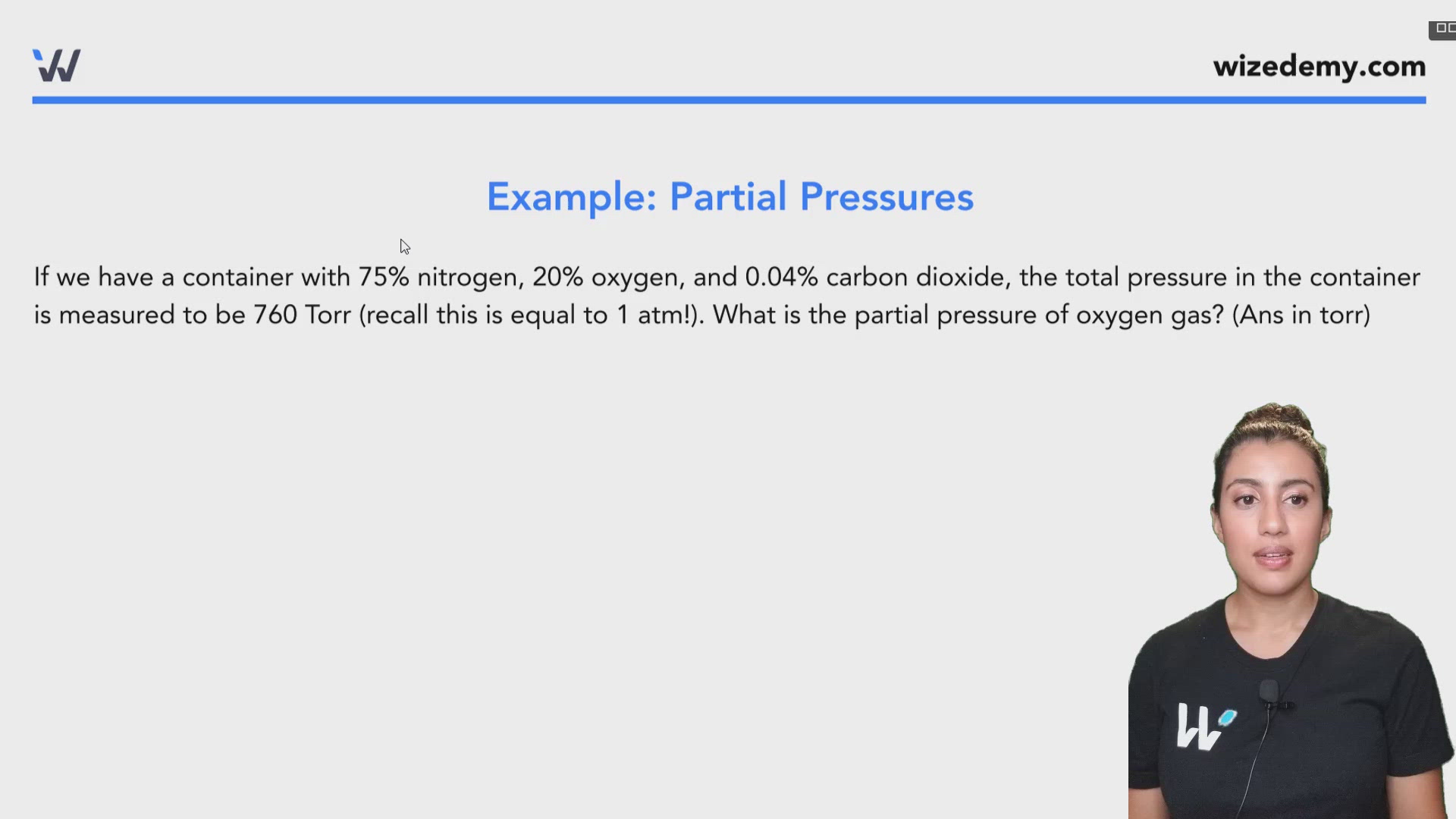
If we have a container with 75% nitrogen, 20% oxygen, and 0.04% carbon dioxide, the total pressure in the container is measured to be 760 Torr (recall this is equal to 1 atm!). What is the partial pressure of oxygen gas? (Ans in torr)
PiO2 = XPT
= 0.2(760 torr)
= 152 torr