Wize University Chemistry Textbook > Equilibrium
Solving for K in Different Scenarios

Manipulating Equilibrium Constants
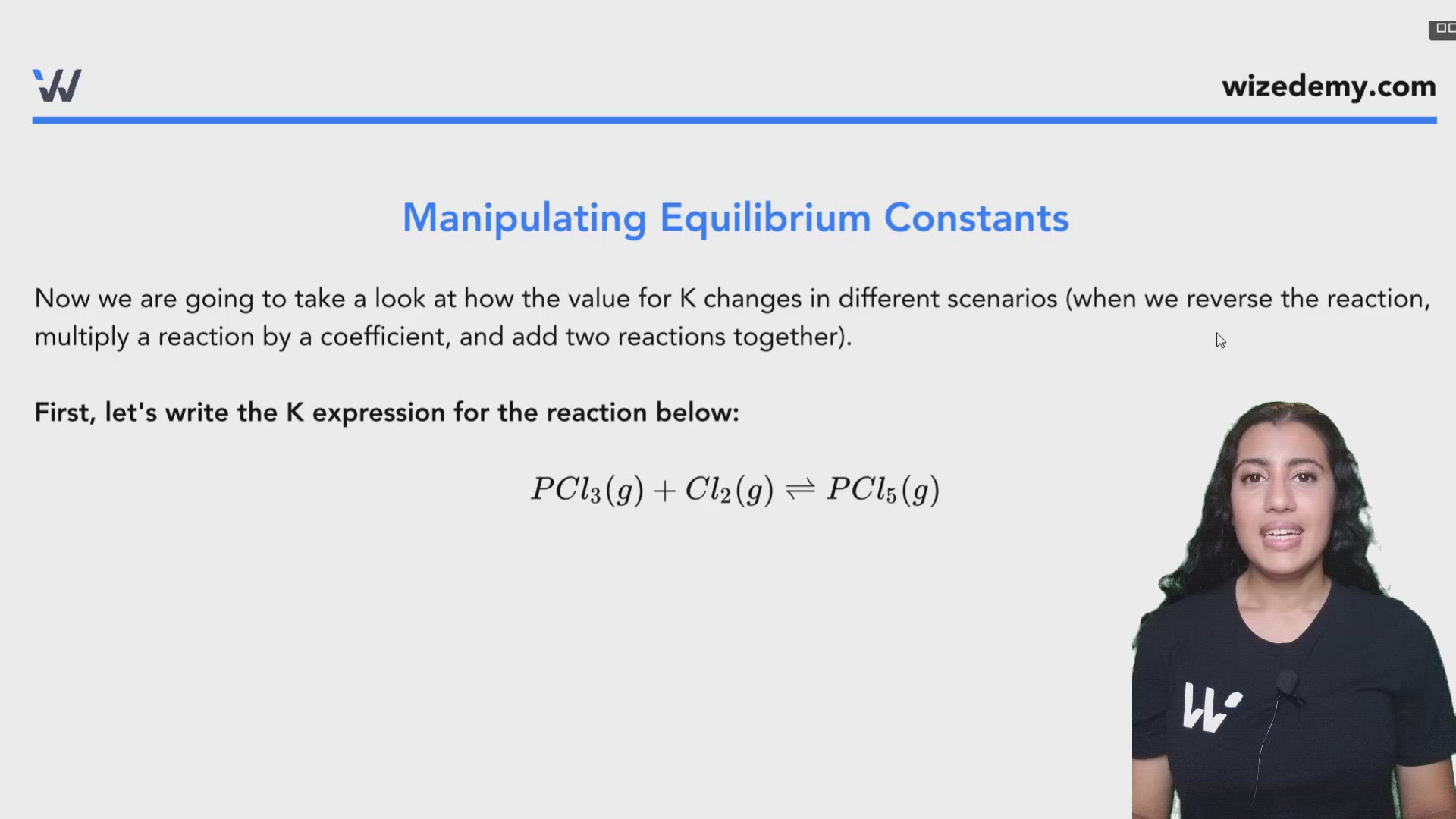
Now we are going to take a look at how the value for K changes in different scenarios (when we reverse the reaction, multiply a reaction by a coefficient, and add two reactions together).
First, let's write the K expression for the reaction below:
PCl3(g)+Cl2(g)⇌PCl5(g)
Kc=[Cl2][PCl3][PCl5]
PAGE BREAK
What happens to K when we reverse the reaction?
PCl5(g)⇌PCl3(g)+Cl2(g)
Kc1=[PCl5][Cl2][PCl3]
PAGE BREAK
What happens to K when we multiply the reaction by a factor?
2PCl3(g)+2Cl2(g)⇌2PCl5(g)
(Kc)2=([PCl3][Cl2][PCl5])2
PAGE BREAK
How do we solve for Koverall given K for reactions that are being added together?
2N2(g)+O2(g)⇌2N2O(g)] Kc,1+2N2O(g)+3O2(g)⇌4NO2(g) Kc,22N2(g)+4O2(g)⇌4NO2(g) Koverall
Koverall = (Kc,1)∗(Kc,2)