Popular Courses
MCAT
General Course
General Chemistry
University Study Guides
CHEM 112
Queen's University
DAT
General Course
Chemistry
General Course
General Chemistry
University Study Guides
CHEM 1E03
McMaster University
CHM135H1
University of Toronto
CHEM 102
University of Alberta
CHY 102
Toronto Metropolitan University
CHEM 120
McGill University
SC/CHEM 1001 3.00
York University
APSC 132
Queen's University
CHEM 112B
Queen's University
CHY 103
Toronto Metropolitan University
CHEM 102
University of Victoria
CHEM 123
University of Waterloo
CHEM 130
University of British Columbia
CHEM 1100
University of Manitoba
CHEM 1481
Texas A & M University
0:00 / 0:00
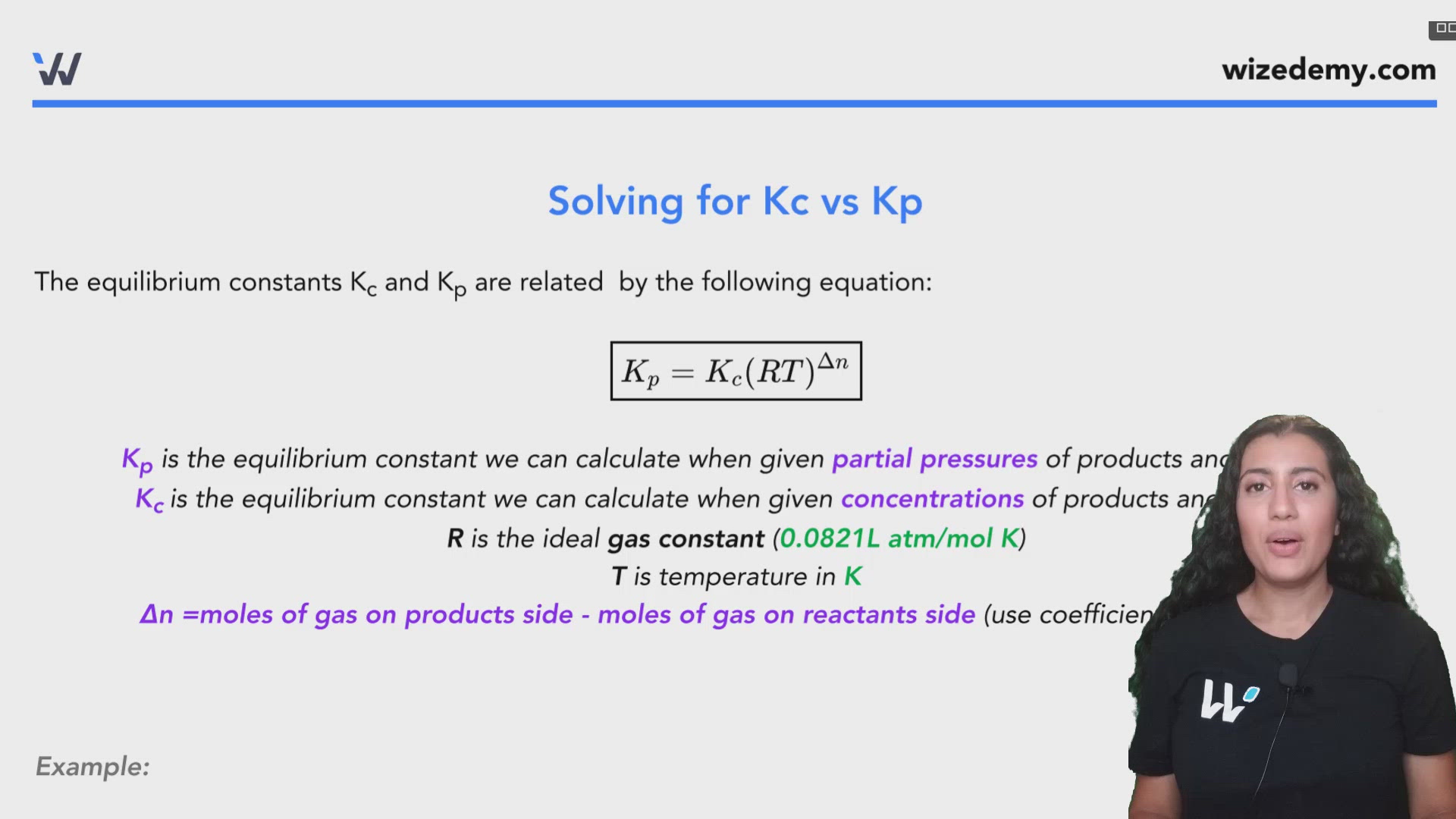
Solving for Kc vs Kp
The equilibrium constants Kc and Kp are related by the following equation:
Kp is the equilibrium constant we can calculate when given partial pressures of products and reactants
Kc is the equilibrium constant we can calculate when given concentrations of products and reactants
R is the ideal gas constant (0.0821L atm/mol K)
T is temperature in K
Δn =moles of gas on products side - moles of gas on reactants side (use coefficients in equation)
Example:
In the synthesis of ammonia from nitrogen and hydrogen, N2 (g) + 3 H2 (g) ⇌ 2 NH3 (g), Kc = 9.60 at 300oC. Calculate Kp for this reaction at this temperature. R=0.0821 Latm mol-1K-1
n = 2 - (1 + 3) = 2 - 4 = -2
Kp = Kc (RT)Δn
= (9.60)
Kp = 4.34 10-3
Example:
And now what if we are told that the pressure at equilibrium for H2(g) is 3x10⁻¹ atm and N2(g) is 2.5x10⁻²atm. What is the pressure of NH3 at equilibrium?
Kp=
4.34x10⁻³ (6.75x10⁻⁴)=[NH3]2
[NH3]=1.7x10⁻³ atm