Wize University Chemistry Textbook > Equilibrium
Solving for K in Different Scenarios
Popular Courses
MCAT
General Course
CHEM 1302A/B
Western University
General Chemistry
University Study Guides
AP Chemistry Exam Prep Course
AP Exam Prep
CHEM 112
Queen's University
DAT
General Course
Chemistry
General Course
General Chemistry
University Study Guides
CHEM 1E03
McMaster University
ENGG 204
University of Calgary
CHM135H1
University of Toronto
CHEM 102
University of Alberta
CHEM 123
University of British Columbia
CHY 102
Toronto Metropolitan University
CHEM 120
McGill University
CHE 102
University of Waterloo
SC/CHEM 1001 3.00
York University
APSC 132
Queen's University
CHEM 112B
Queen's University
CHY 103
Toronto Metropolitan University
0:00 / 0:00
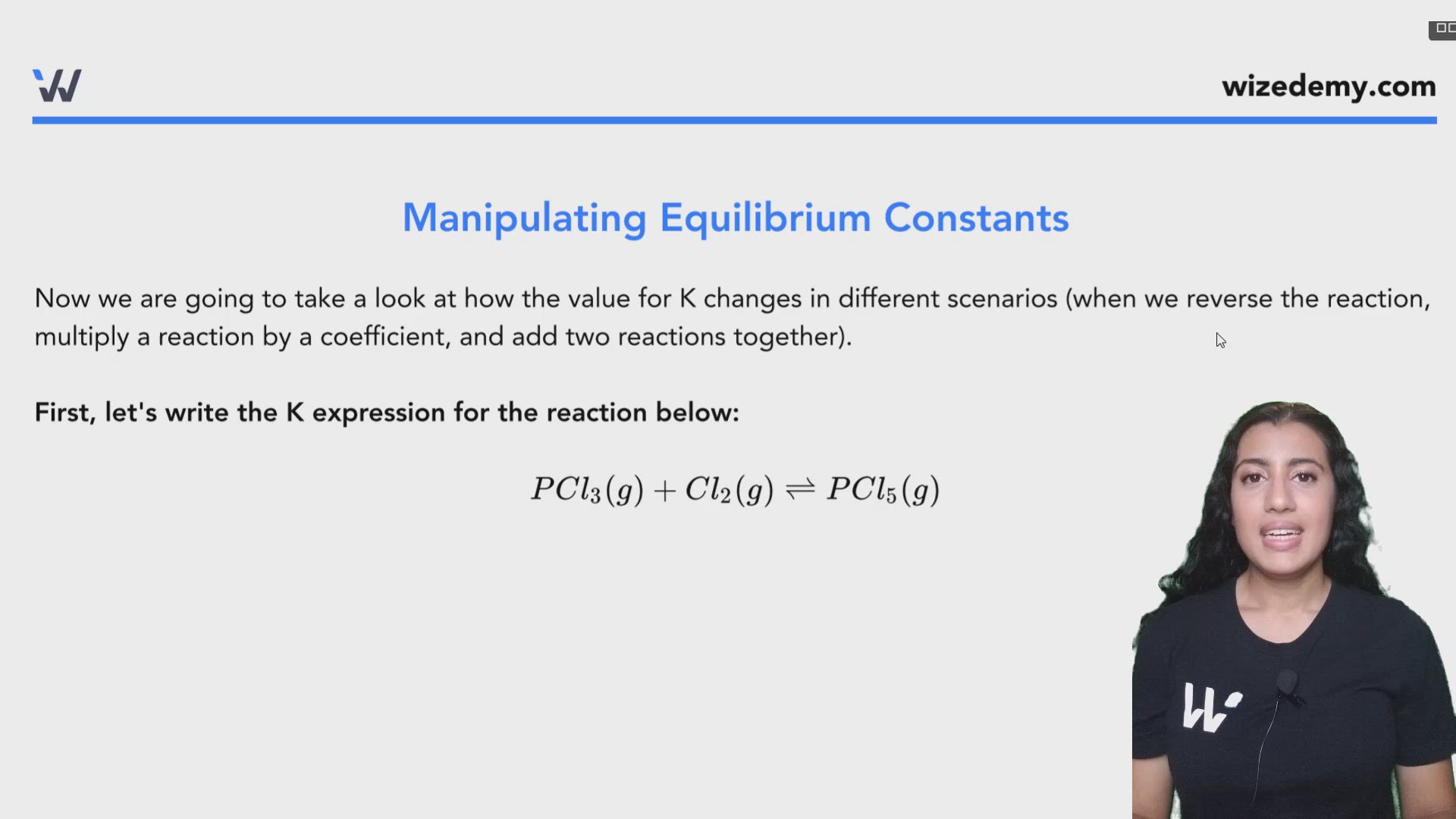
Manipulating Equilibrium Constants
Now we are going to take a look at how the value for K changes in different scenarios (when we reverse the reaction, multiply a reaction by a coefficient, and add two reactions together).
First, let's write the K expression for the reaction below:
What happens to K when we reverse the reaction?
Wize Tip
If you reverse a reaction, take the inverse of K to find Knew!
What happens to K when we multiply the reaction by a factor?
Wize Tip
When you multiply a reaction by a coefficient, take K to the power of that factor to solve for Knew!
How do we solve for Koverall given K for reactions that are being added together?
Wize Tip
When adding two reactions together, multiply their K values together to solve for Koverall!
Practice: Solving For K
Consider the following equilibria:
The equilibrium constant for the reaction is:
a)
b)
c)
d)
e)