Wize University Chemistry Textbook > Equilibrium
The Equilibrium Constant (K)
Popular Courses
MCAT
General Course
CHEM 1302A/B
Western University
General Chemistry
University Study Guides
AP Chemistry Exam Prep Course
AP Exam Prep
CHEM 112
Queen's University
CHEM 203
University of Calgary
DAT
General Course
Chemistry
General Course
General Chemistry
University Study Guides
CHEM 1E03
McMaster University
ENGG 204
University of Calgary
CHM135H1
University of Toronto
CHEM 154
University of British Columbia
CHEM 102
University of Alberta
CHEM 123
University of British Columbia
CHY 102
Toronto Metropolitan University
CHEM 120
McGill University
SC/CHEM 1001 3.00
York University
APSC 132
Queen's University
CHEM 112B
Queen's University

0:00 / 0:00
Equilibrium Constant (K)
To define the extent to which equilibrium favors one side of the reaction over the other, we can use the Equilibrium Constant.
Given the model reaction:
A & B are reactants and C & D are products.
a,b,c,d are their stoichiometric coefficients
The Equilibrium Expression (in terms of concentration) can be written as:
The equilibrium constant (K) is a ratio used to describe the relative concentrations of products and reactants at equilibrium!
You may also see it called the Law of Mass Action.
Examples:
Keq (at equilibrium), Ka (for acids), Kb (for bases), Kw (for water), Ksp (solubility product constant)
Wize Concept
K can have different subscripts, but all K's follow the same rules!
Example: What is the K expression for the reaction below?
N2(g) + 3H2(g) ⇌ 2NH3(g)
Wize Tip
Since coefficients become exponents in the K expression, we need to make sure that our equation is balanced!
K=
Additional Notes About K:
1) Above we wrote Kc. The c stands for concentration because we are considering the concentrations of the species in mol/L.
2) If instead we were considering gases and their pressures in atm, then we would write Kp!
Example: What is the Kp expression for the following reaction?
2SO2(g) + O2(g) ⇌ 2SO3(g)
3) If any species in the reaction are solids (s) or liquids (l), their concentrations do not affect equilibrium and therefore they do not appear in the equilibrium expression!
Example: What is the equilibrium expression for the following reaction?
PbCl2(s) ⇌ Pb2+ (aq) + 2Cl- (aq)
K= [Pb2+][Cl-]2
4) We will see that changes in volume, pressure, temperature, and concentration can shift the equilibrium (according to Le Chatelier's Principle)
But the only factor that will change K is temperature!

0:00 / 0:00
The Magnitude of the Equilibrium Constant, K
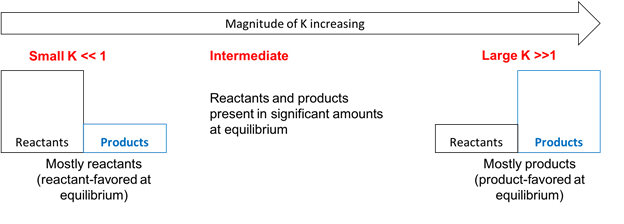
K tells us which side of the reaction (products or reactants) are favored and to what extent.
Example:
If we had the K value 1.8x10¹⁰ would products or reactants be favored at equilibrium?
Products!
Since there is an exponent of 10, then (products/reactants)
products
are favored to a (small/great) great
extent! Example:
If K was 1.2x10⁻⁸ then are products or reactants favored at equilibrium? And to a great or small extent?
Reactants
are favored to a great
extent!Example: Are products or reactants favored at equilibrium according to the following reaction and concentration time graph?
2SO2(g) + O2(g) ⇌ 2SO3(g)
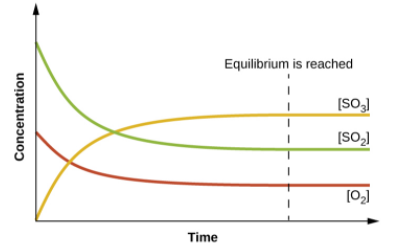
Products are favored at equilibrium since at equilibrium (when the concentrations start to get flat in the graph), there is a higher concentration of SO3 (a product) than the reactants.
Summary of What K Tells Us
Keq > 1
- At equilibrium, products/reactants are favored:products
- This is because products/reactants are more stable:products
- As a result, at equilibrium there will be more reactants, more products, or equal amounts of products and reactants:more products
Keq = 1
- At equilibrium, products/reactants are favored:neither
- This is because products/reactants are more stable:equally stable
- As a result, at equilibrium there will be more reactants, more products, or equal amounts of products and reactants:equal amounts
Keq < 1
- At equilibrium, products/reactants are favoured:reactants
- This is because products/reactants are more stable:reactants
- As a result, at equilibrium there will be more reactants, more products, or equal amounts of products and reactants:more reactants
Practice: Writing Equilibrium Constants
Which of the following expression is the correct equilibrium-constant expression for the reaction below?
HF(aq) + H2O(l) ⇌ H3O+(aq) + F–(aq)
1.
2.
3.
4.
5.
Practice: Calculating the Equilibrium Constant
For the process:
N2 (g) + 3 H2 (g) ⇌ 2 NH3 (g)
Determine the value of Kc when an equilibrium mixture contains 0.0420 mol N2, 0.516 mol H2, and 0.0357 mol NH3 in a 1.00 liter container at 400oC.