Wize University Chemistry Textbook > Equilibrium
Q (Reaction Quotient)
Popular Courses
MCAT
General Course
CHEM 1302A/B
Western University
General Chemistry
University Study Guides
AP Chemistry Exam Prep Course
AP Exam Prep
CHEM 112
Queen's University
Chemistry
General Course
DAT
General Course
General Chemistry
University Study Guides
CHEM 1E03
McMaster University
ENGG 204
University of Calgary
CHM135H1
University of Toronto
CHEM 154
University of British Columbia
CHEM 102
University of Alberta
CHEM 123
University of British Columbia
CHY 102
Toronto Metropolitan University
CHEM 120
McGill University
SC/CHEM 1001 3.00
York University
CHE 102
University of Waterloo
APSC 132
Queen's University
CHEM 112B
Queen's University
0:00 / 0:00
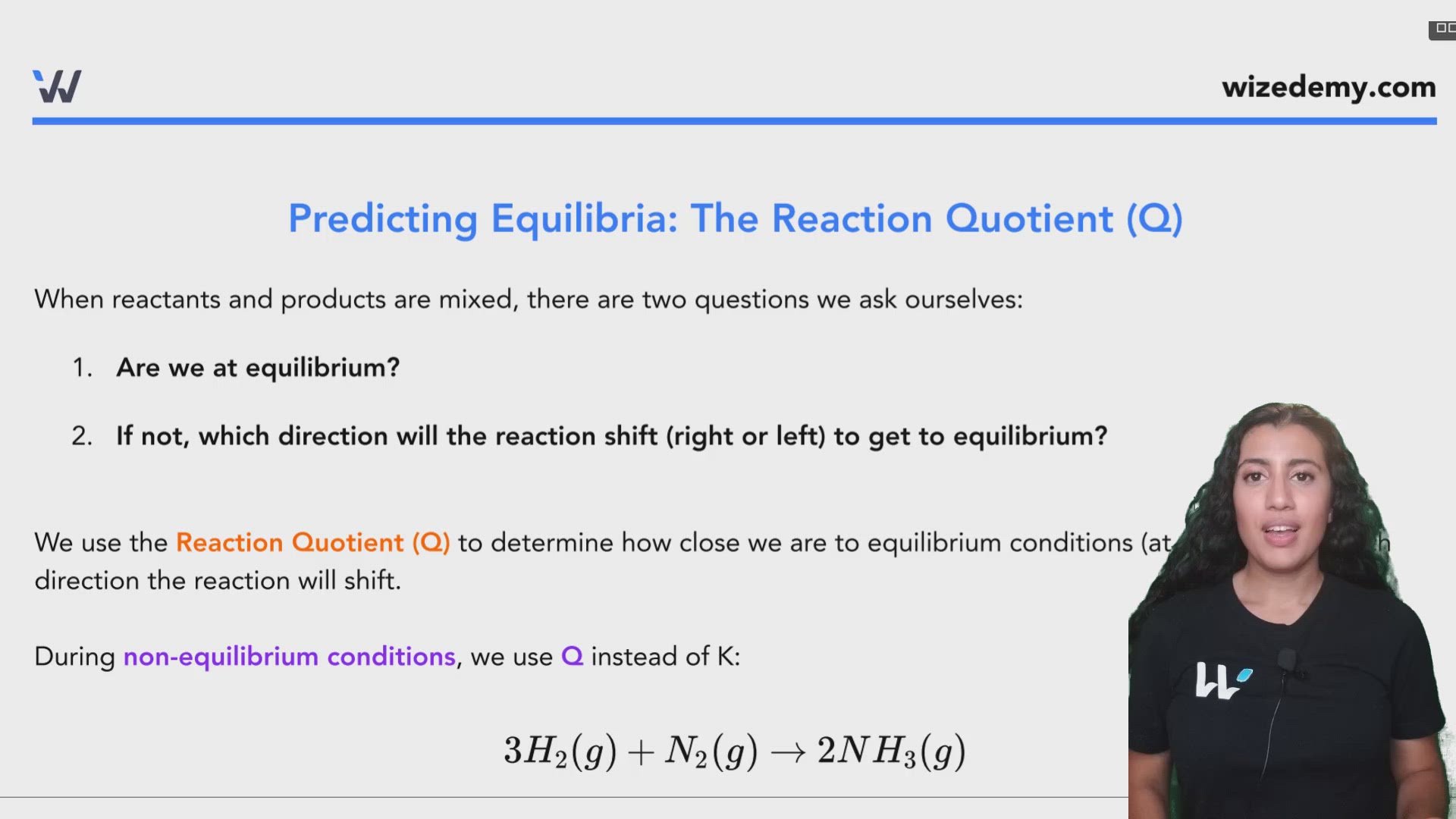
Predicting Equilibria: The Reaction Quotient (Q)
When reactants and products are mixed, there are two questions we ask ourselves:
- Are we at equilibrium?
- If not, which direction will the reaction shift (right or left) to get to equilibrium?
We use the Reaction Quotient (Q) to determine how close we are to equilibrium conditions (at time, t) and which direction the reaction will shift.
During non-equilibrium conditions, we use Q instead of K:
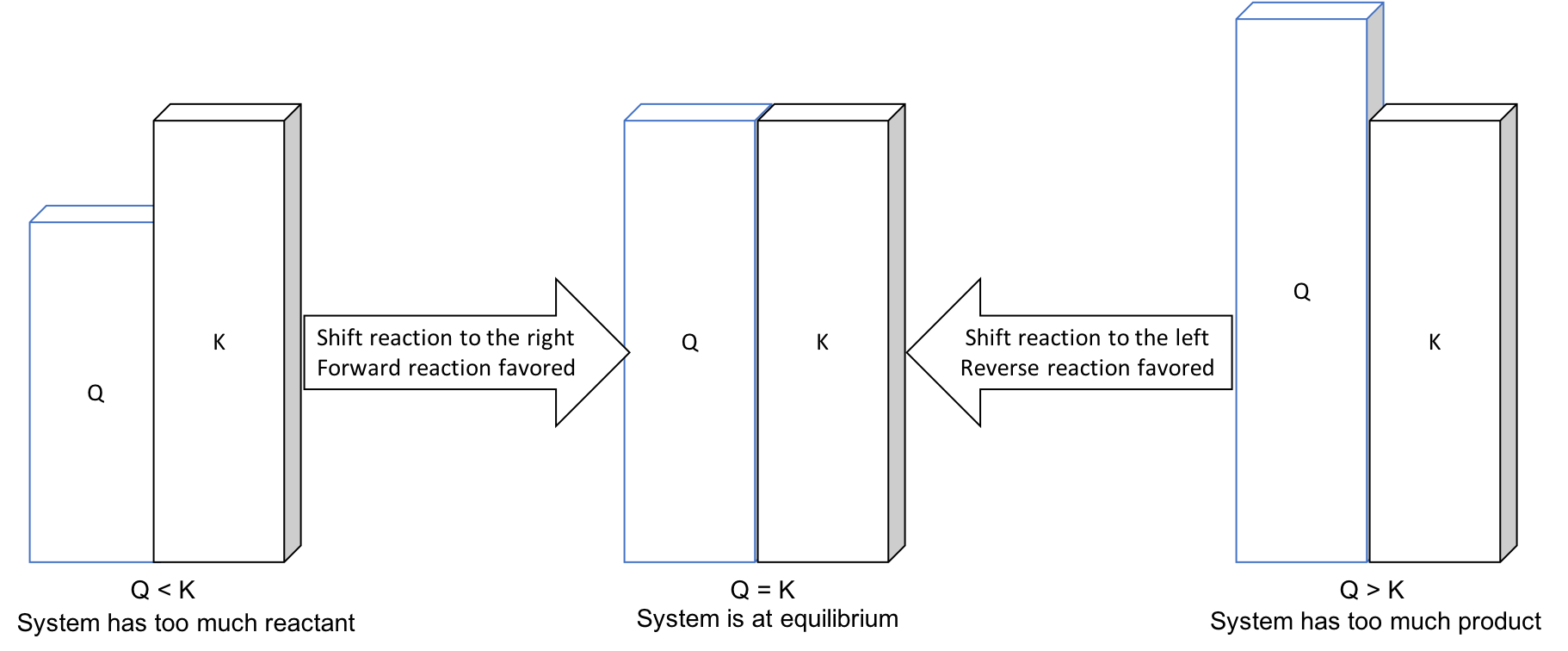
There are three possible situations:
- Q = K: The system is at equilibrium.
- Q > K: The [products] is too (high/low)highcompared to [reactants]. The equilibrium will shiftleft.
- Q < K: The [products] is too (hlgh/low)lowcompared to [reactants]. The equilibrium will shiftright.
Wize Tip
The above 3 points are commonly seen on exams!
Knowing these can help you get the best mark possible :)
Visual Representation
0:00 / 0:00
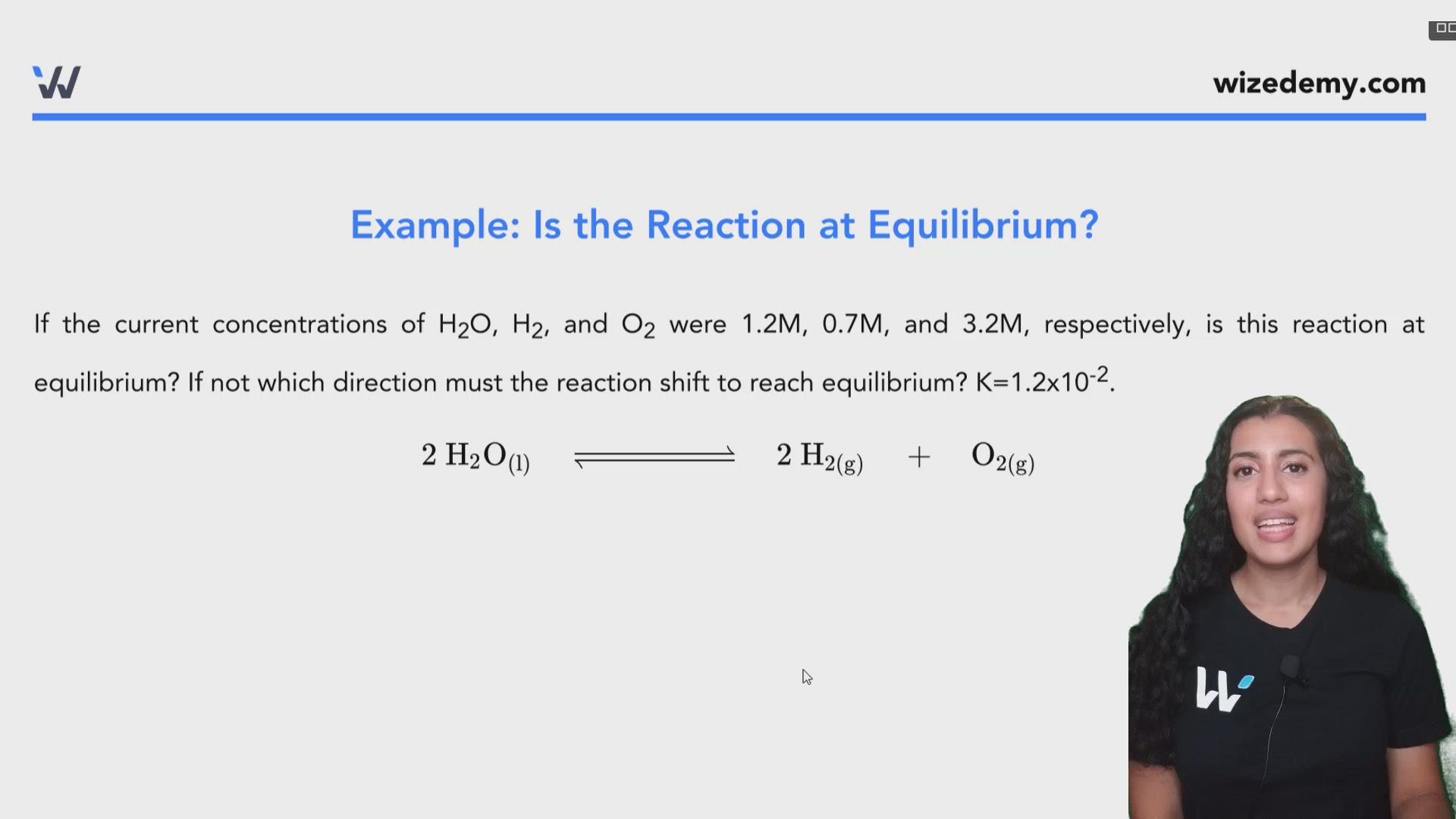
Example: Is the Reaction at Equilibrium?
If the current concentrations of H2O, H2, and O2 were 1.2M, 0.7M, and 3.2M, respectively, is this reaction at equilibrium? If not, which direction must the reaction shift to reach equilibrium? K=1.2x10⁻².
1) To figure out if reaction is at equilibrium we must compare Q and K:
Q= [O2][H2]2
=(3.2)(0.72)
Q =1.568
So Q>K Therefore we are not at equilibrium.
2) Which direction will the reaction shift?
Since Q>K, there are more products than reactants currently, so the equilibrium will shift left towards reactants.
Practice: Understanding Q vs K
Which of the following statements regarding the reaction quotient Qc and the equilibrium constant Kc is true?
Practice: Predicting and Interpreting Equilibrium
Silver chloride will react with acetic acid to form the complex ion silver acetate. A reaction mixture is prepared by adding 0.25 g of AgCl to a 1.25 L solution that already contains 4.6×10‐6M Ag(CH3COO)(aq), 2.3×10‐3M Cl-, 1.1×10‐8M H+, and 0.010M CH3COOH. Based on this information, which of the statements below is true?
After allowing this solution to rest for some time: