Wize University Chemistry Textbook > Equilibrium
Le Chatelier's Principle
Popular Courses
MCAT
General Course
CHEM 1302A/B
Western University
General Chemistry
University Study Guides
AP Chemistry Exam Prep Course
AP Exam Prep
CHEM 1A03
McMaster University
CHEM 112
Queen's University
CHEM 203
University of Calgary
DAT
General Course
Chemistry
General Course
General Chemistry
University Study Guides
CHEM 1E03
McMaster University
ENGG 204
University of Calgary
CHM135H1
University of Toronto
CHEM 102
University of Alberta
CHY 102
Toronto Metropolitan University
CHEM 120
McGill University
SC/CHEM 1001 3.00
York University
APSC 132
Queen's University
CHEM 112B
Queen's University
CHY 103
Toronto Metropolitan University
0:00 / 0:00
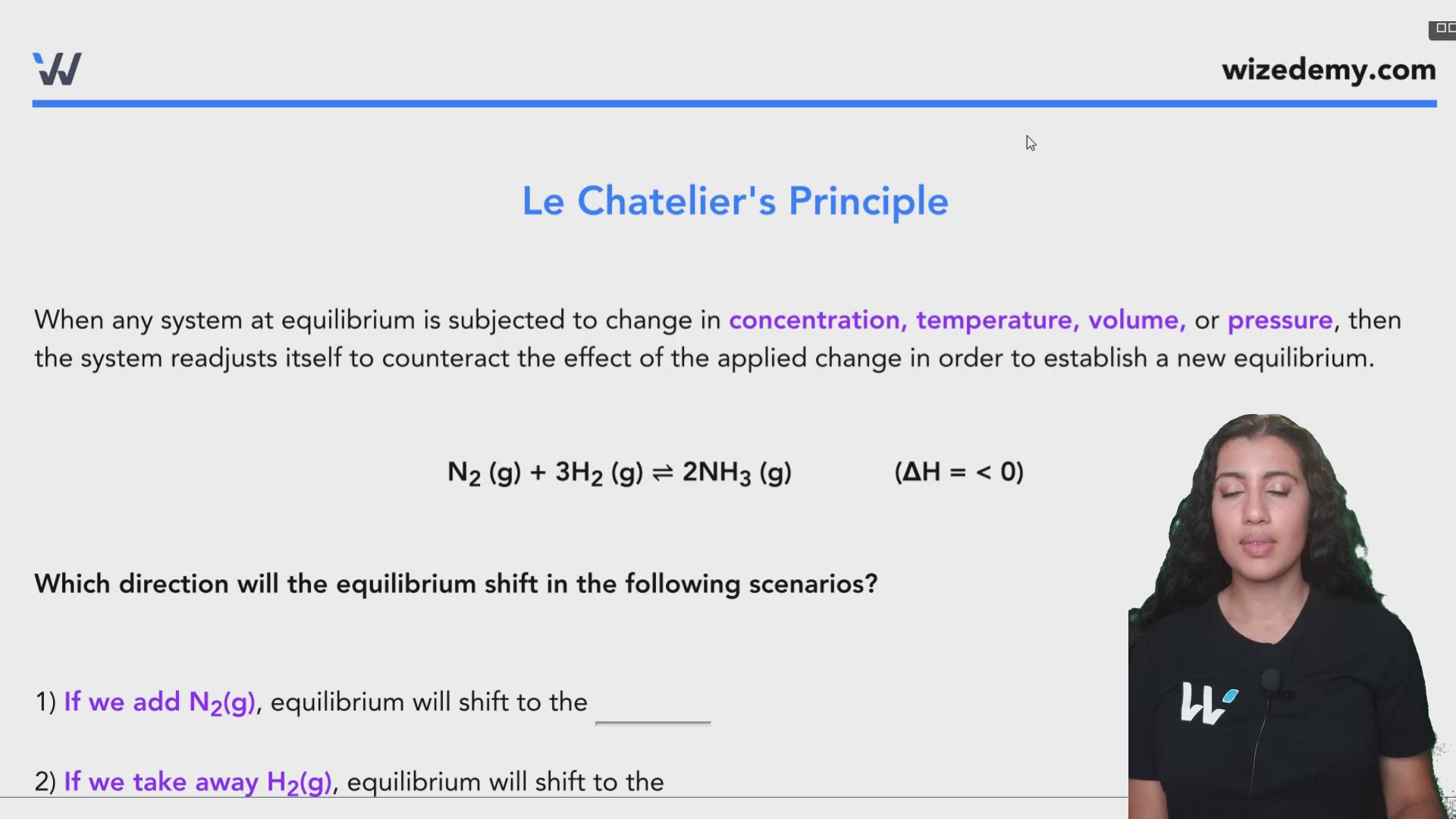
Le Chatelier's Principle
When any system at equilibrium is subjected to change in concentration, temperature, volume, or pressure, then the system readjusts itself to counteract the effect of the applied change in order to establish a new equilibrium.
N2(g) + 3 H2(g) ⇌ 2 NH3(g) (ΔH < 0)
Which direction will the equilibrium shift in the following scenarios?
1) If we add N2(g), equilibrium will shift to the
right
2) If we take away H2(g), equilibrium will shift to the
left
3) If we increase the volume of the container:
- Does the pressure inside the container increase or decrease?decrease
- If pressure is decreased, the equilibrium will want to shift to the side withmoremoles of gas
- If pressure is increased, the equilibrium will want to shift to the side withlessmoles of gasd
- In our example, the equilibrium will shift to theleftside since it hasmoremoles
N2(g) + 3 H2(g) ⇌ 2 NH3(g) (ΔH < 0)
4) If we add heat:
- We want to treat temperature as a reagent
- To do this, we need to figure out what side of the reaction temperature is on for this particular reaction
- We are given an enthalpy value that is negative, does this mean that our reaction is endothermic or exothermic?exothermic
- Based on this, does our reaction require energy or is it releasing energy?
- Itreleasesenergy
- So would we expect to see temperature on the left or right side of the equation? (write it above)rightside
- Now this question is asking what direction the equilibrium will shift, so treat temperature as any other reagent on therightside
- Equilibrium will shift to theleft!
5) For the following reaction what direction would the equilibrium shift if we added more AgCl(s):
AgCl(s) ⇌ Ag+(aq) + Cl–(aq)
Remember that K and Q does not include solids or liquids.
This means that if we change the concentration of a solid or liquid it would not cause any change to the equilibrium! Q would still be equal to K.
No shift in equilibrium.
N2(g) + 3 H2(g) ⇌ 2 NH3(g) (ΔH < 0)
6) If we added a catalyst what direction would the equilibrium shift in?
- Catalysts → Kinetics
- Equilibrium → Thermodynamics
- A catalyst would not affect equilibrium. A catalyst speeds up the rate of the forward and backward reactions equally. As a result, equilibrium amounts aren't changed!
- No shift in equilibrium
N2(g) + 3 H2(g) ⇌ 2 NH3(g) (ΔH < 0)
7) If we add an inert gas to the mixture, what direction would the reaction shift:
a) If the container keeps a constant volume
- This is a rigid container. Remember for Kp we are concerned with the partial pressures of each gas. Inert gases are non-reactive so wouldnt react with anything. Would the partial pressures ratios of the gases change?
- Remember that partial pressure is the pressure that the gas would have if it was alone in the container, the partial pressure ratios would not change (if there was 2x NH3 than H2 that would still be the case after the inert gas was added)
- Therefore the equilibrium would not shift
b) Low yield: If the container was a constant pressure container
- If we add an inert gas this time, it increases the total pressure in the container
- However, this container wants to have a constant pressure, so to avoid that increase in pressure it would change its volume....it would increase its volume so that the pressure remains constant
- Now you can treat this scenario as an "increase in volume" scenario; think of it as before, increase in volume means decrease in pressure, shift to the side with more moles! (shift left in our case)
Practice: Le Chatelier's Principle (Direction of Equilibrium Shift)
Given the following exothermic reaction, decide which direction the equilibrium will shift (if any) in each scenario.
CH4(g) + 2 H2S(g) ⇌ CS2(g) + 4 H2(g)
The concentration of dihydrogen sulfide is decreased.
Practice: Le Chatelier's Principle
The reaction below is at equilibrium. You want to apply Le Chatelier’s principle to produce a higher quantity of product gases. Which change will accomplish this effect?
CO2(g) + 2 H2O(l) ⇌ CH4(g) + 2 O2(g)