
Chemical Equilibrium and ΔG
- In general the Gibbs free energy can be related to the reaction quotient by the following expression
Recall:
∆G < 0 for a spontaneous process
∆G = 0 at equilibrium
- If the reaction is at equilibrium then:
We can rearrange this equation to solve for K:
Gibbs Free Energy and Chemical Reactions
Gibbs free energy is a sate function, so just like enthalpy we can use Gibbs free energies of formation to determine the change in Gibbs free energy for a reaction. This equation can only be used when the temperature is 298K!
van’t Hoff Equation
**memorize this equation as well!
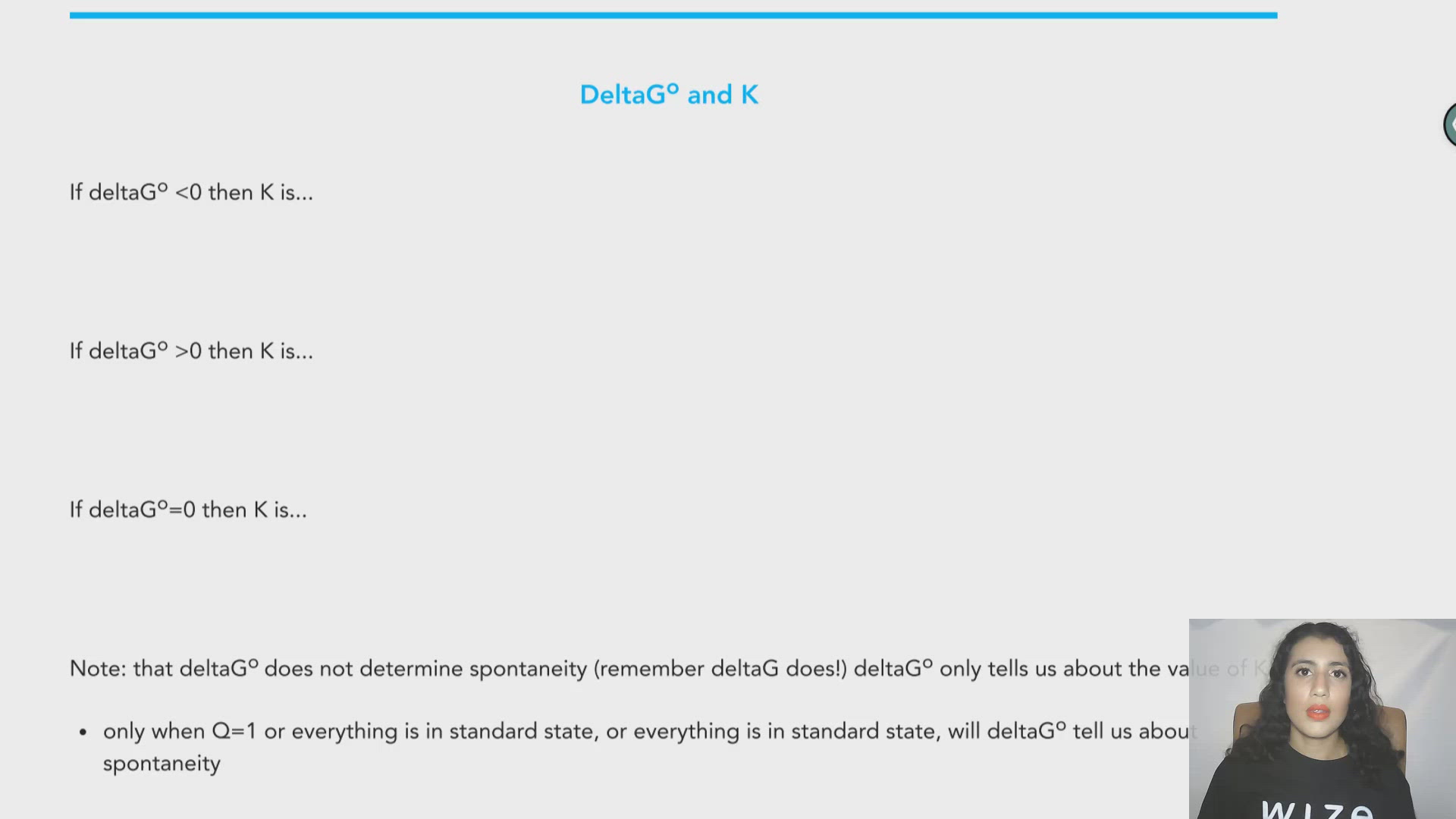
ΔGo and K
If ΔGo < 0 then K is...
K > 1
If ΔGo > 0 then K is...
0 < K < 1
If ΔGo = 0 then K is...
K = 1
Note: that ΔGo does not determine spontaneity (remember ΔG does!) ΔGo only tells us about the value of K
- Only when Q = 1 or everything is in standard state, or everything is in standard state, will ΔGo tell us about spontaneity.
Consider the following reaction at 25°C:
𝐹𝑒(��𝐻)2(𝑠) ⇌ 𝐹𝑒2+(𝑎��) + 2 𝑂𝐻−(𝑎𝑞)
Calculate ΔG° for the reaction. Ksp for Fe(OH)2 is 1.6 × 10⁻¹⁴.
The reaction we are asked to calculate ΔG0 for is the solubility of Fe(OH)2 in water ie, Ksp reaction. Therefore, we can use the relationship between K and ΔG0 to find the answer.
ΔrS° and ΔrH° are known to be –225.3 J K–1mol–1 and –32.8 kJ mol–1 respectively for the following reaction:
a. Is this reaction spontaneous under standard conditions at T = 298K and P = 1 atm?
b. Are reactants or products favoured in the above conditions?
c. At what temperature does the reaction favour the opposite?
a.
ΔG = ΔH - T(ΔS)
ΔG = -32,800 J/mol - (298K)(-225.3 J/Kmol)
ΔG = +34k J/mol
Since the value is positive, the reaction is not spontaneous.
b.
Since ΔGo is positive it means that reactants are favoured over the product under STANDARD conditions.
c.
A reaction transitions from reactants to products or vice versa when ΔGo = 0. In our case, ΔGo > 0 first so reactants are favoured. ΔGo = 0 is the middle point and when ΔGo < 0 products are favored.
Assuming ΔHo and ΔSo are temperature independent:
So any temperature below 145.6K would result in a negative value for ΔGo , where products are favored over reactants!
If you get confused with deciding if the temperature should be below or above 145.6 to get non-spontaneous, think of the signs:
We want ΔG to be negative, ΔH is negative and ΔS is negative:
ΔG = ΔH - T(ΔS)
(-G) = (-H) - T(-S)
Now the minus sign multiplied by the negative sign in front of ΔS will multiply to create a positive sign:
(-G) = (-H) + T(S)
Now we know that when T = 145.6K, ΔG = 0 because the negative H is cancelled out perfectly by +T(S)
If I increased the temperature, then -H + TS would make ΔG positive
If i decreased the temperature, then -H + TS would make ΔG negative
Another way to figure out if ΔG is negative at a temperature lower or higher than 145.6K is by plugging in other temperature values:
a) If we plug in a higher temperature than 145.6K (can pick any number let's do 160K)
ΔG = ΔH - T(ΔS)
ΔG = -32,800J/mol - (160)(-225.3)
ΔG = +3,248 J/mol
Now we know that we get a +ΔG when we use a HIGHER temperature.
b) So we must get a -ΔG when we use a LOWER temperature, but let's check:
We can pick any temperature lower than 145.6K to check this. Let's check 135K
ΔG = ΔH - TΔS
ΔG = -32,800 - (135)(-225)
ΔG = -2,425 J/mol
Now we are sure that we get a -ΔG when we use a LOWER temperature (in this example)
The equilibrium constant for the decomposition of N2O4(g) into NO2(g) has an equilibrium constant K = 660021 at 298K.
- Write the balanced chemical reaction for the decomposition of N2O4(g).
- What is ΔGo for the above reaction?
- It is known that ΔSo = +165 J mol-1 K -1 and ΔHo = +15.9 kJ mol-1 . Assuming ΔHo and ΔSo are temperature independent, calculate the equilibrium constant, K.
a.
b.
deltaG=deltaG0 + RTlnQ
At equilibrium, deltaG=0, deltaGo=-RTlnK
This equation can only be used in standard conditions:
c. Solve for K:
deltaGo = deltaHo - TdeltaSo
deltaGo = 15,900 J/mol - 298K(165 J/molK)
deltaGo = -33,270 J/mol
deltaG0=-RTlnK
lnK = deltaG0/-RT
elnK = edeltaG0/-RT
lne(K) = edeltaG0/-RT lne = 1
K = e13.428...
K = 679063
In British Columbia there has been fierce debate over whether we should increase or halt production of LNG liquefied natural gas (CH4). One alternative to liquefying CH4 (bp = -161.5 oC) is to convert it directly into methanol (CH3OH) which is a liquid at room temperature and pressure in the reaction shown below.

- Calculate ΔHo , ΔSo and ΔGo at 25oC for the conversion of natural gas to methanol. Is this process spontaneous?
- Calculate the equilibrium constant for this reaction at 25oC.
- What are three things you could do to favour the production of methanol?
- Under the following conditions is the reaction spontaneous? (see below)
a.
Since deltaGo is negative, it is spontaneous.
b.
c.
- Increase partial pressure of CH4 or O2
- Remove Methanol from the reaction as formed
- Cool the reaction down .
- Increase Total Pressure / Decrease Total Volume
d.
p(CH3OH)=1atm
Since deltaG <0 the reaction is spontaneous in the forward direction!