The SN1 Mechanism
- SN1 gets its name because it is a nucleophilic substitution SN and it is an overall 1st order reaction.

SN1 Mechanism
- 1st step: Protonate leaving group to make it a better leaving group (not always necessary)
- 2nd step: Loose leaving group and form planar carbocation
- 3rd step: Attack carbocation with nucleophile
- 4th step: Deprotonate to form neutral compound (not always necessary but common)
- The 2nd and 3rd steps are present in every SN1 mechanism.
- The 1st and 4th step are only present if necessary.
- The 1st step is necessary if the leaving group is poor. ie. or but unnecessary if the leaving group is good , , where is a halogen.
- The 4th step is necessary if the nucleophile was neutral and needs to be deprotonated after attacking. Typically this is for nucleophiles like , .
- The mechanism involves a planar carbocation intermediate which can be attacked from either side. This means that if the reaction is proceeding by an SN1 mechanism any stereochemistry present at the electrophile will be racemized (converted to a 50:50 mixture of R and S).
Factors that Favour SN1 Mechanisms
- For SN1 reactions we are attacking a cationic carbon center with our nucleophile so the nucleophile can be very very weak, so any nucleophile will do. Also, the loss of the leaving group is typically much slower than the rate of nucleophile attack so the nucleophile does not affect the rate of the substitution reaction
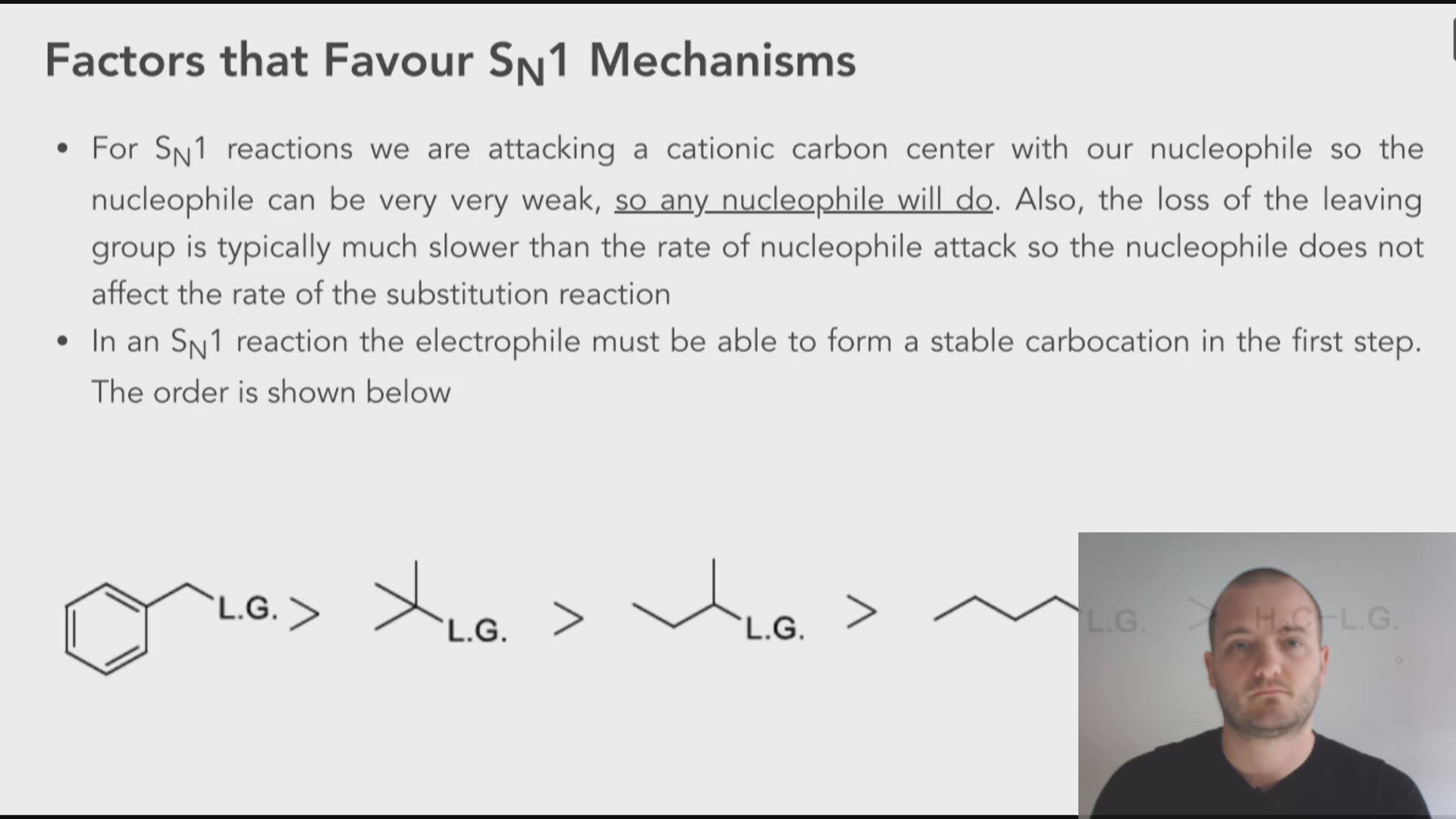
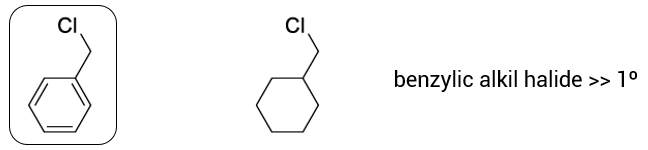
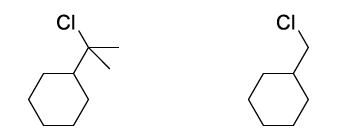
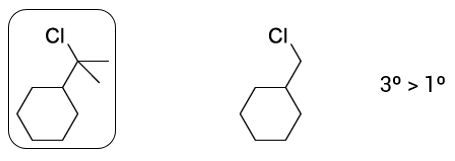
- In an SN1 reaction the electrophile must be able to form a stable carbocation in the first step. The order is shown below

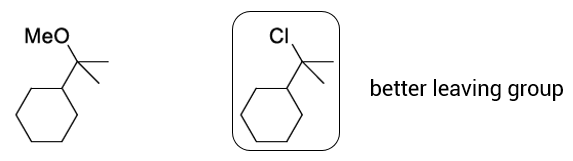
- The leaving group is also very important. A Good leaving group is one which is a very weak base. Remember ARIO.
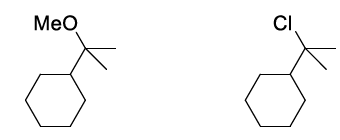
Choose the electrophile which will react fastest in an SN1 reaction
a)
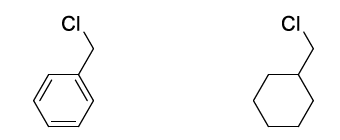
b)
c)