Polar Covalent Bonds
Polar Covalent Bonds:
- Electrons are shared unequally between 2 different non-metals
- There is a difference in EN, 0.4 < ΔEN < 1.7
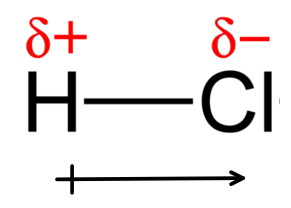
Since electrons are shared unequally in this bond, we say that there is a "dipole moment"
- The dipole moment is a vector with both magnitude and direction (more on this later!)
- Partial negative charge (δ-) is assigned to the atom with the higher EN
- Partial positive charge (δ+) is assigned to the atom with the lower EN
- The greater the difference in electron density (EN), the greater the dipole moment!
Molecular Polarity
How can we figure out if a molecule is polar or not?
Recall we talked about polar covalent bonds earlier, where electrons are shared unequally between 2 elements.
To figure out if a molecule is polar, we need to consider all of the bonds and use our knowledge of VSEPR.
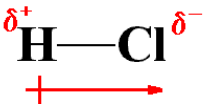
Example: Polar Molecule
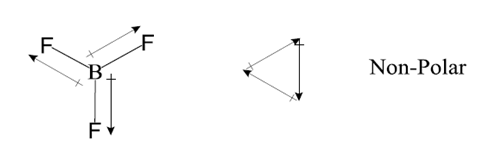
Example: Non-Polar Molecule
Example #1: AlCl3

Are there polar bonds? ________
Is there an overall dipole moment? ________
Therefore, AlCl3 is (polar/non-polar): ________
Example #2: Is H2O a polar molecule?

Are there polar bonds? ________
Is there an overall dipole moment? ________
Therefore, H2O is (polar/nonpolar): ________
Example #3: Is NH3 polar or non-polar?
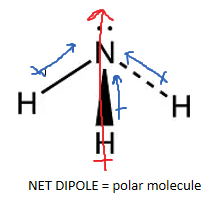
Are there polar bonds? ________
Is there an overall dipole moment? ________
Therefore, NH3 is (polar/nonpolar) : ________
Example: Net Dipole Moment
Determine whether the following molecules have a net dipole moment (polar molecules). For the ones that do, draw the direction of the net dipole moment.
a) XeF4
The molecular shape is square planar. The lone pairs on opposite sides so they cancel out.
The molecule does not have a net dipole moment and is therefore non-polar.

b) CCl4

The molecule does not have a net dipole moment and is therefore non-polar.
c) CHCl3

The molecule has a net dipole moment and is therefore polar
d) SCl2

The molecule has a net dipole moment (that points towards the 2 lone pairs of electrons) and is therefore polar.