Wize University Chemistry Textbook > VSEPR Shapes and Polarity
VSEPR (Molecular Shapes)
Popular Courses
MCAT
General Course
Grade 12 Chemistry
Ontario High School
Grade 12 Chemistry
Canada High School
CHEM 1301A/B
Western University
CHEM 201
University of Calgary
General Chemistry
University Study Guides
AP Chemistry Exam Prep Course
AP Exam Prep
CHEM 1A03
McMaster University
CHEM 101
University of Alberta
CHEM 112
Queen's University
CHEM 121
University of British Columbia
High School Chemistry
US High School
CHM 1311
University of Ottawa
CHEM 1AA3
McMaster University
Chemistry
General Course
DAT
General Course
General Chemistry
University Study Guides
CHEM 103
University of Alberta
CHEM 110
McGill University
CHEM 1E03
McMaster University

0:00 / 0:00
VSEPR Theory
VSEPR aka Valence Shell Electron Pair Repulsion theory: states that repulsion of electron pairs (both bonds and lone pairs) in the valence shell will dictate the molecular geometry of a compound.

Wize Concept
To predict a molecular shape using VSEPR we need the BEST Lewis Structure!
Drawing the best Lewis Structure will provide us with two key pieces of information:
- The number of lone pairs on the central atom
- The number of bound atoms to the central atom
Once we have this information we can determine the electron geometry and the molecular shape as well as the bond angles of the molecule in question! These are all very common exam questions :)
Electron Geometry (aka Orbital Geometry or Parent Shape)
Electron geometry is based on the number of electron groups around the central atom
EGs are electron groups
Example:
How many electron groups does the C atom on the left have?

EGs=# of lone pairs of electrons + number of bound atoms
EGs=0 +2
EGs= 2
Watch Out!
The triple bond has no effect on EGs because we are counting the number of bound atoms, so whether there is a C bound to another C with a single bond, double bond, or triple bond, those will all just count as 1 EG!
Molecular Shape
The shape of a molecule is determined by where the atoms are located.
Write the number of electron groups on the left side of the table.

Wize Tip
The tables in this lesson are very commonly tested on!
Take a few minutes to memorize these tables as you will likely see many questions relating to VSEPR theory on your exams!
Write the number of electron groups on the left side of the table.

Note:
- Wedges mean the bond is coming out of the page and dashes mean the bond is going back into the page.
- LP=lone pairs of electrons
- BA=bound atoms
- Lone pairs give more push (are even more repelled by other electrons), which is why wee see the bond angles change slightly.
0:00 / 0:00
Example: Parent and Molecular Shape
Determine the parent shape and molecular shape for the following.
a) NH3

Electron geometry: tetrahedral
Molecular shape: trigonal pyramidal
b) SCl2

Electron geomtery: tetrahedral
Molecular shape: bent
c) IF7

Electron geometry: pentagonal bipyramidal
Molecular shape: pentagonal bipyramidal
d) SF4
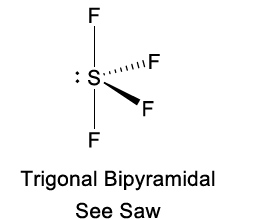
Electron geometry: trigonal bipyramidal
Molecular shape: see-saw

0:00 / 0:00
Example: VSEPR and Molly
MDMA (3,4-methylenedioxy-methamphetamine) or “Molly” is a psychoactive drug commonly used for recreational purposes, which has been investigated as a treatment for PTSD. It functions by triggering serotonin release and inhibiting serotonin reuptake in the human brain, causing euphoric and empathogenic effects on the user. The structure of MDMA is shown below.

a) What is the molecular shape of the nitrogen atom in MDMA?
Trigonal Pyramidal
b) Approximate the O-C-O bond angle in MDMA?
c) How many atoms with a trigonal planar electron geometry are there in MDMA?
6
Practice: VSEPR Shapes
Consider the VSEPR for the “best” Lewis diagrams for the following species and use them to answer the next three questions
1. PH3
2. AlH4–
3. IO3–
Which of the following has a central atom with a tetrahedral electron-pair geometry?
Practice: Bond Angle Identification
Which of the following compounds has a 120° bond angle?
VSEPR and Molecular Shapes - Cheatsheet

The last shape when 7 atoms are bound to the central atom: pentagonal bipyramidal