Wize University Chemistry Textbook > VSEPR Shapes and Polarity
Molecular Polarity
Popular Courses
MCAT
General Course
CHEM 1301A/B
Western University
CHEM 201
University of Calgary
General Chemistry
University Study Guides
AP Chemistry Exam Prep Course
AP Exam Prep
CHEM 1A03
McMaster University
CHEM 101
University of Alberta
CHEM 112
Queen's University
CHEM 121
University of British Columbia
Chemistry
General Course
DAT
General Course
General Chemistry
University Study Guides
CHEM 103
University of Alberta
CHEM 110
McGill University
CHEM 1E03
McMaster University
ENGG 204
University of Calgary
CHM135H1
University of Toronto
CHEM 101
University of Victoria
CHEM 120
University of Waterloo
CHEM 205
Concordia University
Polar Covalent Bonds
Polar Covalent Bonds:
- Electrons are shared unequally between 2 different non-metals
- There is a difference in EN, 0.4 < ΔEN < 1.7
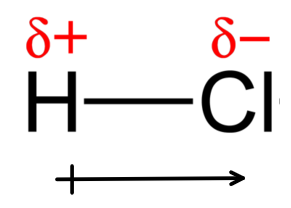
Since electrons are shared unequally in this bond, we say that there is a "dipole moment"
- The dipole moment is a vector with both magnitude and direction (more on this later!)
- Partial negative charge (δ-) is assigned to the atom with the higher EN
- Partial positive charge (δ+) is assigned to the atom with the lower EN
- The greater the difference in electron density (EN), the greater the dipole moment!
Wize Tip
You can think of the dipole moment as a tug of war. The dipole moment (arrow) points towards the winner that is able to pull electrons more towards itself (is more electronegative!)
0:00 / 0:00
Molecular Polarity
How can we figure out if a molecule is polar or not?
Recall we talked about polar covalent bonds earlier, where electrons are shared unequally between 2 elements.
To figure out if a molecule is polar, we need to consider all of the bonds and use our knowledge of VSEPR.
Wize Concept
If there are no polar bonds in the molecule-> it is non-polar!
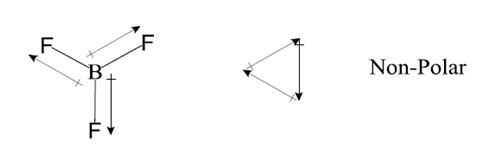
If they are polar bonds but they are symmetrical, their dipole moments will cancel each other out-> molecule is non-polar!
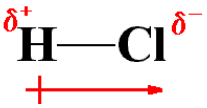
If there are polar bonds that are not symmetrical, the dipole moments don't cancel each other out and we are left with a net dipole moment-> molecule is polar!
Example: Polar Molecule
Example: Non-Polar Molecule
Example #1: AlCl3

Are there polar bonds? Yes!
Yes!
Is there an overall dipole moment? No!
No!
Therefore, AlCl3 is (polar/non-polar): non-polar
non-polar
Wize Tip
In order for a MOLECULE to be considered polar, then there must be a net dipole moment and the dipoles can't all cross out!
Example #2: Is H2O a polar molecule?

Are there polar bonds? yes
yes
Is there an overall dipole moment? yes
yes
Therefore, H2O is (polar/nonpolar): polar
polar
Example #3: Is NH3 polar or non-polar?
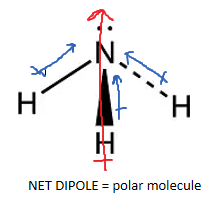
Are there polar bonds?
yes
Is there an overall dipole moment?
yes
Therefore, NH3 is (polar/nonpolar) : polar!
polar!
0:00 / 0:00
Example: Net Dipole Moment
Determine whether the following molecules have a net dipole moment (polar molecules). For the ones that do, draw the direction of the net dipole moment.
a) XeF4
The molecular shape is square planar. The lone pairs on opposite sides so they cancel out.
The molecule does not have a net dipole moment and is therefore non-polar.

b) CCl4

The molecule does not have a net dipole moment and is therefore non-polar.
c) CHCl3

The molecule has a net dipole moment and is therefore polar
d) SCl2

The molecule has a net dipole moment (that points towards the 2 lone pairs of electrons) and is therefore polar.
Practice: Polar Molecules
Which of the following are polar? (Select all that apply) and indicate the direction of polarity.
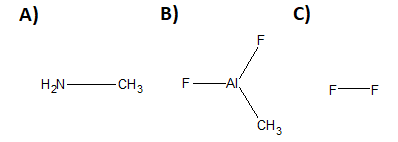
Practice: Polar vs Nonpolar
Are the following compounds polar or nonpolar?
PF5