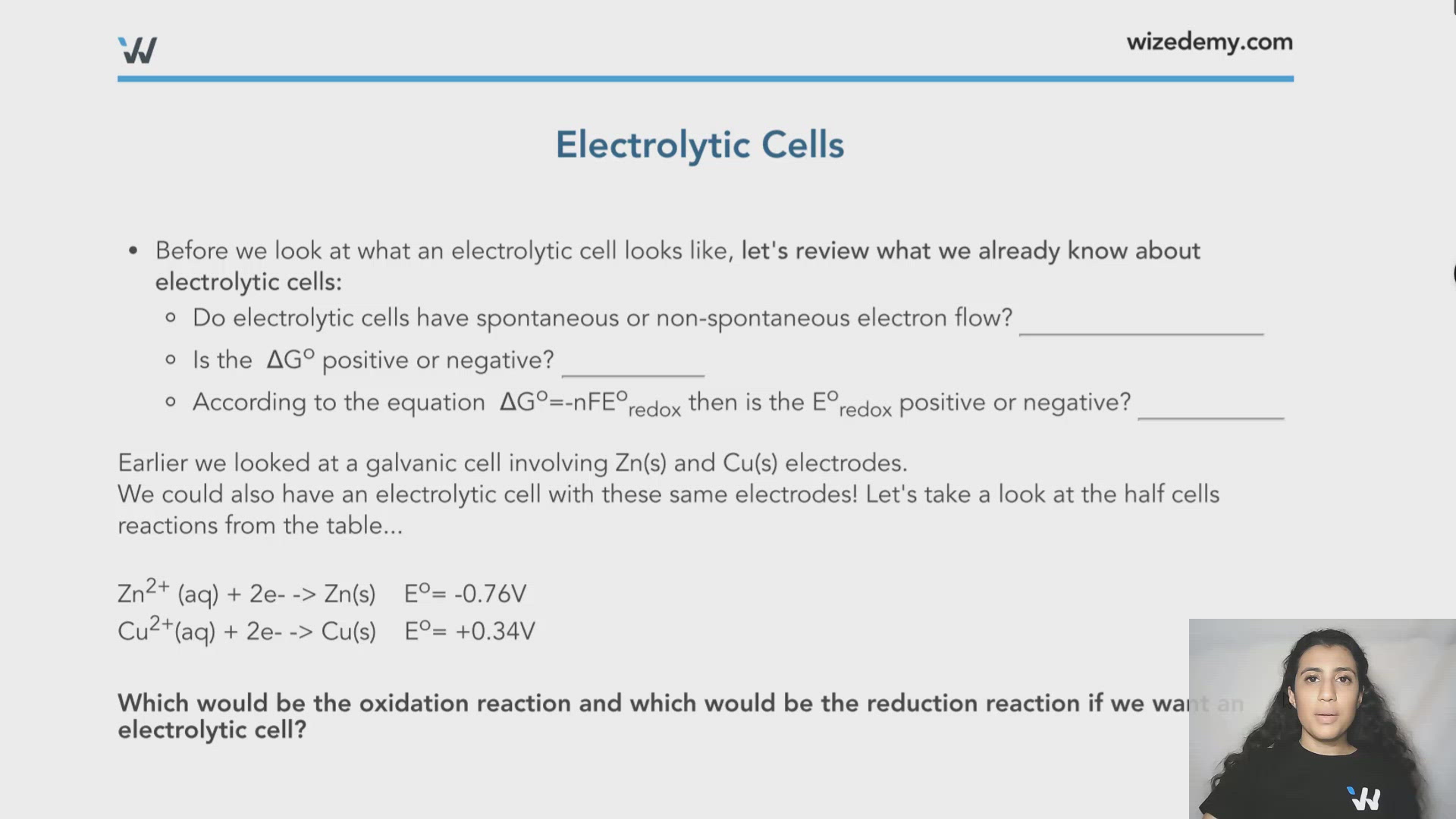
Electrolytic Cells
- Before we look at what an electrolytic cell looks like, let's review what we already know about electrolytic cells:
- Do electrolytic cells have spontaneous or non-spontaneous electron flow? ________
- Is the ΔGo positive or negative? ________
- According to the equation ΔG° = –nFE°redox then is the E°redox positive or negative? ________
Earlier we looked at a galvanic cell involving Zn(s) and Cu(s) electrodes.
We could also have an electrolytic cell with these same electrodes! Let's take a look at the half cells reactions from the table...
Zn2+ (aq) + 2 e– → Zn(s) E° = –0.76 V
Cu2+(aq) + 2 e– → Cu(s) E° = +0.34 V
Which would be the oxidation reaction and which would be the reduction reaction if we want an electrolytic cell?
Zn2+ (aq) + 2 e- -> Zn(s) Eo = -0.76 V reduced
Cu(s) --> Cu2+(aq) + 2 e- Eo = -0.34 V oxidized
Eoredox = -1.1 V
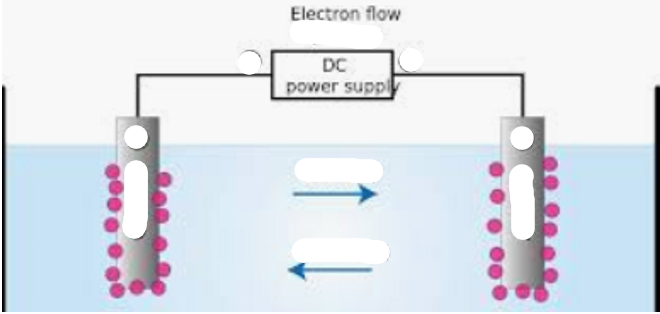
Based on this, label the following:
1) Let's say we are told that Zn(s) is on the left and Cu(s) is on the right. Label the anode and cathode.
2) Draw in electron flow.
3) Draw in charges on the electrodes and on the battery.
- Also note that electrolytic cells do not require separation of the half reactions like galvanic cells do.
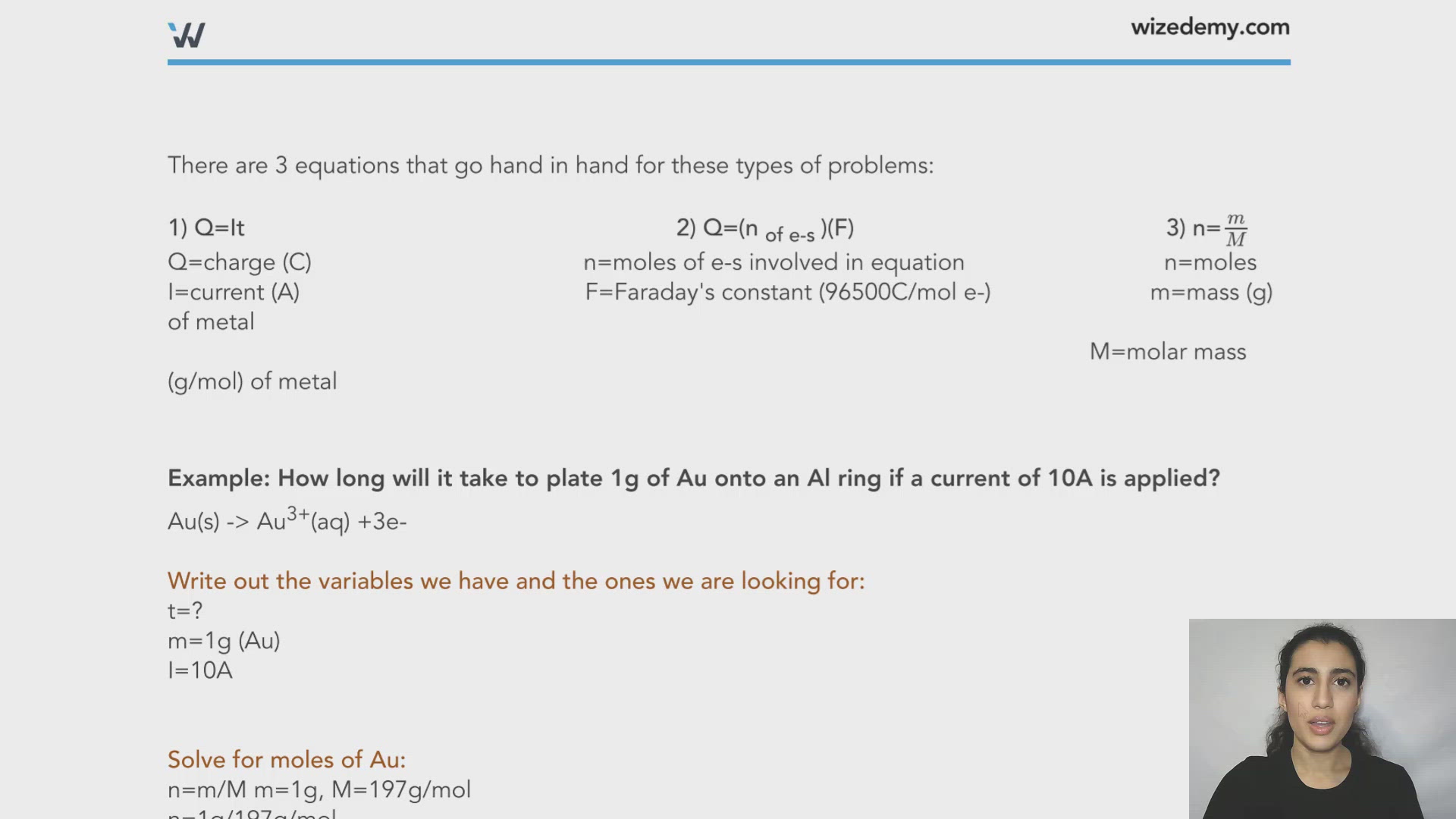
Faraday's Law of Electrolysis
There are 3 equations that go hand in hand for these types of problems:
1) Q = It 2) Q = (n of e- )(F) 3) n =
Q = charge (C) n = moles of e– involved in equation n = moles
I = current (A) F = Faraday's constant (96485C/mol e–) m = mass (g) of metal
t = time (s) M = molar mass (g/mol) of metal
Example: How long will it take to plate 1 g of Au onto an Al ring if a current of 10 A is applied?
Au(s) → Au3+(aq) +3 e–
Write out the variables we have and the ones we are looking for:
t = ?
m = 1 g (Au)
I = 10 A
Solve for moles of Au:
n = m/M
m = 1 g
M = 197 g/mol
n = 1 g/197 g/mol
=
= 0.5 x 10⁻²
n = 0.005 mol of Au
Find the moles of electrons:
n of e- = 3 x 0.005 mol of Au
n of e- = 0.015 mol e-
Solve for Q:
Q = (n of e–)(F)
Q = (0.015 moles of e-)(96500C/mol e-)
~(1.5 x 10⁻²)(9.65 x 10⁴ C)
~(1.5 x 10⁻²)(10 x 104 C)
~15 x 102 C
Q = 1500 C
Solve for time (t):
Q = It
t = Q/I
t = 1500 C/10 A
t = 150 s
Summary of Galvanic vs Electrolytic Cell
Galvanic Cell:
- Spontaneous electron flow towards a positive charge
- Electrons go from the anode -> cathode where the anode is negatively charged and the cathode is positively charged
Electrolytic Cell:
- Non-spontaneous electron flow (requires an external source of energy like a battery)
- Electrons still go from the anode -> cathode but the anode is positively charged and the cathode is negatively charged

Summary of Free Energy, Equilibrium, and Electromotive Force
- Row 1 applies to a galvanic cell
- Since the reaction is spontaneous in the forward direction, it wants to proceed towards the products and so Q < K since the reaction is going to the right.
- Row 3 applies to an electrolytic cell
- Since the forward reaction is nonspontaneous, that means the reverse reaction is spontaneous
- This reaction would want to go from products to reactants
- This reaction wants to go towards the left and has more products than reactants, which is why Q > K