Create a free account to get started

Unlock full course notes by signing up

  • Video lessons taught by top educators
  • Practice questions with guided solutions
  • Written review notes for reference
  • Expert answers anytime from course tutors

The Grignard Reaction


The Grignard reaction forms a new carbon-carbon bond.

  • It requires a carbon nucleophile (called a Grignard reagent).
  • The nucleophile is synthesized from an alkyl halide and magnesium.
  • The reaction needs to be done in a non-protic solvent (usually diethyl ether).
  • The work-up step is the addition of an acid to get rid of the negative charges.
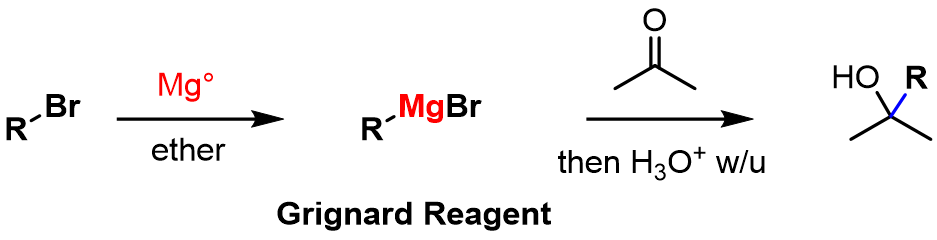

Image illustrating The Grignard Reaction


Create a free account to get started

Unlock full course notes by signing up

  • Video lessons taught by top educators
  • Practice questions with guided solutions
  • Written review notes for reference
  • Expert answers anytime from course tutors

Cyanohydrin Formation

A cyanohydrin has an -OH group and a -CN group bonded to the carbon of interest.

  • A cyano (CN-) group is the carbon nucleophile.
  • The oxygen from the carbonyl is protonated by HCN to give the final product.
  • The cyano group can further react with LiAlH4 (a reducing agent) to make an amine and with acid to make a carboxylic acid.
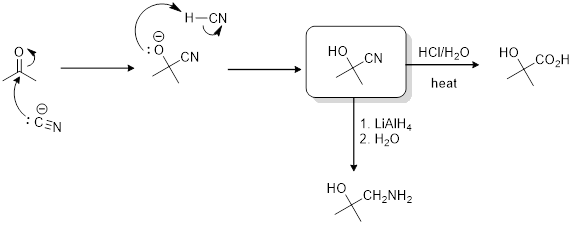
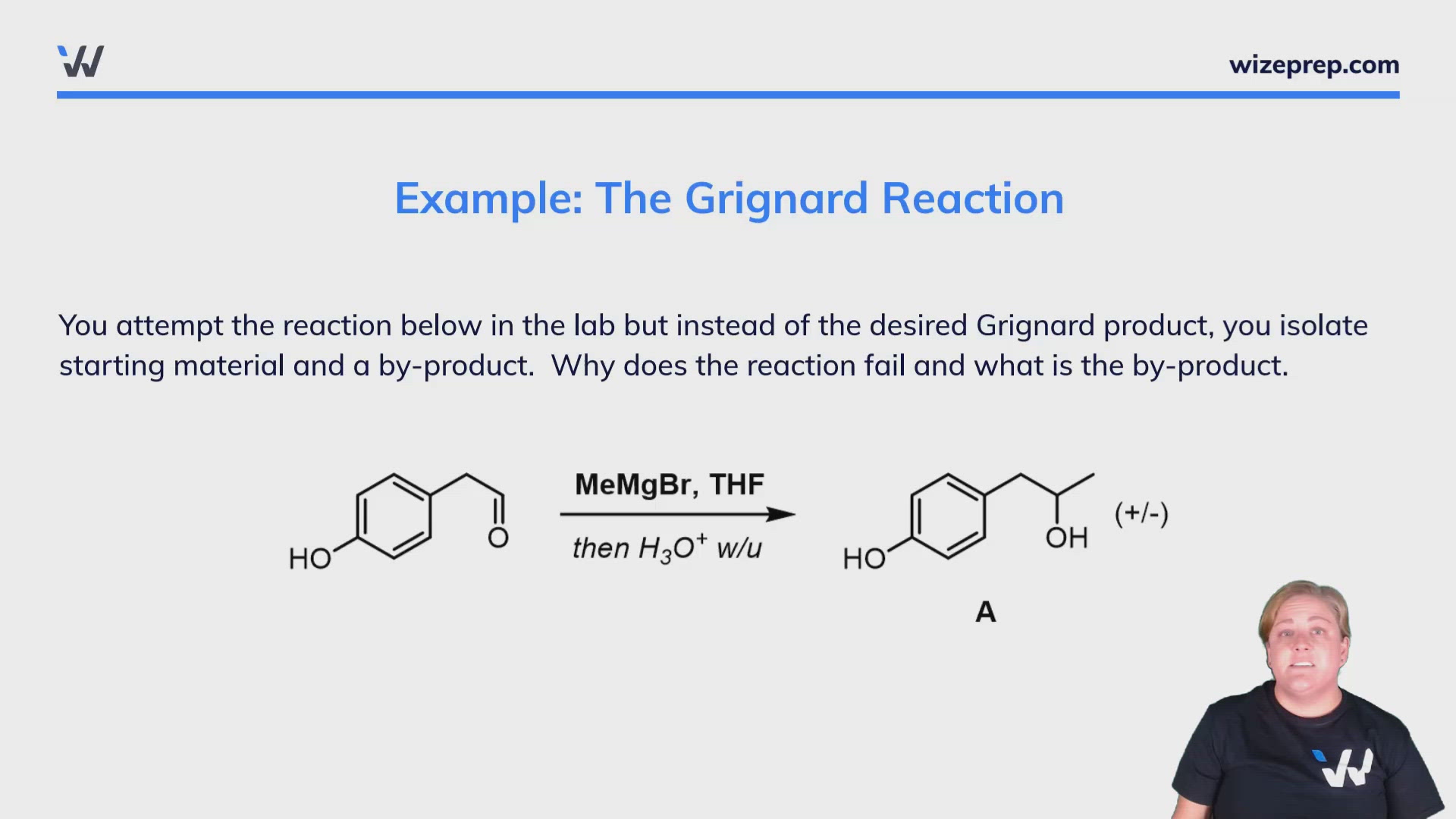
Image illustrating Cyanohydrin Formation


Create a free account to get started

Unlock full course notes by signing up

  • Video lessons taught by top educators
  • Practice questions with guided solutions
  • Written review notes for reference
  • Expert answers anytime from course tutors

Example: Grignard Reaction


You attempt the reaction below in the lab but instead of the desired Grignard product, you isolate starting material and a by-product. Why does the reaction fail and what is the by-product?



Image illustrating Example: The Grignard Reaction

Remember, MeMgBr is a strong nucleophile but also a strong base (you can think of it as Me- and +MgBr). The aromatic alcohol (phenol) is mildly acidic (pKa ~ 10). In the presence of one equivalent of MeMgBr, this OH will just be deprotonated.


The by-product is methane (CH4).

Mark Yourself Question

  1. Grab a piece of paper and try this problem yourself.
  2. When you're done, check the "I have answered this question" box below.
  3. View the solution and report whether you got it right or wrong.

Practice: Grignard Reaction

Predict the product(s) of the following reactions.


Illustration for practice question: Organic Reactions: Grignard Reaction


Create a free account to get started

Unlock full course notes by signing up

  • Video lessons taught by top educators
  • Practice questions with guided solutions
  • Written review notes for reference
  • Expert answers anytime from course tutors