
Solubility Chart
The following table tells us if certain combinations of ions are soluble or insoluble!

Decide whether the following salts would form a precipate or not:
1) NaCl
Na+ is a group 1 ion. When these are part of a compound, it will always be soluble.
Therefore, no precipitate will form!
NaCl → Na+ + Cl-
2) AgCl
Cl- is typically soluble when in a compound, BUT when it is paired with Ag+, that is an exception so the combination of these ions will actually be insoluble.
Insoluble means they won't dissolve into their ions and so we will form a precipitate
3) AgI
I- is typically soluble when in a compound, BUT when it is paired with Ag+, that is an exception so the combination of these ions will actually be insoluble.
Insoluble means they won't dissolve into their ions and so we will form a precipitate
4) NaNO3
Na+ is a group 1 ion. All group 1 ions are always soluble
NO3 is also an ion that is always soluble.
This combination will not form a precipitate.
NaNO3 → Na+ + NO3-
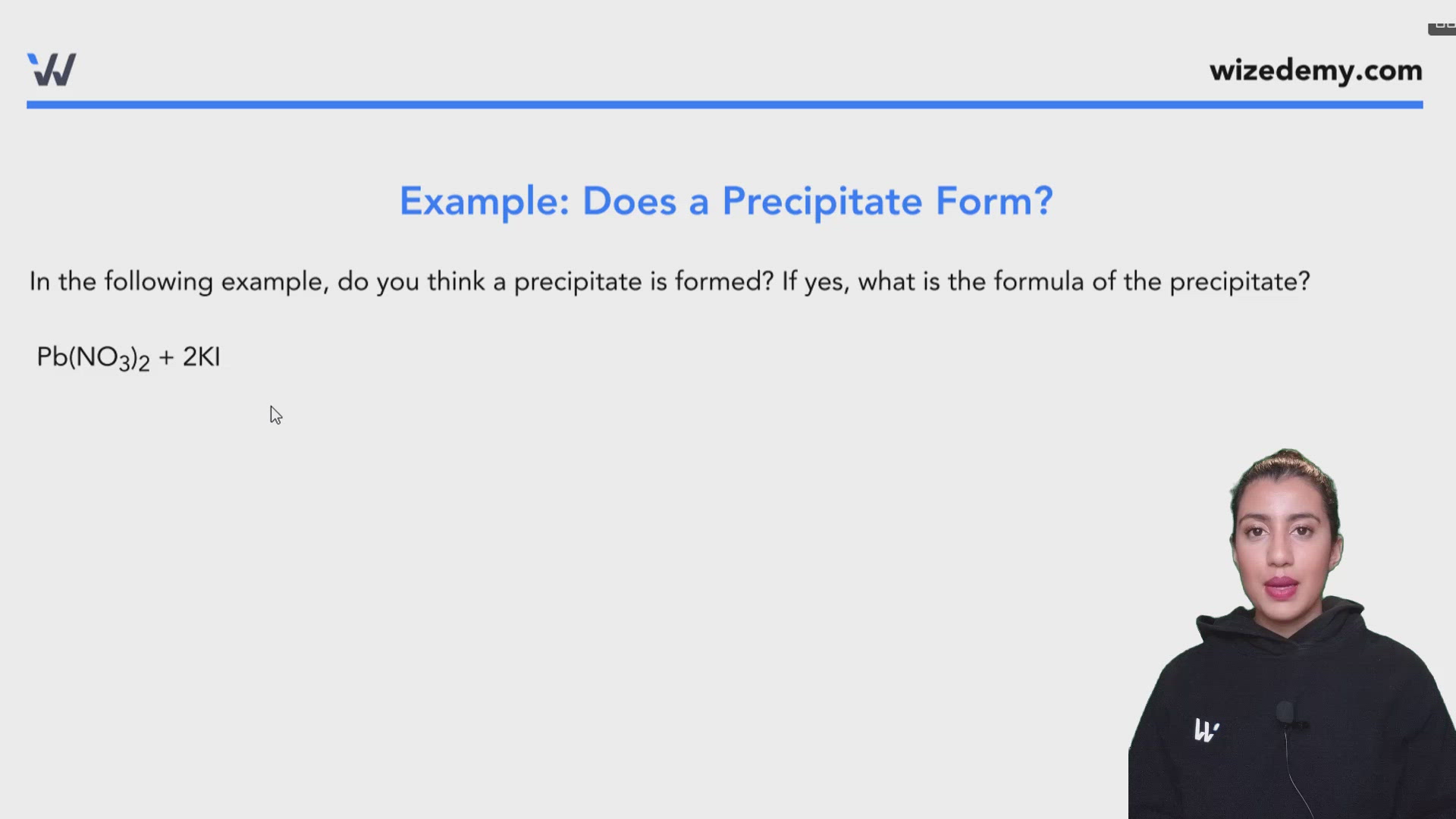
Example: Does a Precipitate Form?
In the following example, do you think a precipitate is formed? If yes, what is the formula of the precipitate?
Pb(NO3)2 + 2KI
1) Write out all ions involved
Pb2+, NO3-, K+, I-
2) Consider different combinations of the ions that were not already done:
Pb2+ & I-, NO3- & K+
3) Determine if each combination would be soluble or insoluble:
We know that I- is generally soluble, but Pb2+ is one of the exceptions so this compound is insoluble
For our second set of ions, anything with NO3- is soluble!
4) Since we do have a precipitate we must now give the formula for the precipitate:
Pb2+ and I-
PbI2
Write the complete chemical reaction:
Pb(NO3)2________ + 2KI________ → ________ + ________
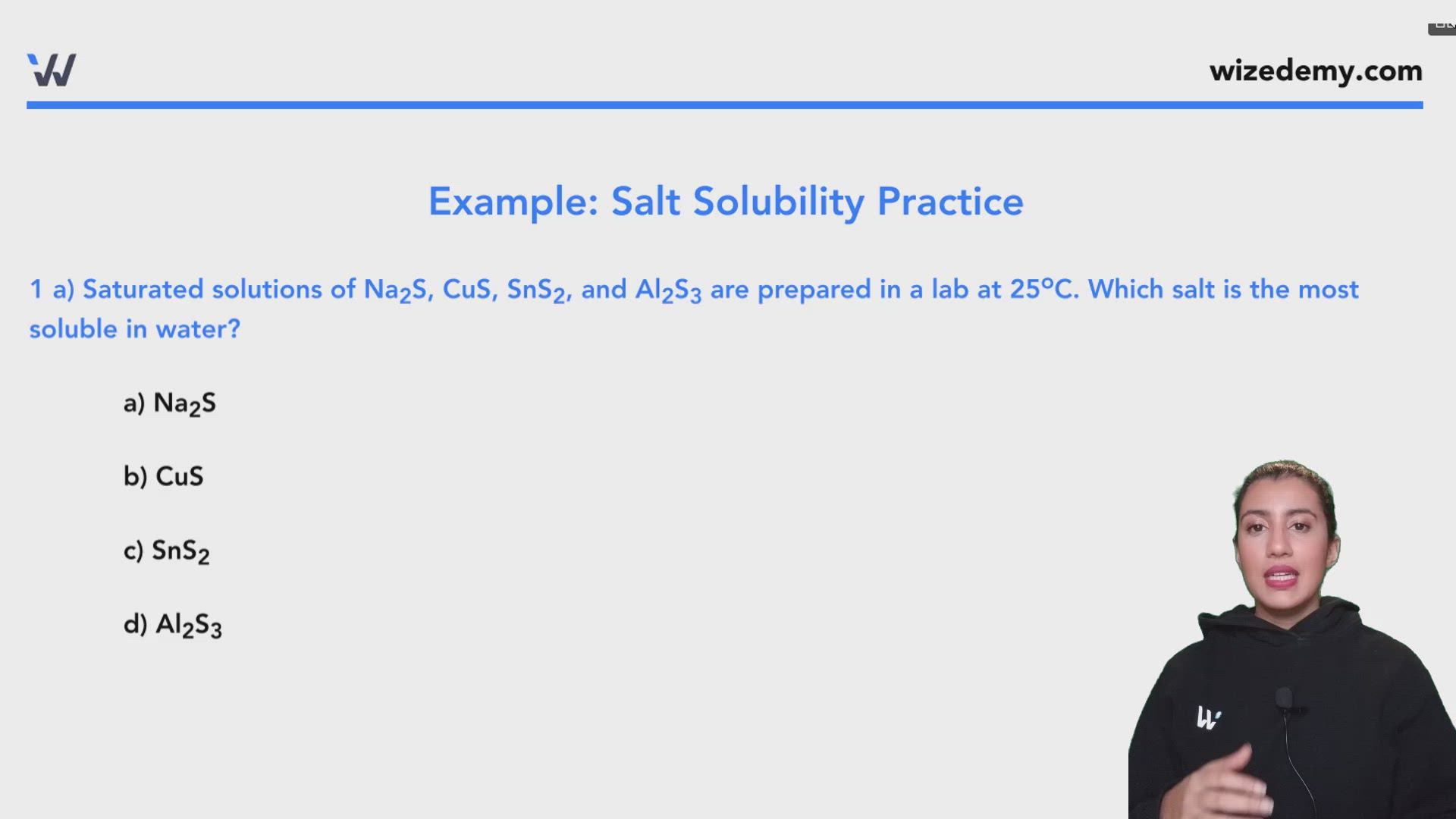
Example: Salt Solubility Practice
1 a) Saturated solutions of Na2S, CuS, SnS2, and Al2S3 are prepared in a lab at 25oC. Which salt is the most soluble in water?
a) Na2S
b) CuS
c) SnS2
d) Al2S3
Think of the salt solubility rules. Rule #1 is any group 1 cation will be soluble.
a) has Na+ (a group 1 ion)
b) Cu and S, we know S has a charge of -2, since we see no charges, Cu must have a charge of 2+
c) Sn has a charge of 4+ here (S has 2-, divide both charges by 2 to get the compound as written in c))
d) Al3+ and S2-
Therefore Na+ is the only 1+ ion so a) will have the highest solubility!
1 b) Which of the options above would produce the highest [S2-]?
This question is asking us the same thing a) did.
If we have the highest [S2-], it means that the salt was most soluble!
Therefore a) is your answer.
2) Which of the following salts has the lowest solubility?
a) copper (I) perchlorate
b) ammonium sulphide
c) potassium hydroxide
d) mercury(II) sulphate
a) Perchlorate (ClO4-) with any compound is always soluble.
b) Ammonium is NH4+. This compound with anything is always soluble.
c) K+ is a group 1 ion. This salt is soluble.
d) Sulphate (SO42-) is generally soluble but it has a lot of exceptions. Hg2+ is one of them and so the compound is insoluble.
The question is asking us which would have the lowest solubility, so we would choose the insoluble option: d)