
Shapes (aka Boundary Diagrams) of Atomic Orbitals

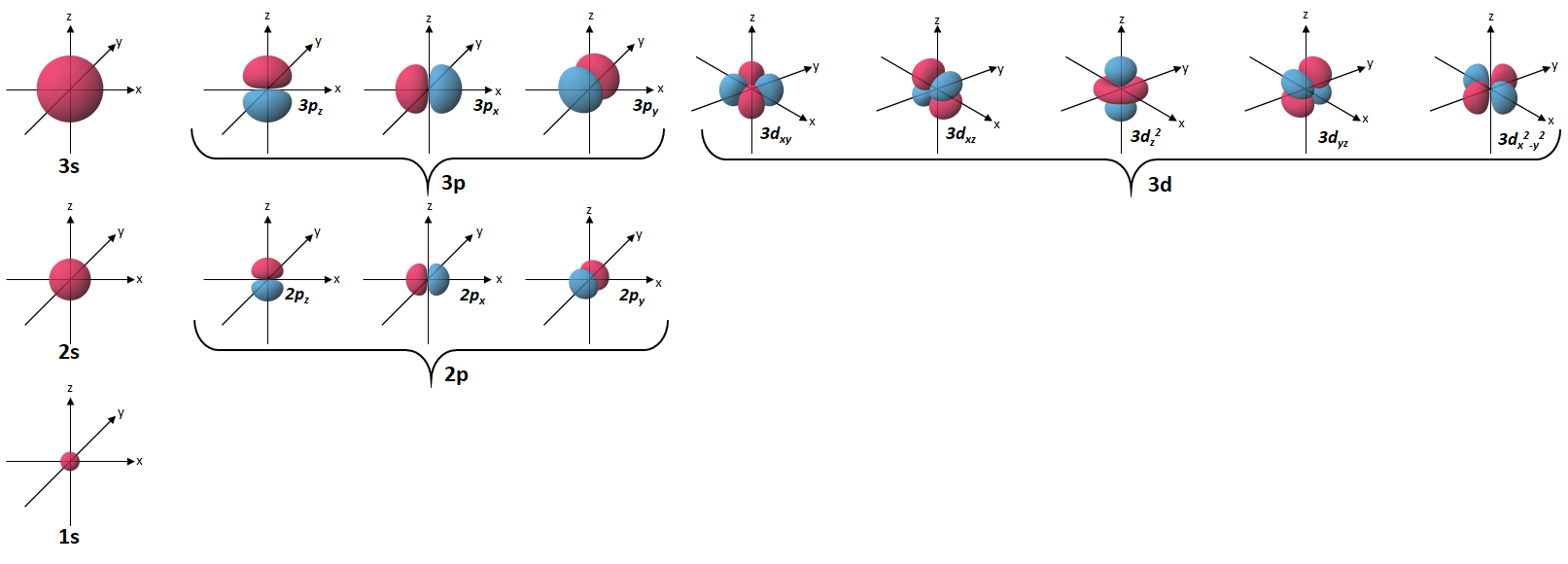
- There is one s orbital in a subshell, which is a sphere
- There are three p orbitals in a subshell, each orientated along an axis (px, py and pz)


- There are five d orbitals in a subshell. The shapes of the d orbitals are more complicated than their s and p counterparts.
- Three orbitals look like 3D cloverleaves, each lying in a plane with the lobes pointed between the axes (dxy, dxz and dyz).
- A fourth orbital is also a cloverleaf, but its lobes point along the axes ().
- The fifth orbital looks quite different with its major lobes pointing along the z- axis, but there is also a “doughnut” of electron density in the xy plane ()
Things to Keep in Mind:
- As the energy level increases, so does the size of the orbitals Example: A 2s orbital is higher in energy and larger than a 1s orbital
- As the energy level increases, so does the number of orbitals Example: when n=1 (lower energy level), we see 1 orbital, whereas when n=2 (higher energy level), there are 4 possible orbitals
- As the number of orbitals increases, so does their complexity Example: d orbitals are more complex than p orbitals
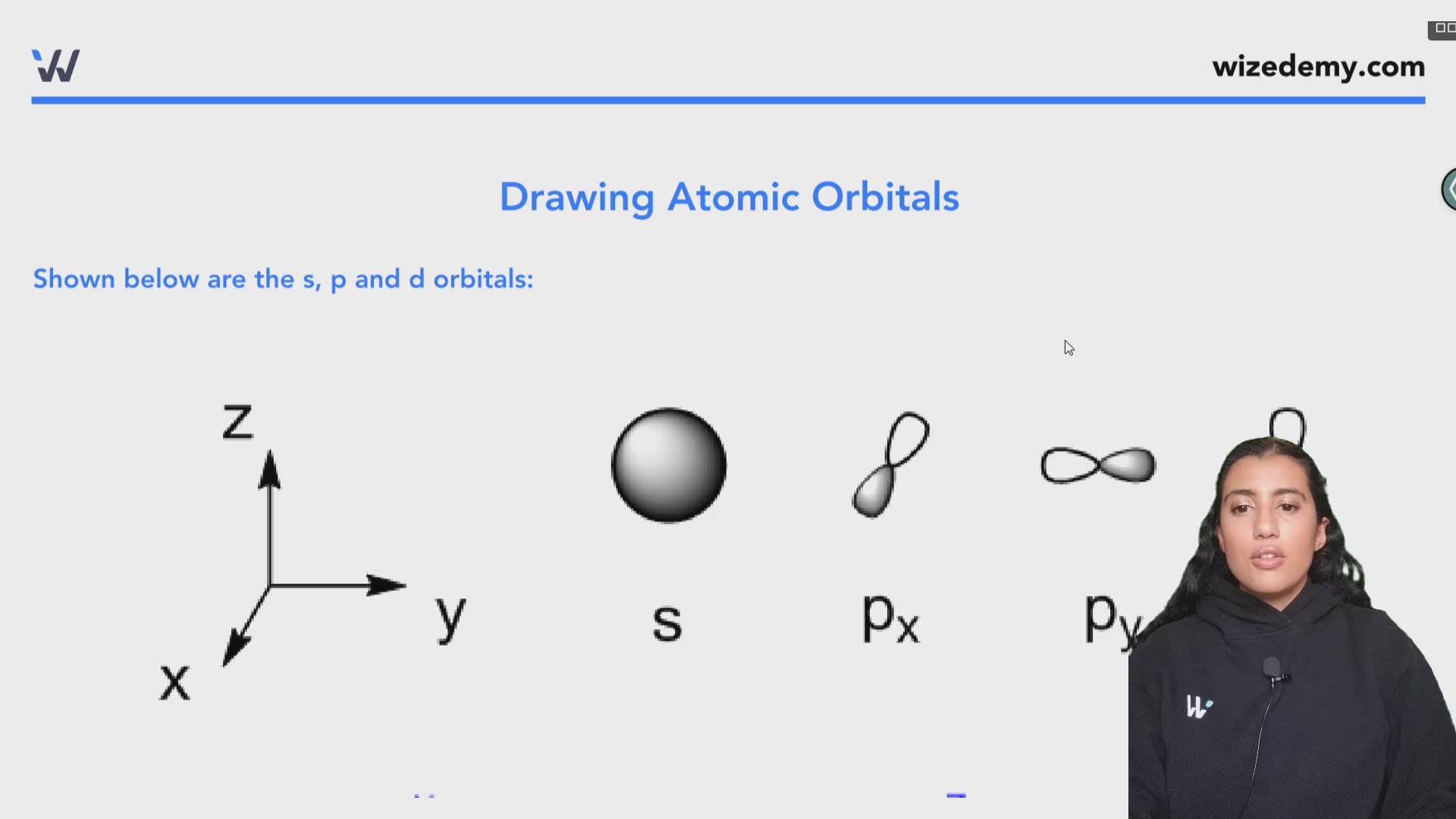
Drawing Atomic Orbitals
Shown below are the s, p and d orbitals:


- The angular momentum quantum number, l, gives us information about the shape of the orbital.
- Note: There are 5 d-orbitals and 5 allowed value for ml. Similarly for s and p the number of orbitals is determined by the # of allowed values of ml.
- Note: Each ml is not associated with a particular orbital (ex. dxy vs dxz). Which means given a set of quantum numbers (n,l,ml) one cannot determine which direction the orbital will be pointing
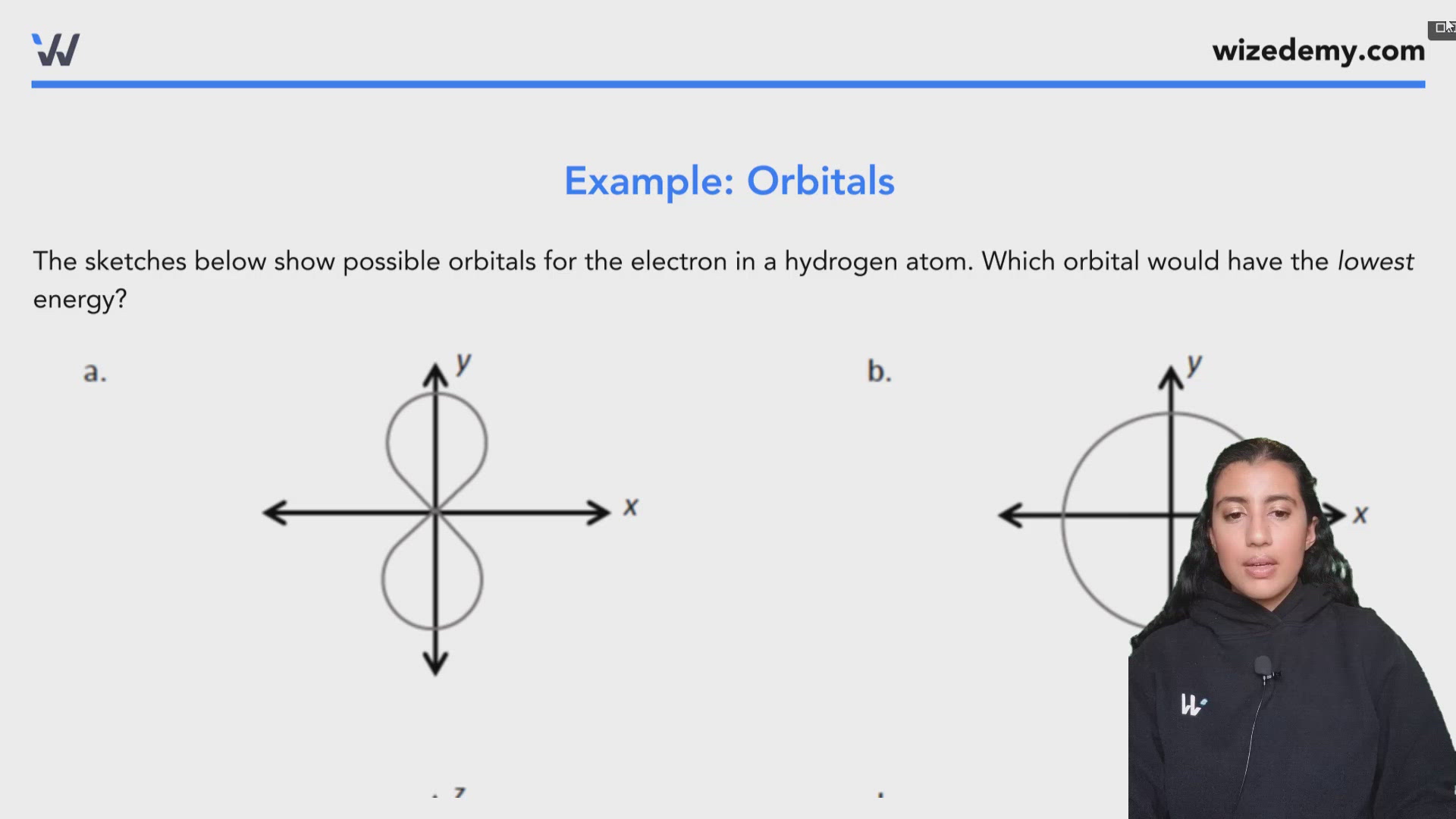
Example: Orbitals
The sketches below show possible orbitals for the electron in a hydrogen atom. Which orbital would have the lowest energy?
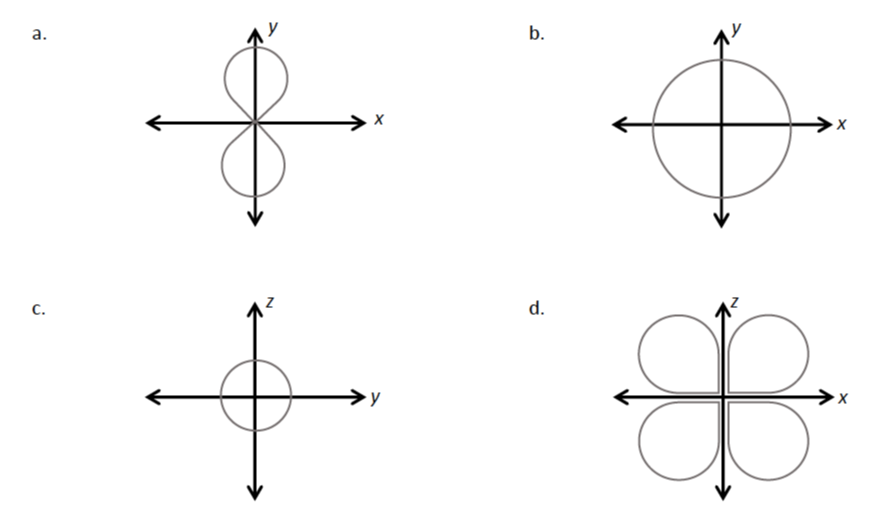
Diagram A represents 2py orbital and diagram B a 2s orbital. We can tell it's a 2s rather than a 3s or 1s based on the relative size compared to diagram A and C. Diagram C represents a 1s orbitals, and diagram D a 3dxz orbital.
s < p < d < f for energy.
Out of b and c (b is a 2s orbital while c is a 1s orbital), we know that the orbital with the smaller size has the lower energy. Therefore c) has the lowest energy!
Answer: C