
VSEPR Theory
VSEPR aka Valence Shell Electron Pair Repulsion theory: states that repulsion of electron pairs (both bonds and lone pairs) in the valence shell will dictate the molecular geometry of a compound.

Electron Geometry (aka Orbital Geometry or Parent Shape)
Electron geometry is based on the number of electron groups around the central atom
EGs are electron groups
Example:
How many electron groups does the C atom on the left have?

EGs=# of lone pairs of electrons + number of bound atoms
EGs=0 +2
EGs= 2
Molecular Shape
The shape of a molecule is determined by where the atoms are located.
Write the number of electron groups on the left side of the table.

Write the number of electron groups on the left side of the table.

Note:
- Wedges mean the bond is coming out of the page and dashes mean the bond is going back into the page.
- LP=lone pairs of electrons
- BA=bound atoms
- Lone pairs give more push (are even more repelled by other electrons), which is why wee see the bond angles change slightly.
Example: Parent and Molecular Shape
Determine the parent shape and molecular shape for the following.
a) NH3

Electron geometry: tetrahedral
Molecular shape: trigonal pyramidal
b) SCl2

Electron geomtery: tetrahedral
Molecular shape: bent
c) IF7

Electron geometry: pentagonal bipyramidal
Molecular shape: pentagonal bipyramidal
d) SF4
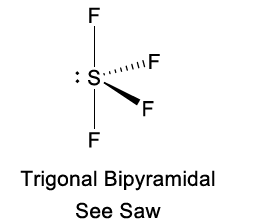
Electron geometry: trigonal bipyramidal
Molecular shape: see-saw

Example: VSEPR and Molly
MDMA (3,4-methylenedioxy-methamphetamine) or “Molly” is a psychoactive drug commonly used for recreational purposes, which has been investigated as a treatment for PTSD. It functions by triggering serotonin release and inhibiting serotonin reuptake in the human brain, causing euphoric and empathogenic effects on the user. The structure of MDMA is shown below.

a) What is the molecular shape of the nitrogen atom in MDMA?
Trigonal Pyramidal
b) Approximate the O-C-O bond angle in MDMA?
c) How many atoms with a trigonal planar electron geometry are there in MDMA?
6
VSEPR and Molecular Shapes - Cheatsheet

The last shape when 7 atoms are bound to the central atom: pentagonal bipyramidal