
Visible Region of the Electromagnetic Spectrum
- Bonus: Electromagnetic radiation is classified based on its wavelength:

Increasing wavelength ________
Increasing Energy ________
Increasing Frequency ________
- Note the order of waves from lowest energy to highest energy (ex. UV rays have higher energy than the visible region)
- Also note the order of colours: R.O.Y.G.B.I.V. (from longest wavelength to shortest or lowest energy to highest!)

Also if given a question about absorbing colours, know that when one colour is absorbed, you will see the colour that is opposite to it on the colour wheel.
- For example, if red is absorbed, you will see ________.
- If we see violet, ________ must have been absorbed.
UV-vis Theory
- Absorptions that correspond to wavelengths of light in the UV-vis range are typically caused by electronic excitation between molecular orbitals.
- For an absorption to occur the electron must move from a filled orbital to an empty orbital, typically the highest occupied molecular orbital (HOMO) to the lowest unoccupied molecular orbital (LUMO).
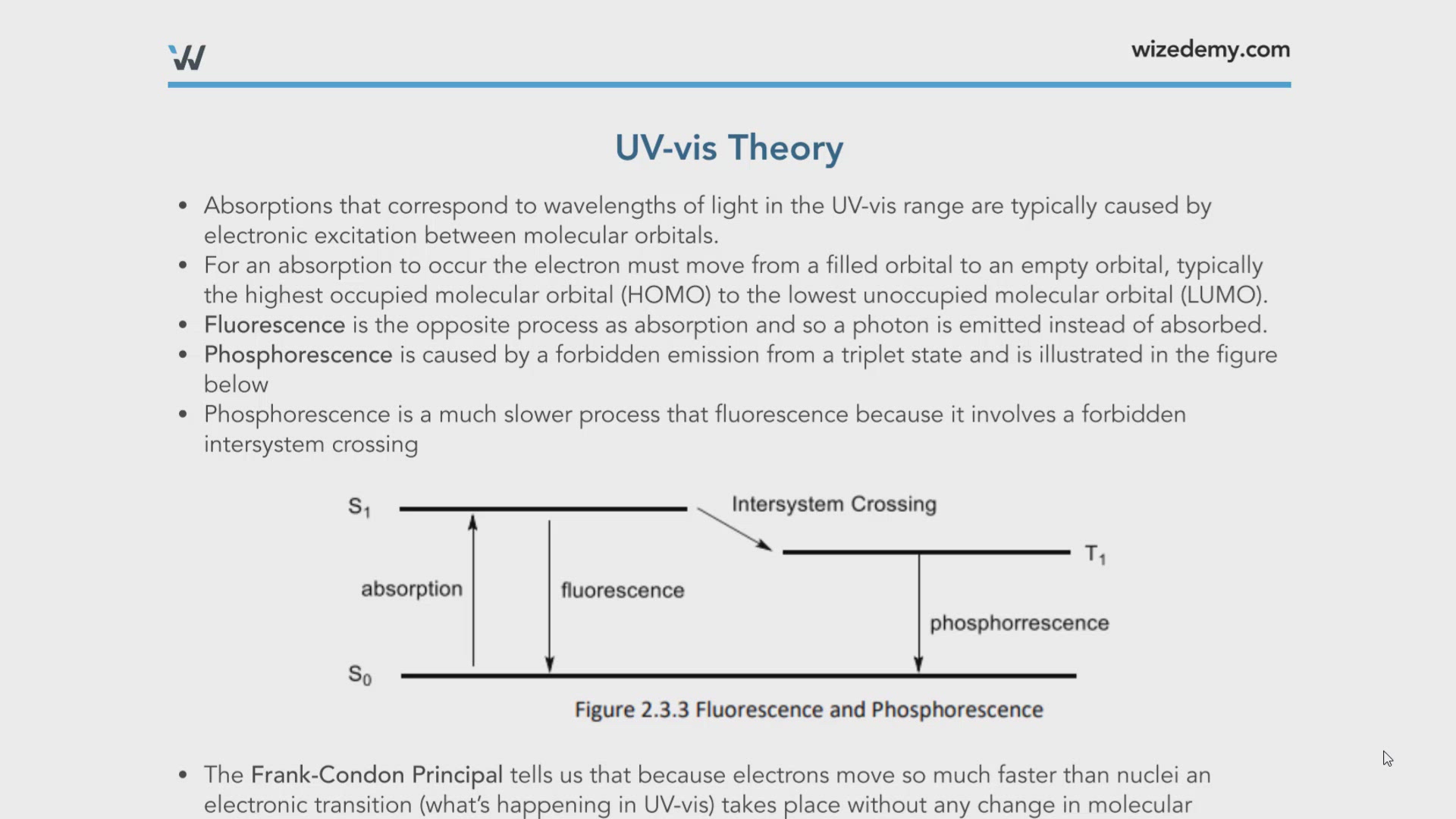
- Fluorescence is the opposite process as absorption and so a photon is emitted instead of absorbed.
- Phosphorescence is caused by a forbidden emission from a triplet state and is illustrated in the figure below
- Phosphorescence is a much slower process that fluorescence because it involves a forbidden intersystem crossing

- The Frank-Condon Principal tells us that because electrons move so much faster than nuclei an electronic transition (what’s happening in UV-vis) takes place without any change in molecular geometry.
- Because molecules can relax rapidly, fluorescence will occur from the ground vibrational level. As we can see in figure 2.3.4 this results in the absorption energy being greater than the emission energy. This difference is called the stokes shift (red line=fluorescence)

What Does it Tell Us For Molecule Identification?
- Honestly, not much. Although this information is often provided along with 1H, 13C NMR spectra and IR absorption spectra, it is never necessary to identify the molecule and is often misleading.
- Compounds which have a UV-vis absorption band typically have conjugated pi systems like benzene rings and double bonds. A table is given on your formula sheet...use it if you are explicitly asked to explain the UV-vis spectrum
- E (extinction coefficient) tells us about the strength of the absorption at that peak
- larger E=stronger absorption

- more conjugated double bonds present=lower energy of the transition=longer wavelength of absorption