
Reduction Potentials
- Each half reaction has a potential.
- For example, the first half reaction below has a reduction potential of –3.05 V!
- We got these potentials from measuring the voltage when the other half reaction was the reference electrode (H, 0 V)
- In the table below, are the reactions showing reductions or oxidations? ________
- Therefore, these are ________ potentials!
- If we flip a reaction, the Eo potential changes signs, let's do this for the first half reaction in the table so it is clear:
Li(s) --> Li+(aq) + e- Eo = 3.05
- Is this reaction now describing reduction or oxidation? ________
- So do you think the potential written would now be a reduction or oxidation potential? ________ potential
- In general:
- If we see a more positive reduction potential:
- It means something is more likely to be oxidized/reduced: ________
- and will act as a(n) reducing/oxidizing agent: ________ agent
- If we see a more negative reduction potential:
- It means something is more likely to be oxidized/reduced: ________
- and will act as a(n) reducing/oxidizing agent: ________ agent

- Based on this table, answer the following questions:
1) What is the strongest oxidizing agent? ________________________________________
2) What is the weakest reducing agent? ________________________________________
3) What is the strongest reducing agent? ________________________
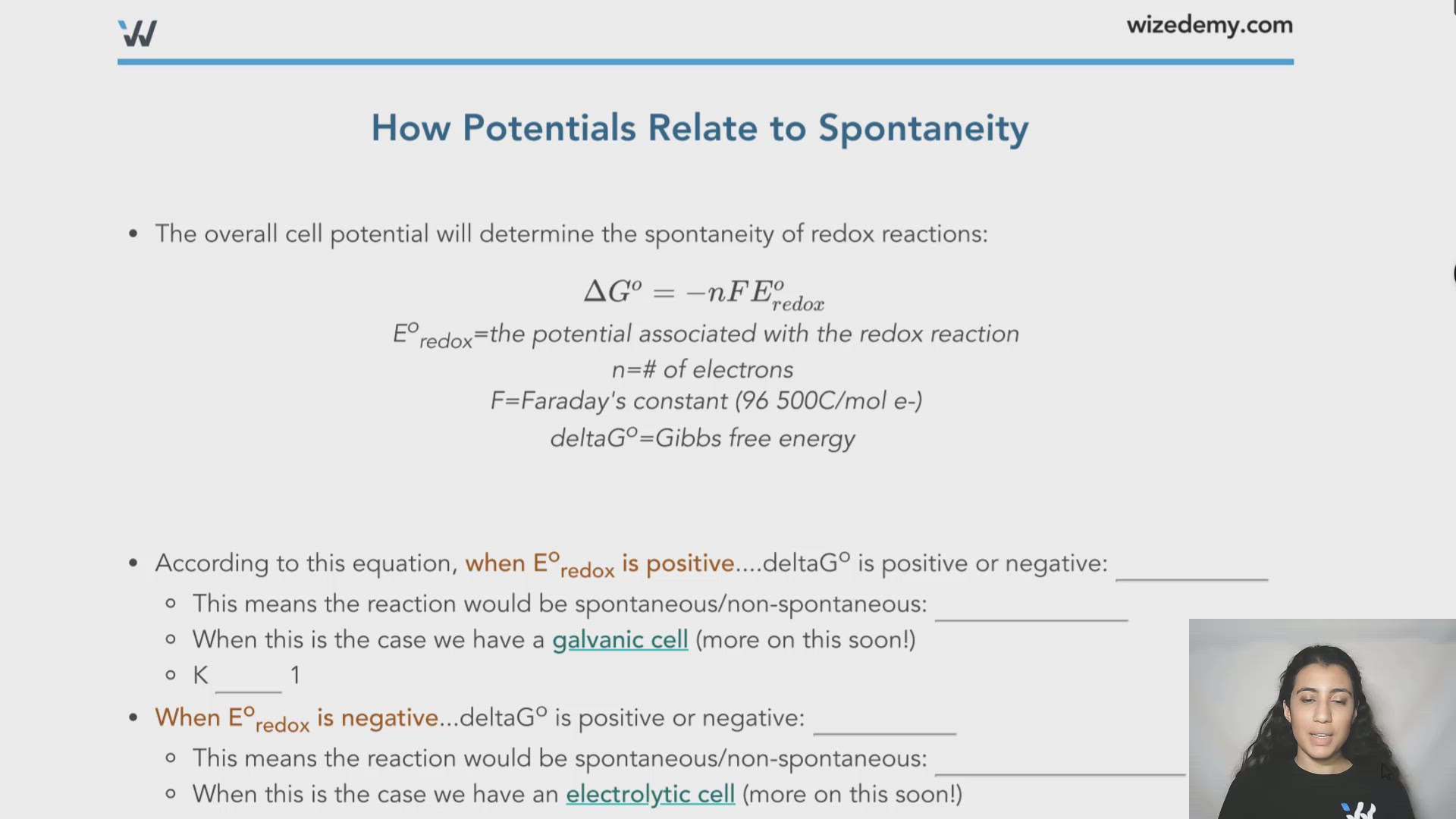
How Potentials Relate to Spontaneity
- The overall cell potential will determine the spontaneity of redox reactions:
Eoredox = potential associated with a redox reaction
n = # of electrons
F = Faraday's constant (96 500C/mol e–)
ΔG° = Gibbs free energy
- According to this equation, when E°redox is positive, is ΔG° positive or negative? ________
- This means the reaction would be spontaneous/nonspontaneous: ________
- When this is the case we have a galvanic cell (more on this soon!)
- K ________ 1
- When E°redox is negative, is ΔG° positive or negative? ________
- This means the reaction would be spontaneous/nonspontaneous: ________
- When this is the case we have an electrolytic cell (more on this soon!)
- K ________ 1
Apply: If we had the following overall reaction, would it be spontaneous or not?
Zn(s) + Cu2+(aq) → Zn2+(aq) + Cu(s)
1) Let's write out the oxidation and reduction half reactions:
a) Oxidation half reaction:
Zn(s) --> Zn2+(aq) + 2 e-
b) Reduction half reaction:
Cu2+(aq) + 2 e- --> Cu(s)
2) Given the above reactions that are occuring, write out an oxidation potential and a reduction potential using the table values below:
From the table:
Zn2+ (aq) + 2 e– → Zn(s) E° = –0.76 V
Cu2+(aq) + 2 e– → Cu(s) E° = +0.34 V
For us,________ is being oxidized, so E°ox = ________ (changes sign)
And ________________________ is being reduced, so E°red = ________ (stays the same)
3) Solve for E°redox:
E°redox = 0.76 V + 0.34 V
E°redox = 1.10 V
4) Figure out if the reaction is spontaneous using this equation:
- Our E°redox value is positive/negative: ________
- This means our ΔG° value is positive/negative: ________
- Therefore, the reaction is spontaneous/nonspontaneous:________
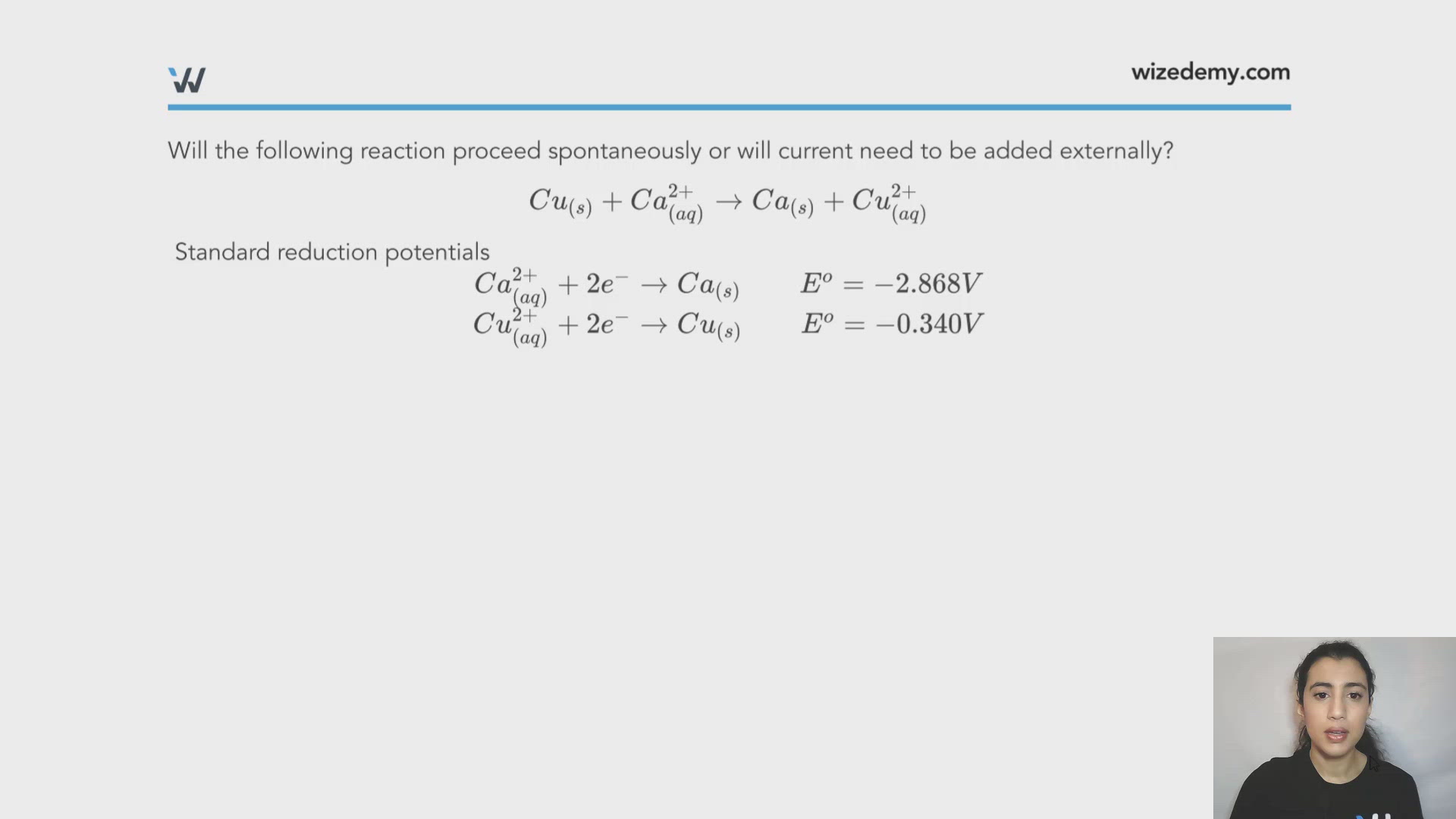
Will the following reaction proceed spontaneously or will current need to be added externally?
Standard reduction potentials
- For reaction 1: -2.868 V stays the same since that equation is not flipped.
- For reaction 2: we get 0.340 V since that equation is flipped according to the overall equation.
- For the Erxn = -2.868 + 0.340 = -2.528 (doing the full calculation isn't necessary since we just need to figure out the sign of E to tell us about the sign of G)
- We know E is negative now, so deltaG would be positive.
- The electromotive force (E) is negative so this reaction would be non-spontaneous. We would have to apply at least 2.528 V to force this reaction to proceed ie, current needs to be added externally.