Mass Spectrometry (MS)

Key Definitions
1. Mass/Charge Ratio – Weight of each ion fragment produced by ionization
2. Ion Abundance/Intensity – Amount of each ion produced (%)
3. Base Peak – Tallest peak in spectrum (most stable)
4. Molecular Ion – Peak of original starting compound
5. Isotope Peaks – Ions containing heavier isotopes (12C vs. 13C)
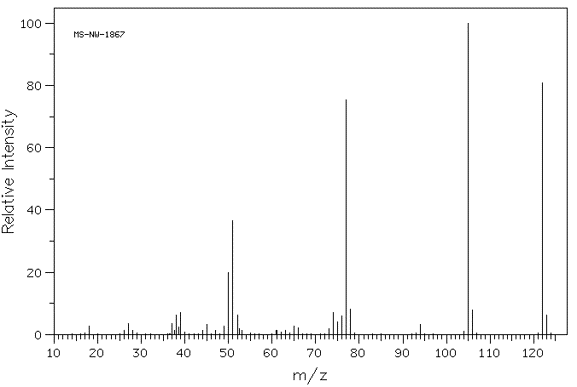
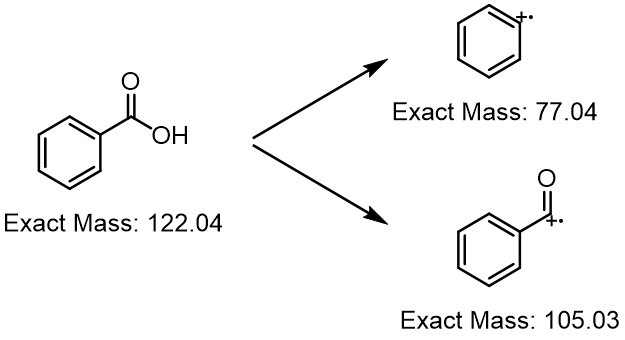
Mass Spectrum of Benzoic Acid
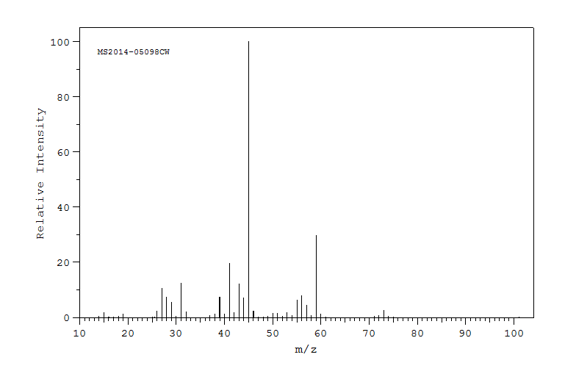
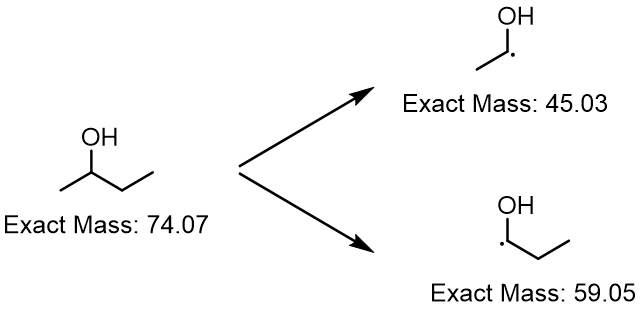
Mass Spectrum of an Alcohol - 2-propanol
Alcohol molecular ions are rarely observed, they rapidily fragment. The oxygen atom will stabilize the radical via resonance.
Isotopes in Mass Spectrometry
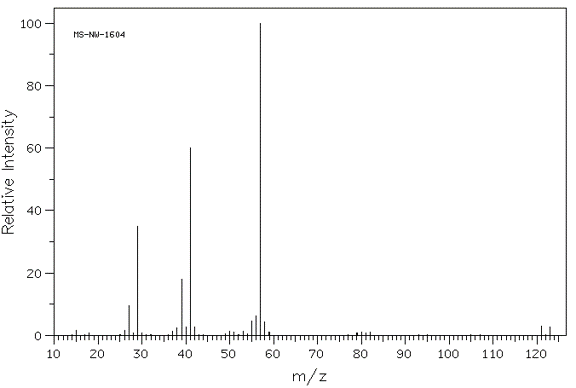
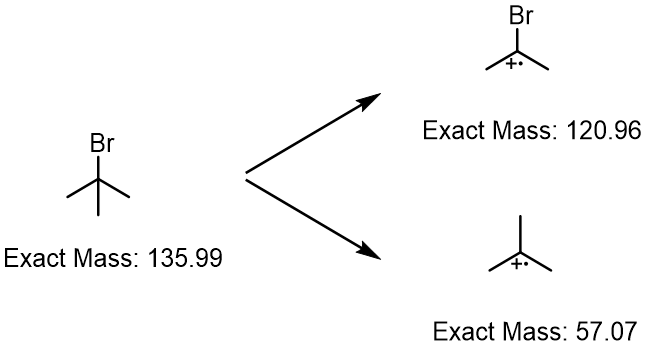
Different isotopes of atoms will be seen in a mass spectrum. In some cases, these isotope peaks are fairly large and can serve as diagnostic tools. For example, Boron, Chlorine and Bromine have very distinct isotope patterns.
Carbon: 12C (99%), 13C (1%)
Boron: 10B (20%), 11B (80%)
Chlorine: 35Cl (76%), 37Cl (24%)
Bromine: 79Br (51%), 81Br (49%)
Mass Spectrum of Tert-butyl Bromide
Using MS to determining # of Carbons
We can use MS to estimate the number of carbon atoms in a compound. It uses the ratio of the mass peak for the 13C isotope to the mass peak of the 12C isotope. The equation we use is as follows:
Max # of Carbons = [M+1]+/M+ x 100
We can explore this relationship looking at the MS spectrum of n-hexane:
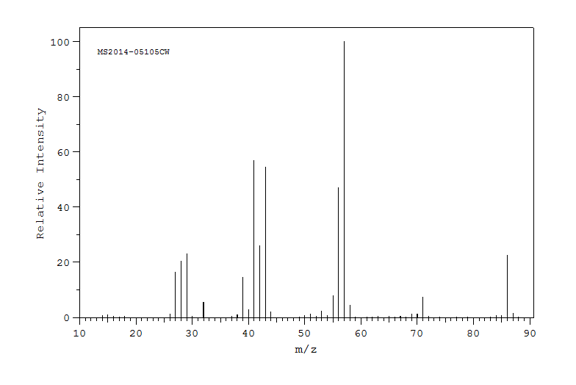
Peak, m/z (% abundance): M+, 86.0 (22.4); [M+1]+, 87.0 (1.4); [M-(C2H5)]+, 57.0 (100); [(M+1)-(C2H5)]+, 58.0 (4.4)

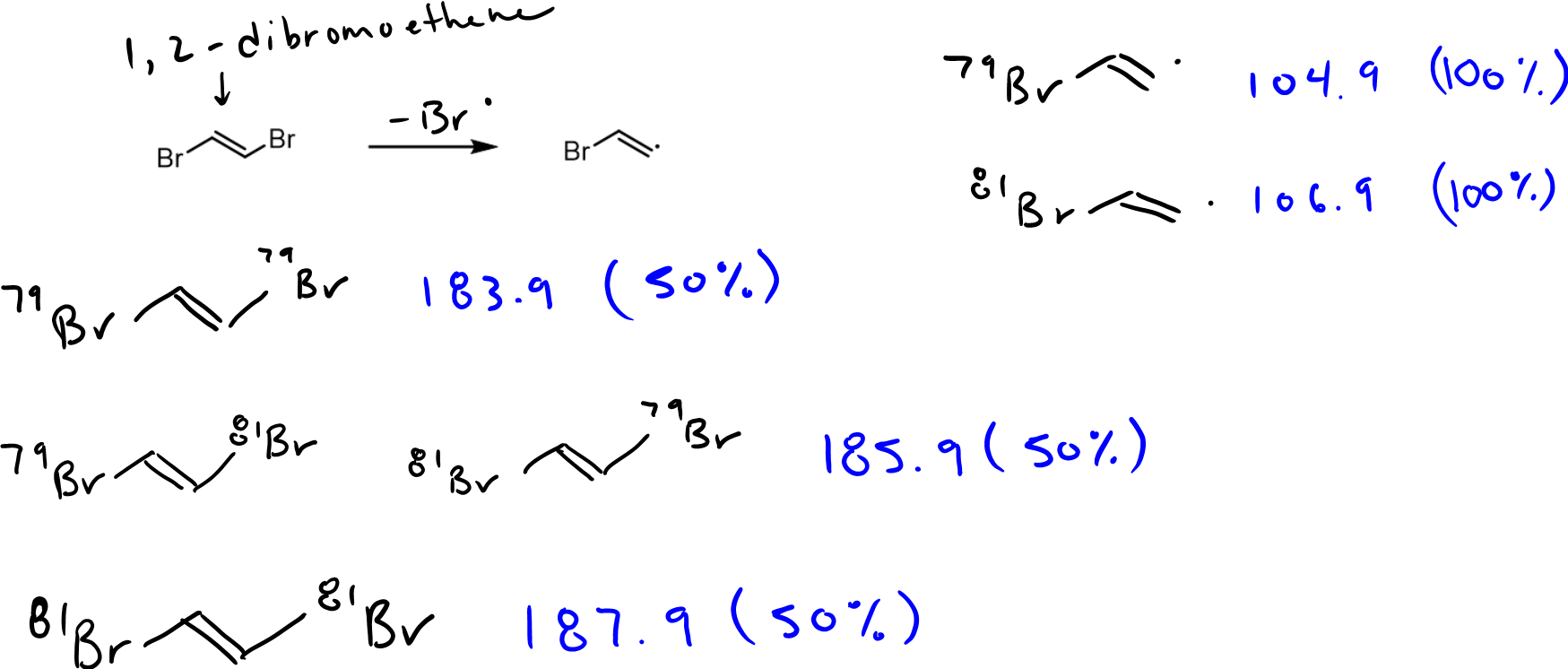
The mass spectrum of (E)-1,2-dibromoethene is shown below. Rationalize the major spectrum peaks at 187.9 (49%), 185.9 (100%), 183.9 (51%), 106.9 (97%), and 104.9 (100%)
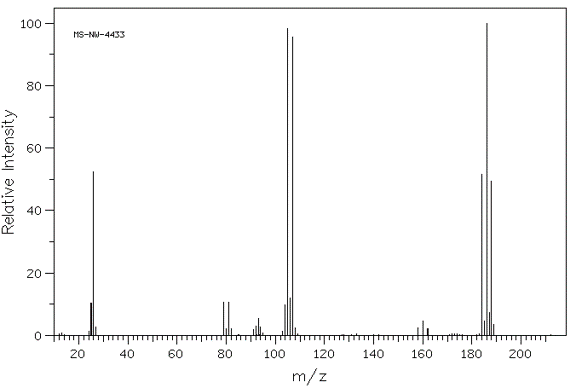
Carbon-halogen bonds will often cleave in a mass spectrometer because the bromide radical is stable. Bromide containing compounds often have a distinct isotope pattern, and multiple bromine atoms further complicate the spectrum:
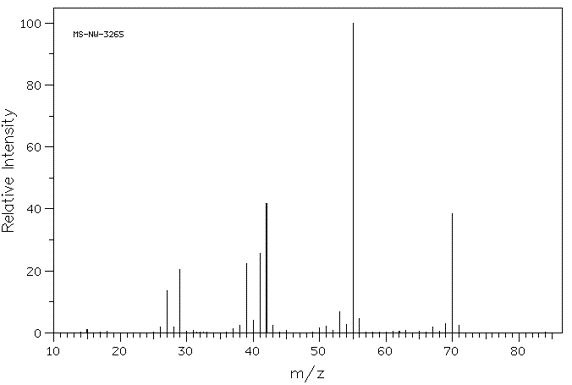
Below is the mass spectrum of 2-pentene. Label the molecular ion and base peak. Provide the structure of the base peak and rationalize its formation.

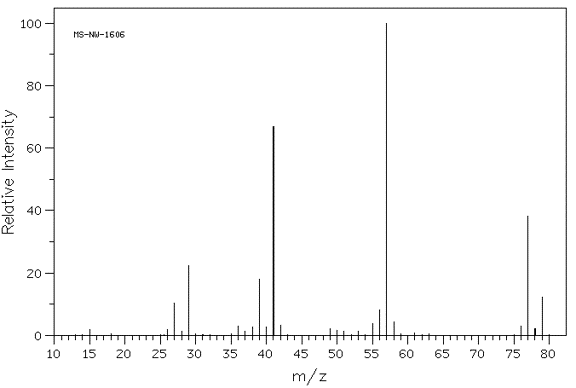
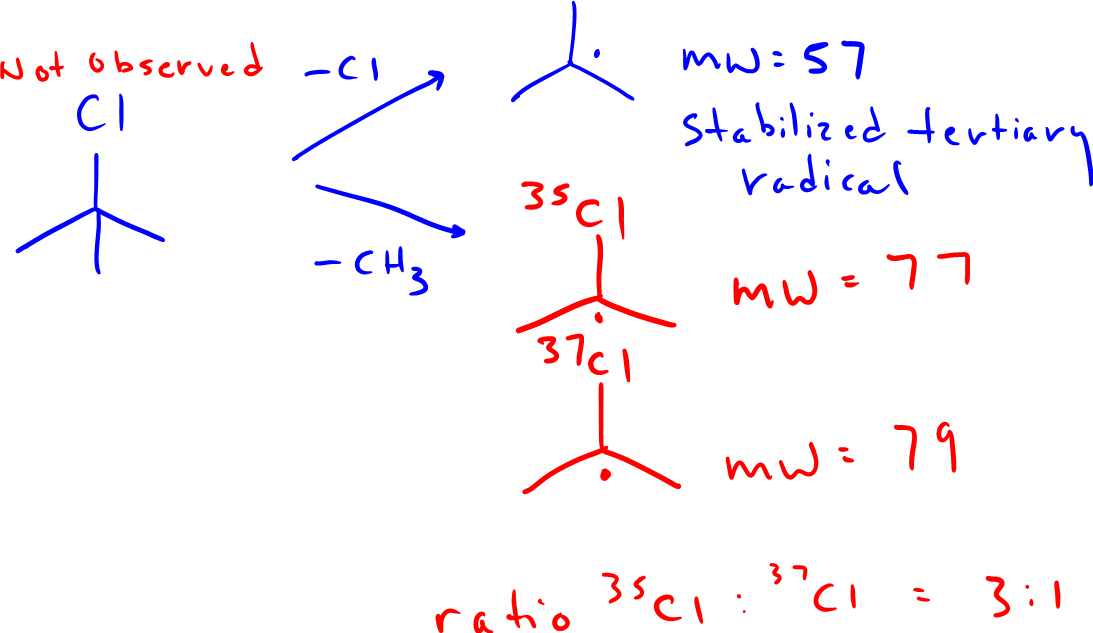
The mass spectrum of tert-butyl chloride (2-chloro-2-methylpropane) does not show it's molecular ion. There is three key diagnostic signals at m/z = 79, 77, and 57. What are the structures of the compounds that give rise to these signals (hint: be specific with any heteroatom isotopes).
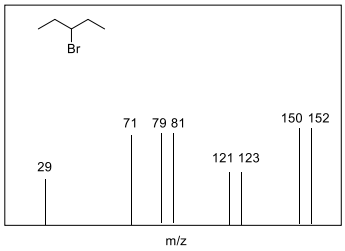
The Mass spectrum of 3-bromopentane is shown below. Explain what each of the labeled peaks represents. Note: 81Br and 79Br exist naturally in a 50:50 ratio