Create a free account to get started

Unlock full course notes by signing up

  • Video lessons taught by top educators
  • Practice questions with guided solutions
  • Written review notes for reference
  • Expert answers anytime from course tutors

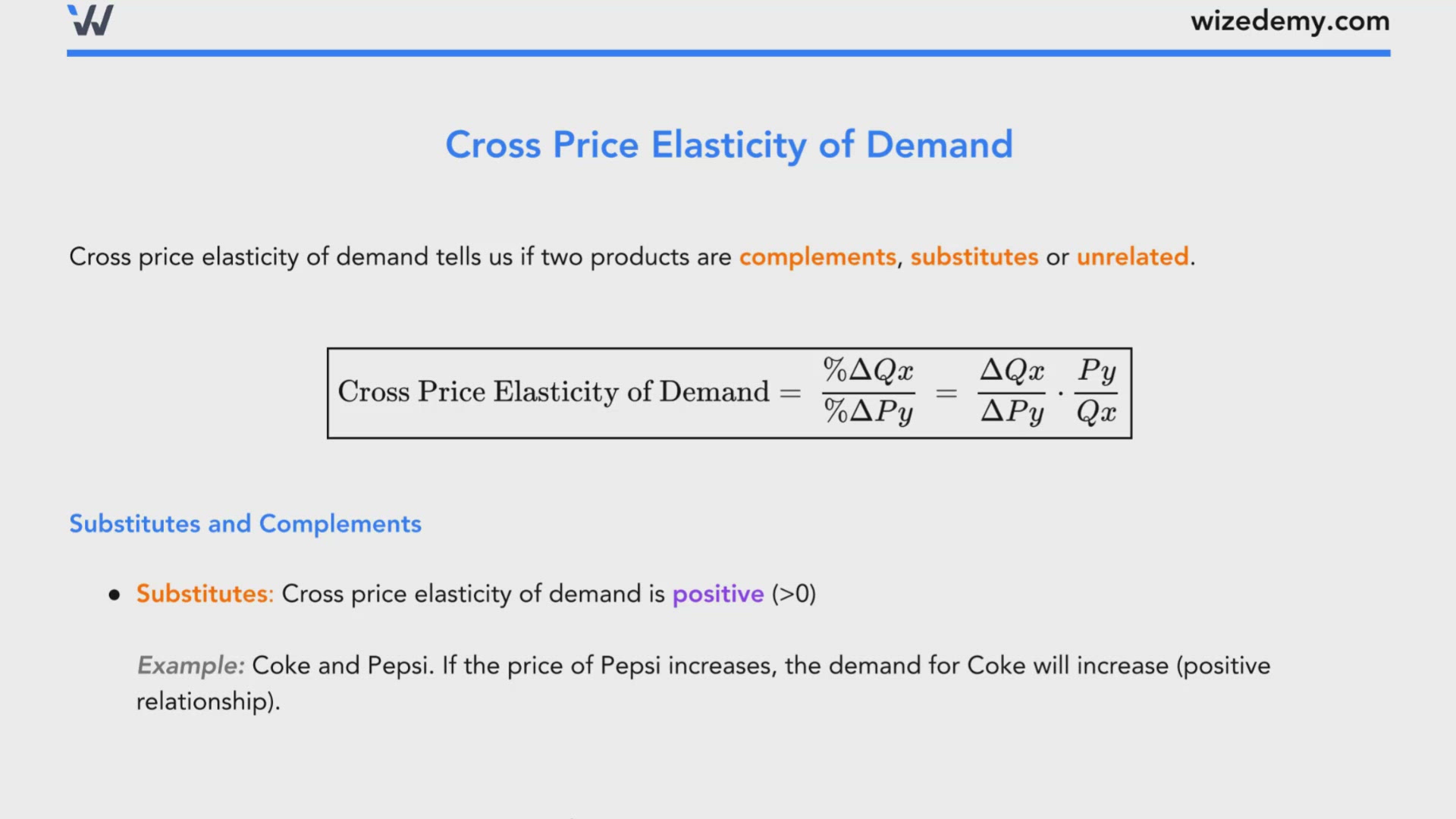
Cross Price Elasticity of Demand


Cross price elasticity of demand tells us if two products are complements, substitutes or unrelated.


Cross Price Elasticity of Demand= %ΔQx%ΔPy = ΔQxΔPy⋅PyQx\boxed{\text{Cross\ Price\ Elasticity\ of\ Demand} =\ \frac{\%ΔQx}{\%ΔPy}\ =\ \frac{ΔQx}{ΔPy}\cdot\frac{Py}{Qx}}


Substitutes and Complements

  • Substitutes: Cross price elasticity of demand is positive (>0) Example: Coke and Pepsi. If the price of Pepsi increases, the demand for Coke will increase (positive relationship).
  • Complements: Cross price elasticity of demand is negative (<0) Example: Cars and gas. If the price of cars increase, the demand for gas will decrease (negative relationship).
  • Unrelated Products: Cross price elasticity of demand is equal to zero. Example: Cars and oranges. If the price of cars increase, it will have no effect on the demand for oranges (no relationship).


Create a free account to get started

Unlock full course notes by signing up

  • Video lessons taught by top educators
  • Practice questions with guided solutions
  • Written review notes for reference
  • Expert answers anytime from course tutors

Example: Cross Price Elasticity of Demand

The table below shows information about lemonade and cola:

Image illustrating Example: Cross Price Elasticity of Demand

a) What is the arc cross price elasticity of demand for lemonade with respect to the price of cola?


Arc Cross Price Elasticity of Demand= Average %ΔQxAverage %ΔPy\text{Arc Cross Price Elasticity of Demand}=\ \frac{Average\ \%ΔQx}{Average\ \%ΔPy}


The table only gives us quantity of lemonade so that means lemonade it good X and cola is good Y.


The price of cola only changes from 2015 to 2016 so those are the only two years we will look at.


Average % ΔQx (lemonade)=(New−Old)Average⋅100 = (25000−15000)20000⋅100 = 50%Average\ \%\ ΔQx\ \left(lemonade\right)=\frac{\left(New-Old\right)}{Average}\cdot100\ =\ \frac{\left(25000-15000\right)}{20000}\cdot100\ =\ 50\%


Average % ΔP (Cola)=(New−Old)Average⋅100 = (1.4−1)1.2⋅100 = 33.33%Average\ \%\ ΔP\ \left(Cola\right)=\frac{\left(New-Old\right)}{Average}\cdot100\ =\ \frac{\left(1.4-1\right)}{1.2}\cdot100\ =\ 33.33\%


Arc Cross Price Elasticity of Demand= Average % ΔQxAverage % ΔPy= 50%33.33%=1.5\text{Arc Cross Price Elasticity of Demand}=\ \frac{Average\ \%\ ΔQx}{Average\ \%\ ΔPy}=\ \frac{50\%}{33.33\%}=1.5


This means cola and lemonade are substitutes because the cross price elasticity is positive.


Practice: Cross Price Elasticity of Demand

The price of peaches at a market rises from $3.95 to $4.05 per kilo, and as a result the quantity of plums that consumers purchase increases from 4950 to 5050 kilos per week. The arc cross-price elasticity is

Choose an answer

Create a free account to get started

Unlock full course notes by signing up

  • Video lessons taught by top educators
  • Practice questions with guided solutions
  • Written review notes for reference
  • Expert answers anytime from course tutors