Create a free account to get started

Unlock full course notes by signing up

  • Video lessons taught by top educators
  • Practice questions with guided solutions
  • Written review notes for reference
  • Expert answers anytime from course tutors

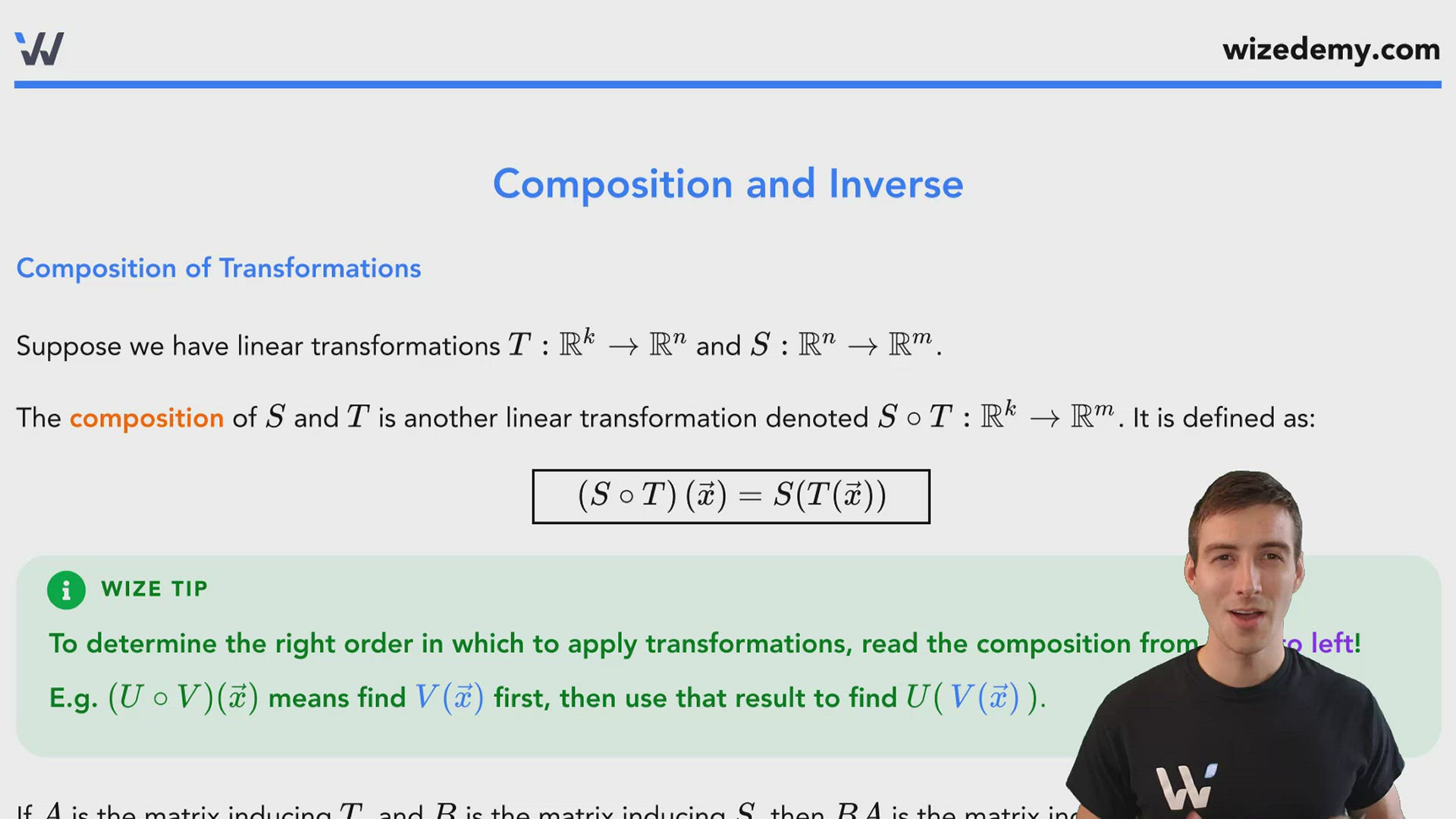
Composition and Inverse

Composition of Transformations

Suppose we have linear transformations T:Rk→RnT:\mathbb{R}^k\to\mathbb{R}^n and S:Rn→RmS:\mathbb{R}^n\to\mathbb{R}^m.

The composition of SS and TT is another linear transformation denoted S∘T:Rk→RmS \circ T: \reals^k \to \reals^m. It is defined as:

(S∘T)(x⃗)=S(T(x⃗))\boxed{\quad \left(S\circ T\right)(\vec{x})=S(T(\vec{x})) \quad}


If AA is the matrix inducing TT, and BB is the matrix inducing SS, then BABA is the matrix inducing S∘TS\circ T:

(S∘T)(x⃗)=S(T(x⃗))=B(Ax⃗)=(BA)x⃗\begin{aligned} \left(S\circ T\right)(\vec{x}) &=S(T(\vec{x})) \\[0.3em] &=B(A\vec{x}) \\[0.3em] &= (BA)\vec{x} \end{aligned}

Inverse of a Linear Transformation

Suppose T:Rn→RnT:\mathbb{R}^n\to\mathbb{R}^n and S:Rn→RnS:\mathbb{R}^n\to\mathbb{R}^n are linear transformations.

We say that SS and TT are inverses of one another if, for every x⃗∈Rn\vec{x}\in \reals^n:

(S∘T)(x⃗)=x⃗(S\circ T)(\vec{x})=\vec{x} and (T∘ S)(x⃗)=x⃗(T\circ\ S)(\vec{x})=\vec{x}


Matrix Form of the Inverse Transformation

If AA is the matrix inducing TT, then TT has an inverse transformation if and only if AA is invertible.

The inverse is unique and denoted by T−1:Rn→RnT^{-1}:\mathbb{R}^n\to\mathbb{R}^n , and is induced by the matrix A−1A^{-1}.

Create a free account to get started

Unlock full course notes by signing up

  • Video lessons taught by top educators
  • Practice questions with guided solutions
  • Written review notes for reference
  • Expert answers anytime from course tutors

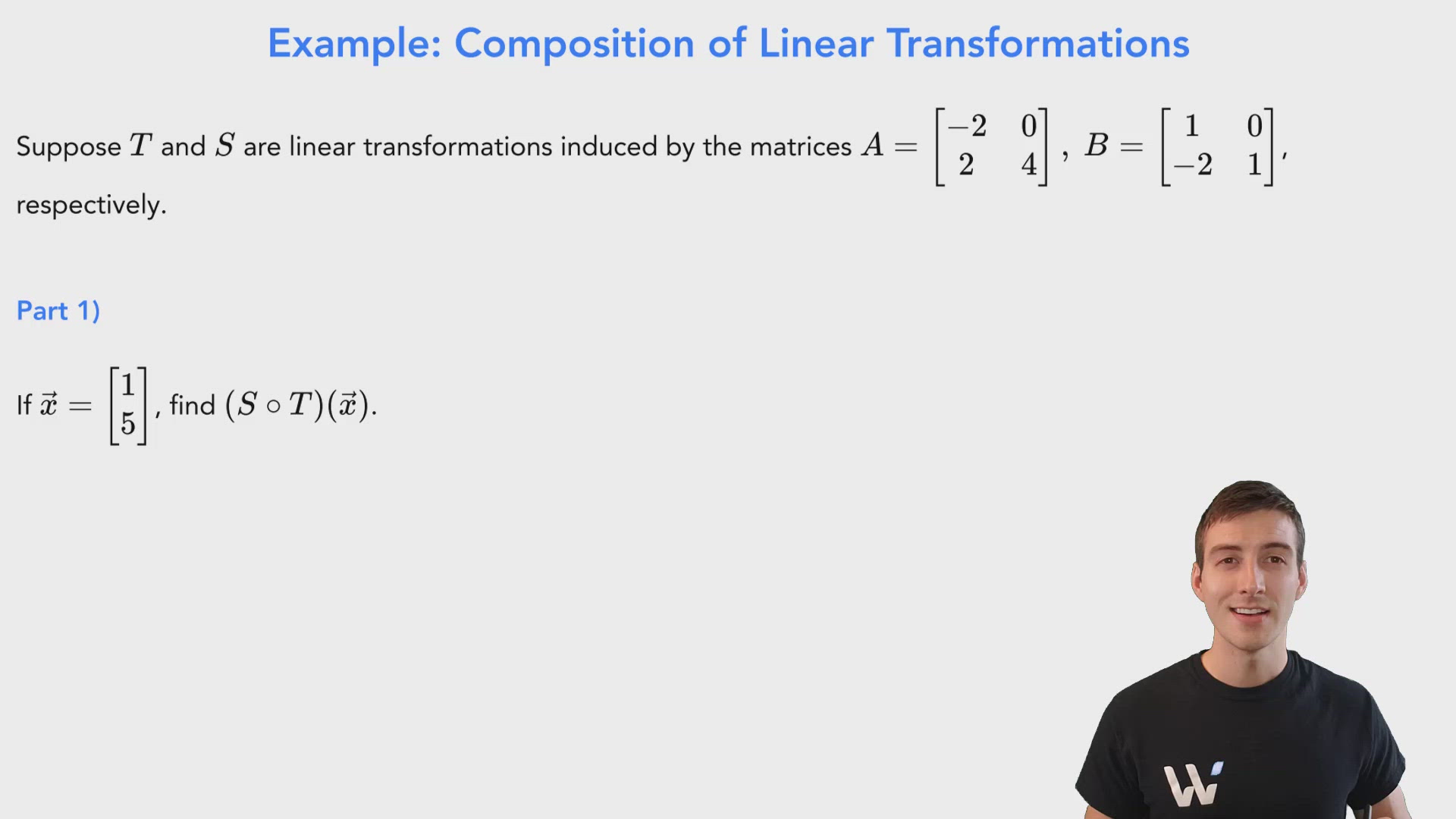
Example: Composition of Linear Transformations

Suppose TT and SS are linear transformations induced by the matrices A=[−2024], B=[10−21]A= \begin{bmatrix} -2&0\\ 2&4 \end{bmatrix}, \ B= \begin{bmatrix} 1&0\\ -2&1 \end{bmatrix}, respectively.

Part 1)

If x⃗=[15]\vec{x}= \begin{bmatrix} 1\\ 5 \end{bmatrix}, find (S∘T)(x⃗)(S \circ T)(\vec{x}).

(S∘T)(x⃗)=BAx⃗=[10−21][−2024][15]=[−2064][15]=[−226]\begin{aligned} (S \circ T)(\vec x) &= BA\vec x\\[0.3em] &= \begin{bmatrix} 1&0\\ -2&1 \end{bmatrix} \begin{bmatrix} -2&0\\ 2&4 \end{bmatrix} \begin{bmatrix} 1\\ 5 \end{bmatrix}\\[1.5em] &= \colorTwo{ \begin{bmatrix} -2&0\\ 6&4 \end{bmatrix}} \begin{bmatrix} 1\\ 5 \end{bmatrix}\\[1.5em] &= \boxed{ \begin{bmatrix} -2\\ 26 \end{bmatrix}} \end{aligned}

Note that AB=[−2064]AB= \colorTwo{ \begin{bmatrix} -2&0\\ 6&4 \end{bmatrix}} is the matrix that induces S∘TS \circ T.

Part 2)

Find the matrix inducing T∘S−1T \circ S^{-1}.

Since SS is induced by the matrix BB, S−1S^{-1} must be induced by B−1B^{-1}.

B=[10−21]  ⟹  B−1 = [1−0−(−2)1] = [1021]B= \begin{bmatrix} \colorOne1 & 0\\ -2 & \colorTwo1 \end{bmatrix} \quad\implies\quad B^{-1} \ =\ \begin{bmatrix} \colorTwo1& \colorFour{-}0\\ \colorFour{-}(-2) & \colorOne1 \end{bmatrix} \ =\ \begin{bmatrix} 1 & 0\\ 2 &1 \end{bmatrix}

We know that for any vector x⃗∈R2\vec x \in \reals^2:

(T∘S−1)(x⃗)=T( S−1(x⃗) )=T(B−1x⃗)=AB−1x⃗(T \circ S^{-1})(\vec x) = T(\, S^{-1}(\vec x)\, ) = T(B^{-1}\vec x) = AB^{-1}\vec x

Therefore, the matrix inducing T∘S−1T \circ S^{-1} is given by AB−1AB^{-1}:

AB−1=[−2024][1021]=[−20104]AB^{-1} = \begin{bmatrix} -2&0\\ 2&4 \end{bmatrix} \begin{bmatrix} 1 & 0\\ 2 & 1 \end{bmatrix} = \boxed{ \begin{bmatrix} -2&0\\ 10&4 \end{bmatrix} }

Practice: Composition of Linear Transformations

Let T:R2→R3T:\mathbb{R}^2\to\mathbb{R}^3 be a linear transformation defined by T[xy]=[x+y3yx+2y]T\begin{bmatrix}x\\y\end{bmatrix}=\begin{bmatrix}x+y\\3y\\x+2y\end{bmatrix}.

Let S:R2→R2S:\reals^2 \to \reals^2 be the linear transformation induced by the matrix B=[1101]B= \left[ \begin{array}{rrr} 1 & 1 \\ 0 & 1 \\ \end{array} \right].

Find the vector u⃗=[uv]\vec u = \begin{bmatrix} u\\ v \end{bmatrix} such that (T∘S−1)(u⃗)=[2−31](T\circ S^{-1})(\vec u) = \begin{bmatrix} 2\\ -3\\ 1 \end{bmatrix}.

Your answers

Create a free account to get started

Unlock full course notes by signing up

  • Video lessons taught by top educators
  • Practice questions with guided solutions
  • Written review notes for reference
  • Expert answers anytime from course tutors

Extra Practice