
Projection and Perpendicular
The projection of onto is denoted by and is obtained by calculating:
Notes
- The projection of onto is the "shadow" that casts onto
- is a scalar multiple of
- is also called the vector component of parallel to
The perpendicular of onto is denoted by and is obtained by calculating:
The perpendicular is the vector component of orthogonal to


Example: Projection
Let and .
Part A)
Find .
Part B)
Find .

Example: Projection and Perpendicular
Let .
Part A)
Sketch vectors and and guess whether is in the same direction or the opposite direction of .
Calculate to check your guess.
We can see that projecting onto will require us to extend in the opposite direction.
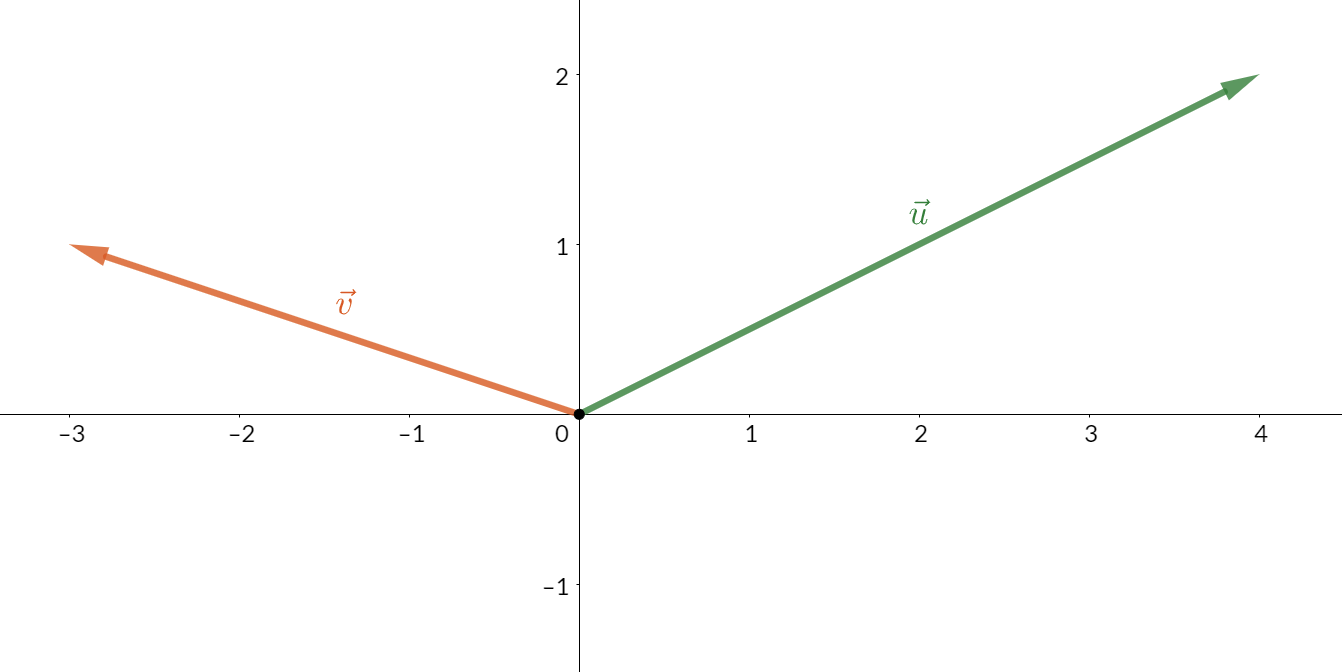
Since the scalar multiple of is negative , we have confirmed that is in the opposite direction of .
Part B)
Calculate .
We can use our answer from Part A):
So calculating is as simple as:
Notice that, as usual, this result is a position vector: if the vector were translated to start at the origin, it would go left 1 and up 2.
