Create a free account to get started

Unlock full course notes by signing up

  • Video lessons taught by top educators
  • Practice questions with guided solutions
  • Written review notes for reference
  • Expert answers anytime from course tutors

Derivatives of Trig Functions

We may often want to take derivatives involving the trigonometric functions. Rather than deriving them each time, it's much easier to simply remember the following derivatives.

Trig Derivatives

The derivatives of the six trigonometric functions are:

(sin⁡x)′=cos⁡x          (cos⁡x)′=−sin⁡x(tan⁡x)′=sec⁡2x      (sec⁡x)′=sec⁡xtan⁡x(cot⁡x)′=−csc⁡2x(csc⁡x)′=−csc⁡xcot⁡x\begin{array}{c} \boxed{(\sin x)'=\cos x}\ \ \ \ \ \hspace{1 cm}\ \ \ \ \ \boxed{(\cos x)'=-\sin x } \\ \\ \boxed{(\tan x)'=\sec^{2} x} \ \ \ \ \ \ \qquad\boxed{(\sec x)'=\sec x\tan x} \\ \\ \boxed{ (\cot x)'=-\csc^{2}x}\qquad\boxed{(\csc x)'=-\csc x\cot x } \end{array}


Create a free account to get started

Unlock full course notes by signing up

  • Video lessons taught by top educators
  • Practice questions with guided solutions
  • Written review notes for reference
  • Expert answers anytime from course tutors

Example: Trig Derivatives


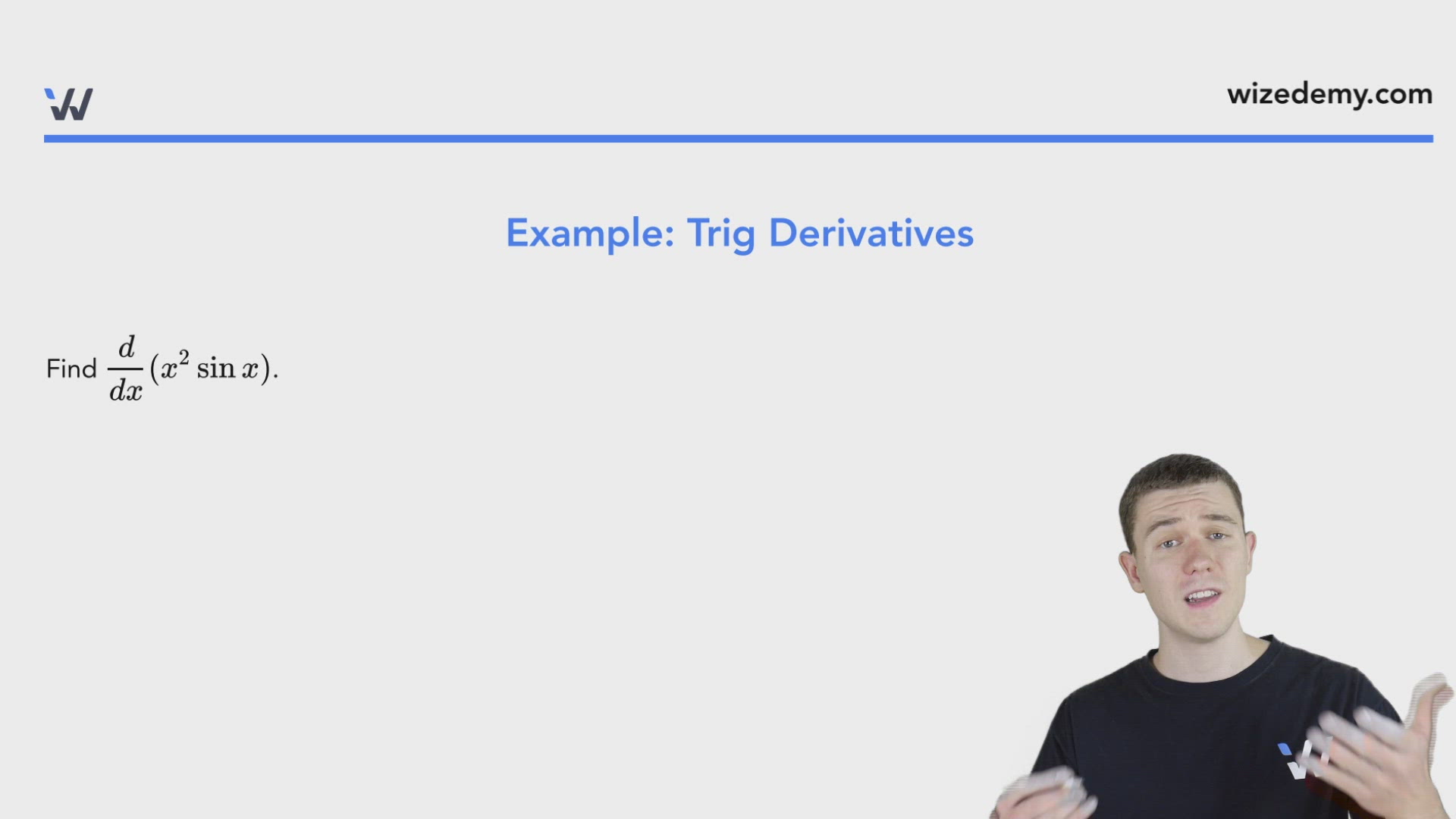
Find ddx(x2sin⁡x)\displaystyle\frac{d}{dx}(x^2\sin{x}).


ddx(x2sin⁡x)\displaystyle \frac{d}{dx}(x^2\sin{x})

=(ddxx2)×sin⁡x+x2×(ddxsin⁡x)\displaystyle =(\frac{d}{dx}x^2)\times\sin{x}+x^2\times(\frac{d}{dx}\sin{x})

=2xsin⁡x+x2cos⁡x\displaystyle =2x\sin{x}+x^2\cos{x}

Create a free account to get started

Unlock full course notes by signing up

  • Video lessons taught by top educators
  • Practice questions with guided solutions
  • Written review notes for reference
  • Expert answers anytime from course tutors

Example: Trig Derivatives

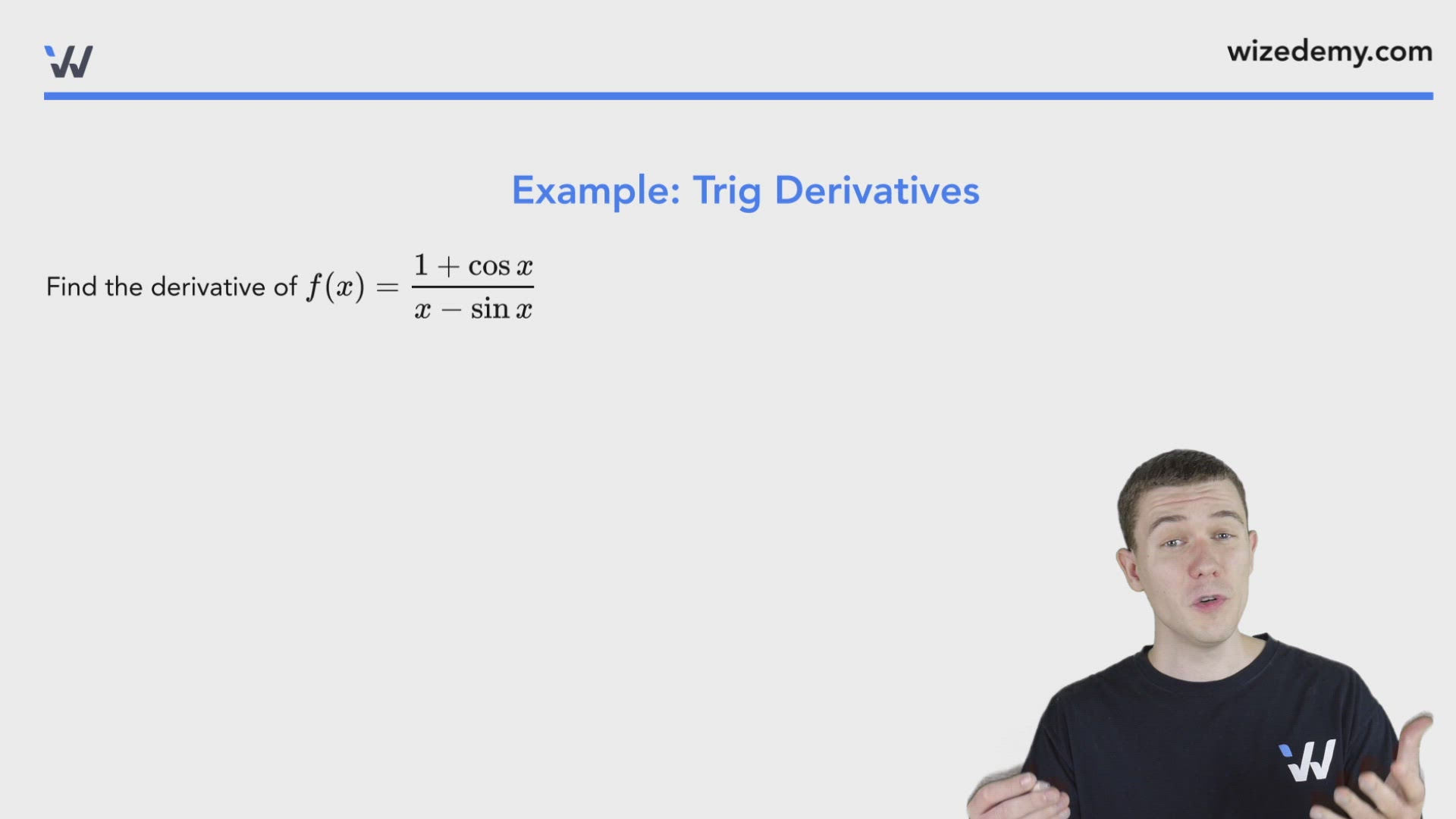
Find the derivative of f(x)=1+cos⁡xx−sin⁡x\displaystyle f(x)=\frac{1+\cos x}{x-\sin x}


f(x)=y=1+cos⁡xx−sin⁡x\displaystyle f(x)=y=\frac{1+\cos x}{x-\sin x}


Quotient rule:


y′=−sin⁡x(x−sin⁡x)−(1+cos⁡x)(1−cos⁡x)(x−sin⁡x)2y'=\dfrac{-\sin x(x-\sin x)-(1+\cos x)(1-\cos x)}{(x-\sin x)^2}


=−xsin⁡x+sin⁡2x−1+cos⁡2x(x−sin⁡x)2=\dfrac{-x\sin x+\sin ^2x-1+\cos ^2x}{(x-\sin x)^2}


=−xsin⁡x(x−sin⁡x)2=-\dfrac{x\sin x}{(x-\sin x)^2}

Create a free account to get started

Unlock full course notes by signing up

  • Video lessons taught by top educators
  • Practice questions with guided solutions
  • Written review notes for reference
  • Expert answers anytime from course tutors

Example: Trig Derivatives

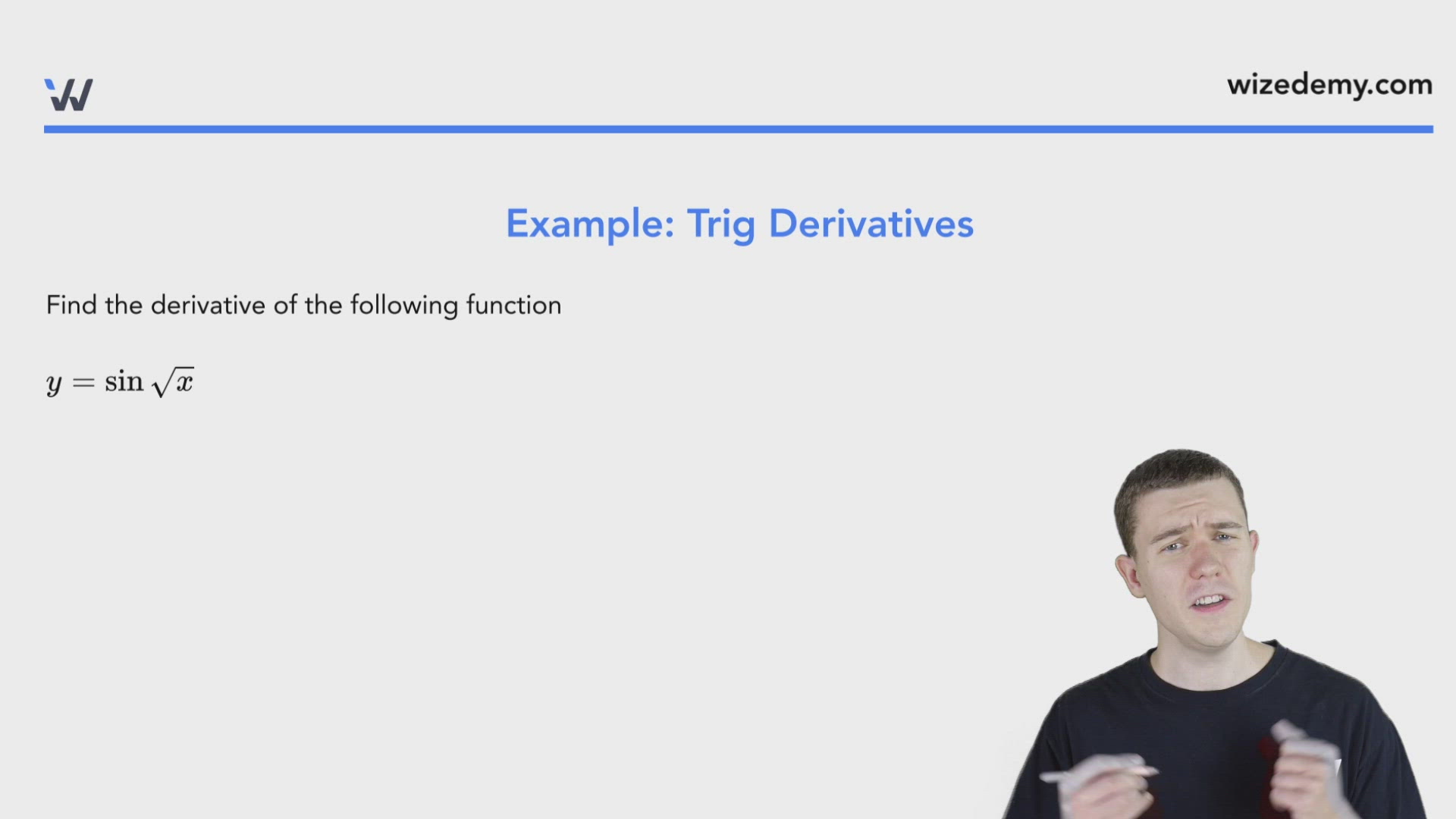
Find the derivative of the following function


y=sin⁡xy=\sin\sqrt{x}


The outside function is f(x)=sin⁡(x)f(x)=\sin (x) and the inside function is g(x)=x=x−12g(x)=\sqrt{x}=x^{-\frac{1}{2}}.


The chain rule tells us that the derivative is the derivative of the outside function (keeping the inside the same), times the derivative of the inside function:

y′=f′(g(x))×g′(x)y'=f'\left(g\left(x\right)\right)\times g'\left(x\right)

y′=cos⁡(x)×12x−12\displaystyle y'=\cos\left(\sqrt{x}\right)\times\frac{1}{2}x^{-\frac{1}{2}}


Simplifying:

y′=cos⁡(x)2x\displaystyle y'=\frac{\cos\left(\sqrt{x}\right)}{2\sqrt{x}}

Find the derivative of


f(θ)=(sin⁡θ−cos⁡θ)sec⁡θ\displaystyle f(\theta)=(\sin\theta-\cos\theta)\sec\theta


Choose an answer

Create a free account to get started

Unlock full course notes by signing up

  • Video lessons taught by top educators
  • Practice questions with guided solutions
  • Written review notes for reference
  • Expert answers anytime from course tutors

Find y(23)y^{(23)} , the 23rd derivatives, given y=sin⁡x\displaystyle y=\sin x.


Choose an answer

Create a free account to get started

Unlock full course notes by signing up

  • Video lessons taught by top educators
  • Practice questions with guided solutions
  • Written review notes for reference
  • Expert answers anytime from course tutors

Extra Practice