Popular Courses
MATH 211
University of Calgary
MATH 1229A/B
Western University
Linear Algebra
University Study Guides
MATH 152
University of British Columbia
Linear Algebra
General Course
MAT188H1
University of Toronto
Linear Algebra
University Study Guides
MATH 115
University of Waterloo
MAT223H1
University of Toronto
MATH-1270
University of Windsor
MATH 1210
University of Manitoba
MATH 111
Queen's University
MATH 1104
Carleton University
MATH 136
University of Waterloo
MATH 1300
University of Manitoba
MATH 1107
Carleton University
ENGM 1041
Dalhousie University
MATH 114
University of Waterloo
MATH-1260
University of Windsor
MA-UY 2034
New York University
0:00 / 0:00
Hyperplanes
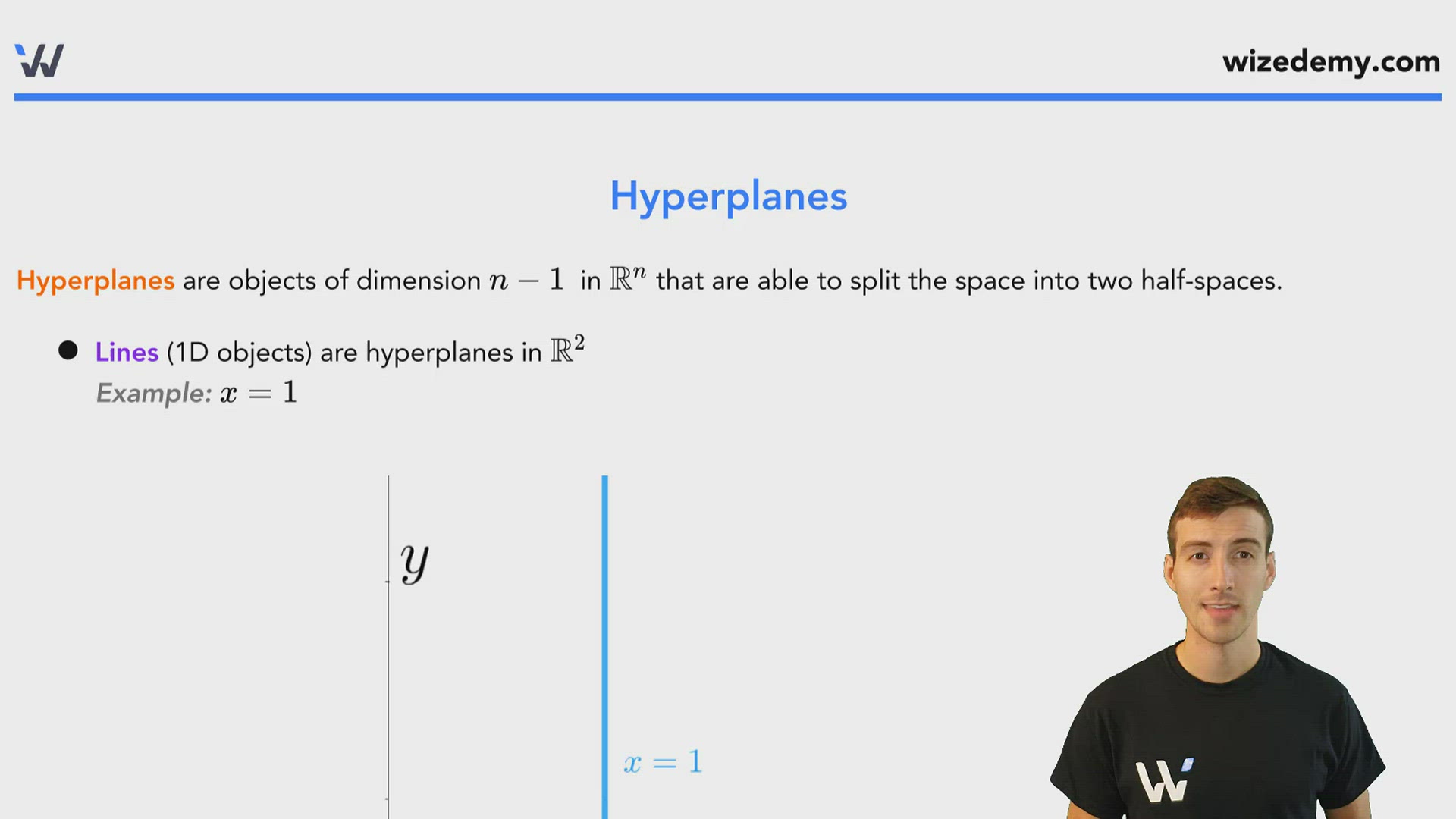
Hyperplanes are objects of dimension in that are able to split the space into two half-spaces.
- Lines (1D objects) are hyperplanes in Example:

- Planes (2D objects) are hyperplanes in Example:

Point-Normal Form
A general point on the hyperplane appears along with a known point on the hyperplane, , and a normal vector :
Standard Form
As before, we use a normal vector and a point on the hyperplane to compute :
Wize Tip
An equation in standard form always represents a hyperplane in .
0:00 / 0:00
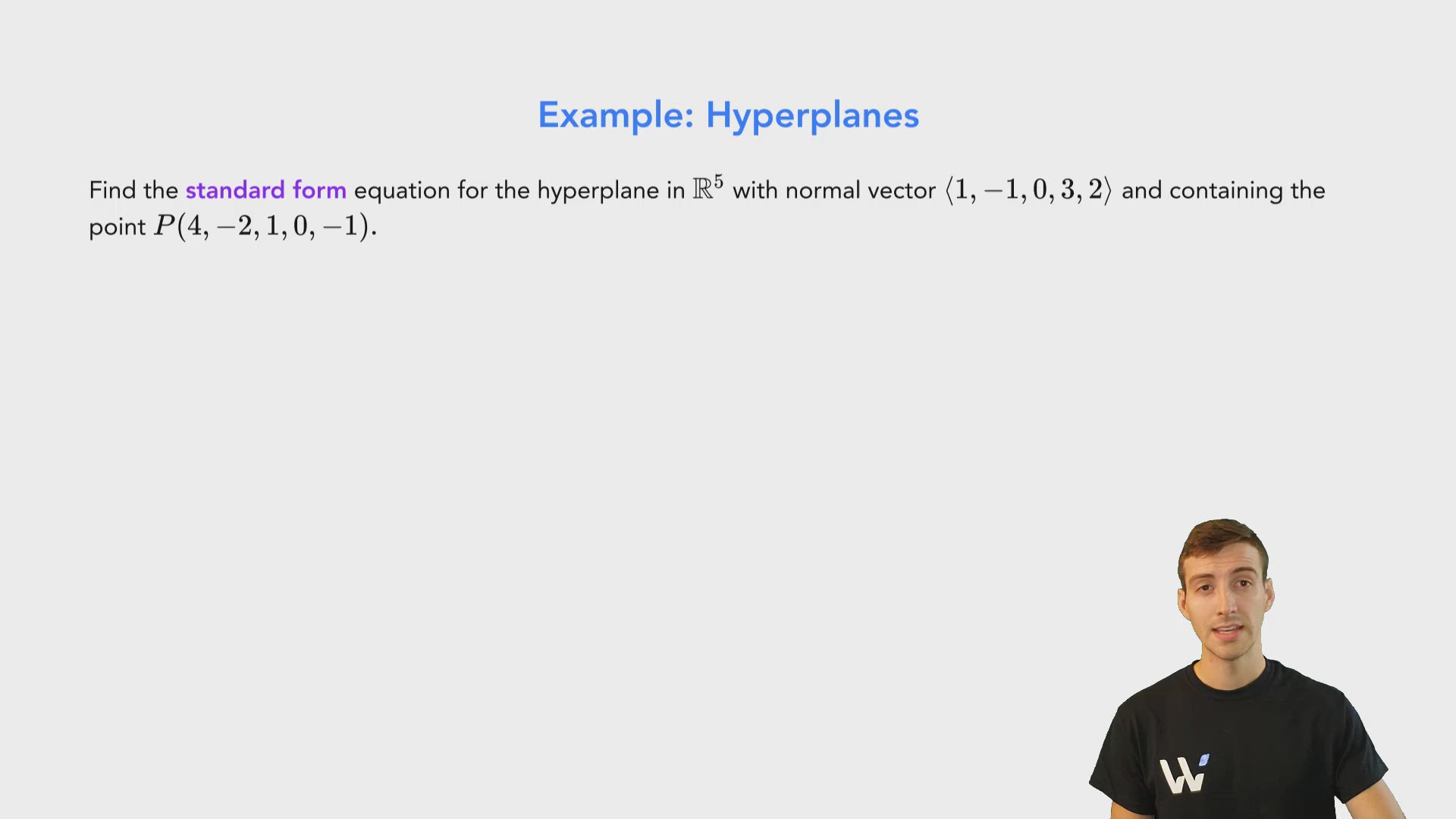
Example: Hyperplanes
Find the standard form equation for the hyperplane in with normal vector and containing the point
We have a normal vector and a known point on the hyperplane .
So, the standard form equation of the hyperplane in is:
Note: we can also written the point-normal form:
Practice: Hyperplanes
Determine if the following hyperplanes are orthogonal, parallel, or neither. [Answer with a single word]
Part A)
and
Part B)
and