Create a free account to get started

Unlock full course notes by signing up

  • Video lessons taught by top educators
  • Practice questions with guided solutions
  • Written review notes for reference
  • Expert answers anytime from course tutors

Resistance and Ohm's Law
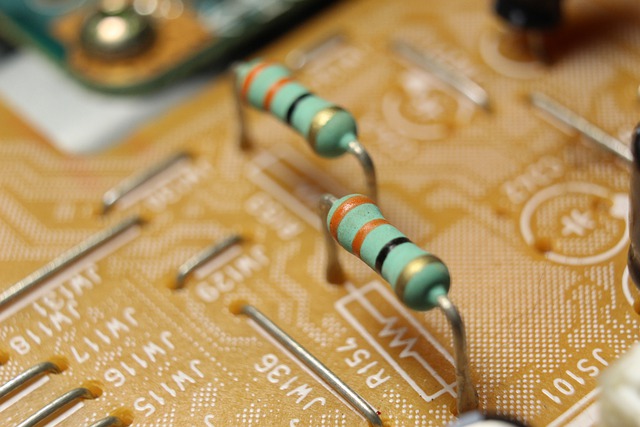

Image illustrating Resistance and Ohm's Law


The resistance of an object is a measure of how difficult it is for electrons to flow through it. It depends on the resistivity of the material the object is made of, as well as its geometry.


The resistance of a cylindrical wire is given by:

 R=ρ LA \boxed{\ R=\rho\ \dfrac{L}A\ }
  • ρ\rho is the resistivity of the material
  • LL is the length of the wire
  • AA is the cross-sectional area of the wire


NOTE: In our circuits the wires are usually ideal and have no resistance.


Ohm's Law states that the current flowing through an object is directly proportional to the potential difference across it (which gives the electrons their energy to push through), and inversely proportional to the resistance of that object (which slows down the electron flow):


 V=IR \boxed{\ V=IR \ }


  • VV is the potential difference (voltage) across the object
  • II is the current
  • RR is the resistance


Create a free account to get started

Unlock full course notes by signing up

  • Video lessons taught by top educators
  • Practice questions with guided solutions
  • Written review notes for reference
  • Expert answers anytime from course tutors

Example: Two Wires


In household wiring, you usually want wiring of different materials to have the same resistance per unit length.


What is the ratio of the diameters of aluminum and copper wires, so that they have the same resistance per unit length?


The resistivity of aluminum is 2.65×10−82.65\times10^{-8} Ωm, and the resistivity of copper is 1.72×10−81.72\times10^{-8}Ωm.


We can rearrange the resistance equation:


R=ρ LAR=\rho\ \dfrac{L}A


to get the resistance per unit length as:


RL=ρA\dfrac{R}{L}=\dfrac{\rho}A


This has to be the same for the two wires, so we have:


ρaluminumAaluminum=ρcopperAcopper\dfrac{\rho_{aluminum}}{A_{aluminum}}=\dfrac{\rho_{copper}}{A_{copper}}


ρaluminumπ raluminum2=ρcopperπ rcopper2\dfrac{\rho_{aluminum}}{\pi \ r_{aluminum}^2}=\dfrac{\rho_{copper}}{\pi \ r_{copper}^2}


raluminum2rcopper2=ρaluminumρcopper\dfrac{r_{aluminum}^2}{r_{copper}^2}=\dfrac{\rho_{aluminum}}{\rho_{copper}}


raluminumrcopper=ρaluminumρcopper\dfrac{r_{aluminum}}{r_{copper}}=\sqrt\dfrac{\rho_{aluminum}}{\rho_{copper}}


=2.651.72=1.24=\sqrt\dfrac{2.65}{1.72}=1.24


Practice: Ohm's Law

A 1.01.0 m long wire of an unknown material with a cross section of 3.03.0 mm2 was observed to produce a current of 2.02.0 A when a potential difference of 100.0100.0 V was applied across its ends. Find the conductivity of the material.


Your answers

Create a free account to get started

Unlock full course notes by signing up

  • Video lessons taught by top educators
  • Practice questions with guided solutions
  • Written review notes for reference
  • Expert answers anytime from course tutors