Wize University Physics Textbook (Master) > DC Circuits
Temperature Dependent Resistors
Popular Courses
MCAT
General Course
PHYSICS 1202A/B
Western University
PHYSICS 1E03
McMaster University
PHYS*1300
University of Guelph
APSC 112
Queen's University
PHYSICS 1402A/B
Western University
PHYS 205
Concordia University
PHYS 118
University of British Columbia
PHYS 142
McGill University
ENGG 212
University of Calgary
PHY132H1
University of Toronto
PHY132H1
University of Toronto
PHYS-1300
University of Windsor
PHY 1121
University of Ottawa
PHYS 121
University of Waterloo
PHYSICS 1102A/B
Western University
PHYS 227
University of Calgary
SC/PHYS 2020 3.00
York University
PHYS 116
Queen's University
PHY 9B
University of California - Davis
0:00 / 0:00
Temperature Dependent Resistors
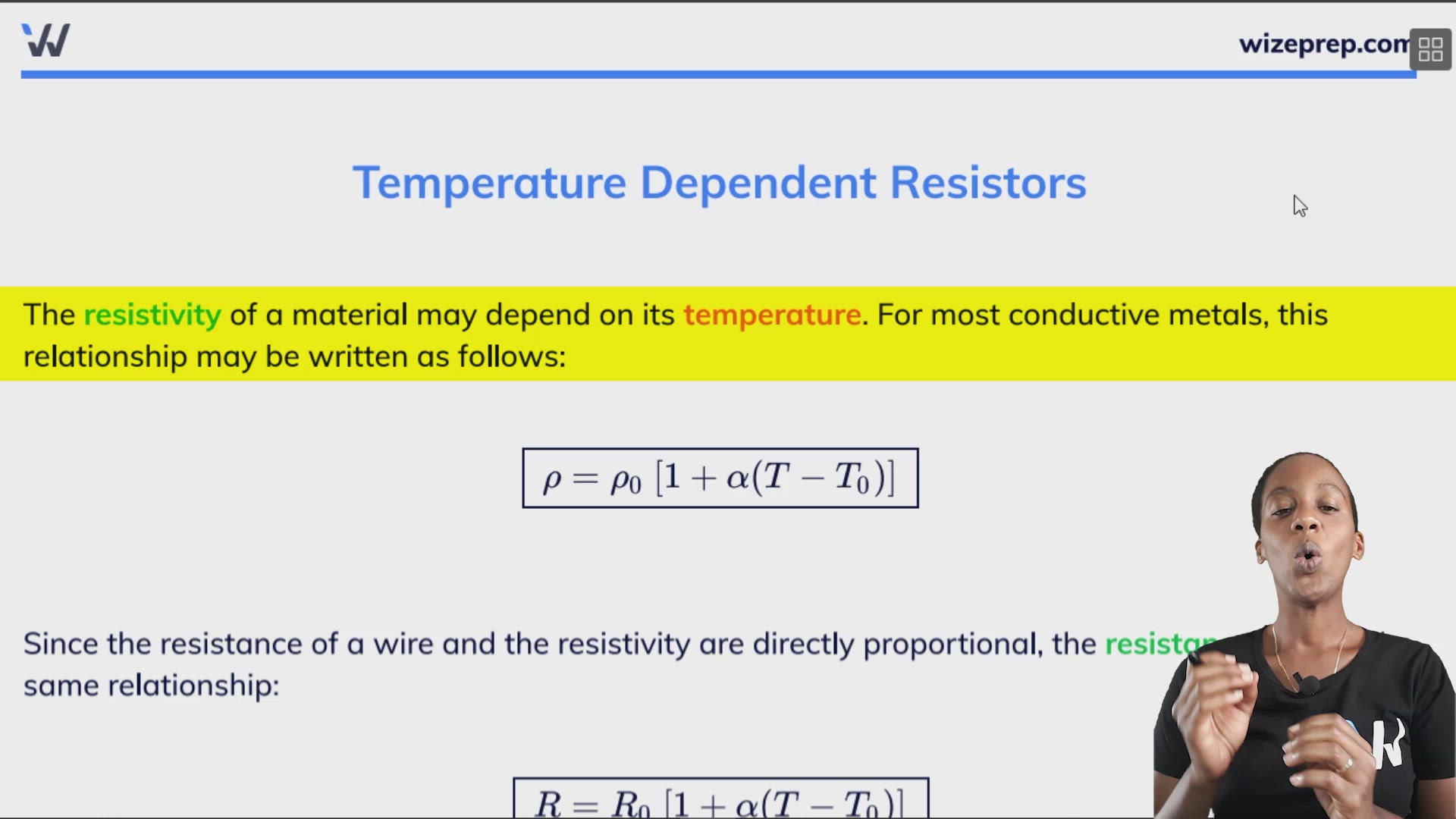
The resistivity of a material may depend on its temperature. For most conductive metals, this relationship may be written as follows:
Since the resistance of a wire and the resistivity are directly proportional, the resistance follows the same relationship:
- and are the resistivity and resistance
- is the temperature
- and and the reference resistivity and resistance at the reference temperature
- is the temperature coefficient (specific to the material)
Some materials have a resistivity that actually becomes exactly zero below a certain temperature. These are called superconductors. Currents in a superconductor (called supercurrents) can flow forever without dissipation.
0:00 / 0:00
Example: Silver Wire
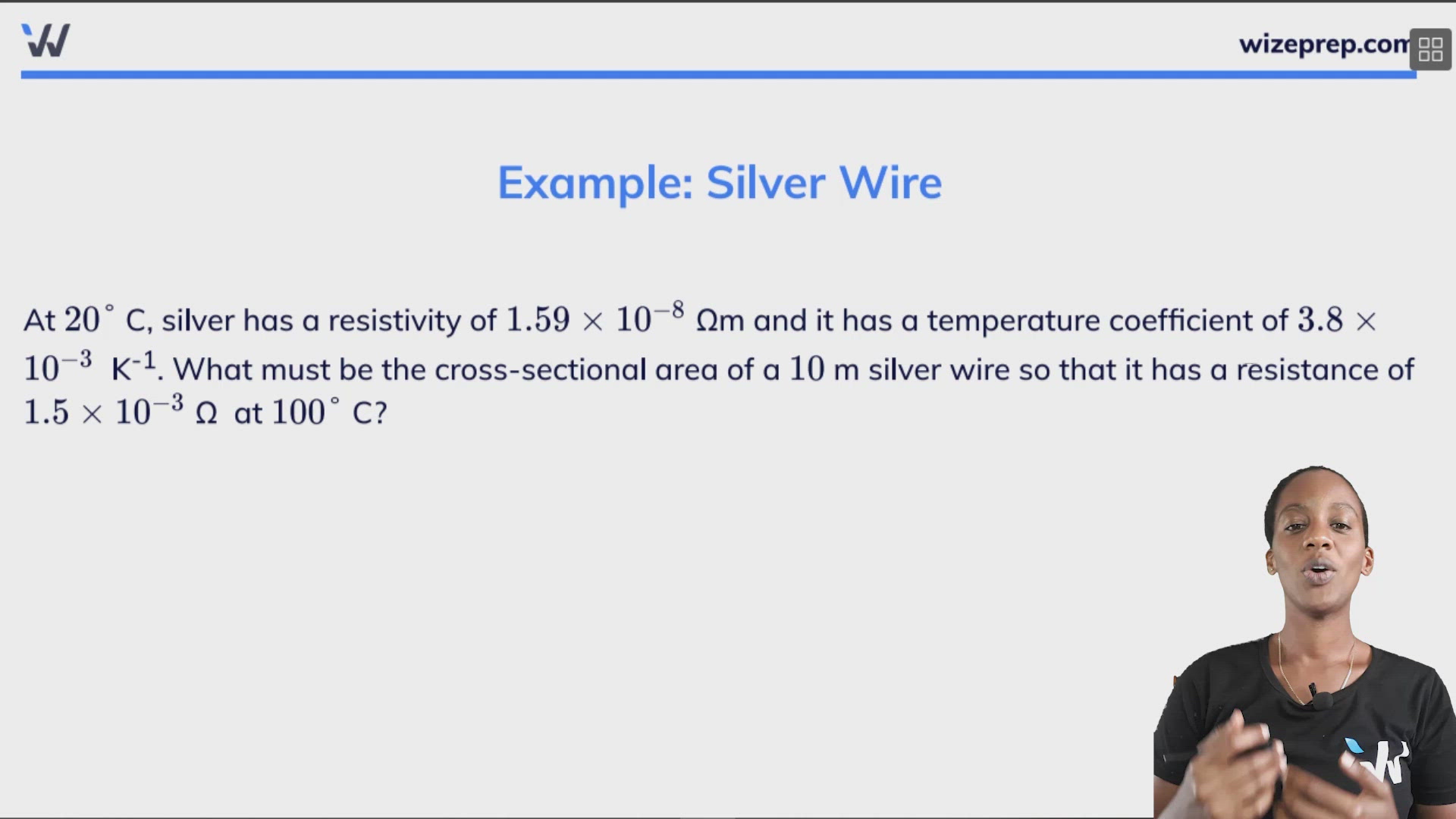
At C, silver has a resistivity of Ωm and it has a temperature coefficient of K-1. What must be the cross-sectional area of a m silver wire so that it has a resistance of Ω at C?
Let's use the temperature-dependent resistivity equation:
Combine it with the resistance of a wire:
So we get:
Isolate the area:
(m2)
Practice: Tungsten Filament
At C, you want a tungsten filament (in a light bulb) to have a resistance of Ω. The filament has a diameter of mm. What should be the length of this filament? Answer in millimeters.
The resistivity of tungsten is Ωm at C, and it is Ωm at C.