Wize University Physics Textbook (Master) > DC Circuits
Resistance and Ohm's Law
Popular Courses
MCAT
General Course
PHYSICS 1202A/B
Western University
PHYSICS 1E03
McMaster University
PHYS*1300
University of Guelph
PHYS 223
University of Calgary
APSC 112
Queen's University
PHYSICS 1402A/B
Western University
PHYS 205
Concordia University
PHYS 110
University of Victoria
PHYS 118
University of British Columbia
PHYS 142
McGill University
ENGG 212
University of Calgary
PHY132H1
University of Toronto
PHY132H1
University of Toronto
PHYS-1300
University of Windsor
PHY 1121
University of Ottawa
PHYS 121
University of Waterloo
PHYSICS 1102A/B
Western University
PHYS 227
University of Calgary
SC/PHYS 2020 3.00
York University
0:00 / 0:00
Resistance and Ohm's Law

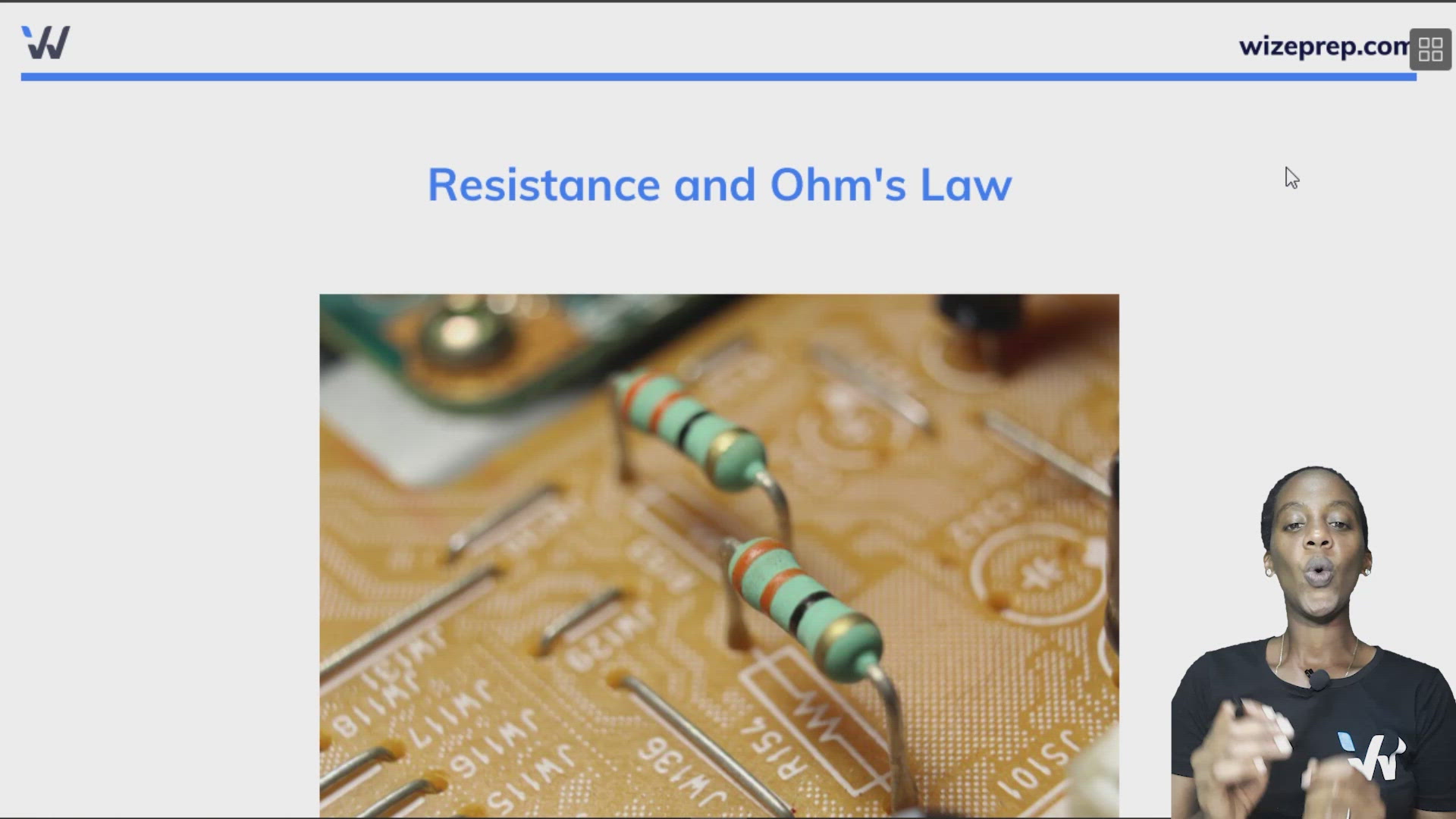
The resistance of an object is a measure of how difficult it is for electrons to flow through it. It depends on the resistivity of the material the object is made of, as well as its geometry.
The resistance of a cylindrical wire is given by:
- is the resistivity of the material
- is the length of the wire
- is the cross-sectional area of the wire
NOTE: In our circuits the wires are usually ideal and have no resistance.
Ohm's Law states that the current flowing through an object is directly proportional to the potential difference across it (which gives the electrons their energy to push through), and inversely proportional to the resistance of that object (which slows down the electron flow):
- is the potential difference (voltage) across the object
- is the current
- is the resistance
Wize Concept
Resistance is what makes the charges "drop" in potential energy as they flow through.
0:00 / 0:00
Example: Two Wires
In household wiring, you usually want wiring of different materials to have the same resistance per unit length.
What is the ratio of the diameters of aluminum and copper wires, so that they have the same resistance per unit length?
The resistivity of aluminum is Ωm, and the resistivity of copper is Ωm.
We can rearrange the resistance equation:
to get the resistance per unit length as:
This has to be the same for the two wires, so we have:
Practice: Ohm's Law
A m long wire of an unknown material with a cross section of mm2 was observed to produce a current of A when a potential difference of V was applied across its ends. Find the conductivity of the material.