Wize University Physics Textbook (Master) > DC Circuits
Resistivity and Conductivity
Popular Courses
PHYSICS 1202A/B
Western University
PHYSICS 1E03
McMaster University
PHYS*1300
University of Guelph
APSC 112
Queen's University
PHYSICS 1402A/B
Western University
PHYS 205
Concordia University
PHYS 110
University of Victoria
PHYS 118
University of British Columbia
PHYS 142
McGill University
ENGG 212
University of Calgary
PHY132H1
University of Toronto
PHY132H1
University of Toronto
PHYS-1300
University of Windsor
PHY 1121
University of Ottawa
PHYS 121
University of Waterloo
PHYSICS 1102A/B
Western University
PHYS 227
University of Calgary
SC/PHYS 2020 3.00
York University
PHYS 116
Queen's University
PHY 9B
University of California - Davis
0:00 / 0:00
Resistivity and Conductivity
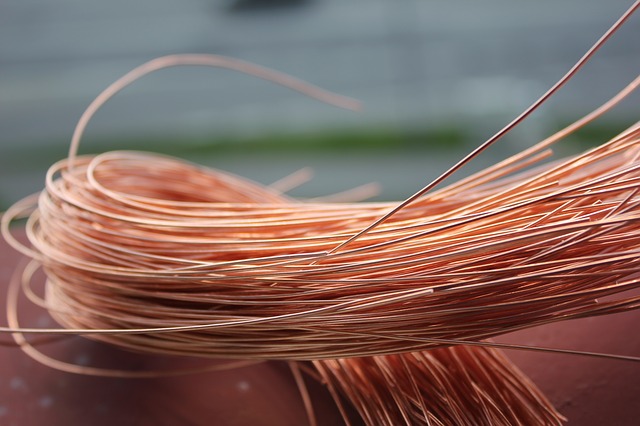
The resistivity of a material is a measure of its resistance to electrons flowing through it.
The conductivity of a material is a measure of how easily electrons flow through it. It's defined to be:
- is the electron density (number of electrons per unit volume)
- is the charge of the electron
- is the mean free time (time between collisions)
- is the mass of the electron
The resistivity is defined as:
The units of resistivity are .
Exam Tip
Resistivity and conductivity are reciprocals of each other.
Wize Concept
The resistivity/conductivity are intrinsic properties of the material, and don't depend on the size or shape of the conductor.
We can now relate the current density to the conductivity/resistivity of the material and the electric field inside:
where is the current density and is the electric field.
Wize Concept
The current density and electric field are proportional to each other (and pointing in the same direction, with the conductivity being the constant of proportionality.
0:00 / 0:00
Example: Different Thicknesses
A cylindrical conductor is made out of copper as shown below. The two ends of it are connected to a battery. Compare the current, current density, electric field, conductivity, and resistivity in the regions A and B.
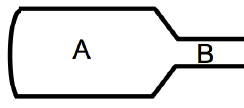
The current is the same everywhere inside, so we have .
The current density is defined to be , therefore inversely proportional to the area. Since the areas are , we have .
Both pieces are made of the same material, so their resistivity and conductivity are the same: and .
The electric field is related to current density as , therefore they are proportional and since is the same for both, the same relationship holds for the field as for the density: .
Practice: Find Electric Field
A piece of copper wire has diameter of mm and is connected to a battery. Find the magnitude of the electric field which is generating a current of mA inside the wire. The resistivity of copper is Ωm.