Wize University Physics Textbook (Master) > DC Circuits
Electric Current
Popular Courses
MCAT
General Course
PHYSICS 1202A/B
Western University
PHYSICS 1E03
McMaster University
PHYS*1300
University of Guelph
PHYS 223
University of Calgary
APSC 112
Queen's University
PHYSICS 1402A/B
Western University
PHYS 205
Concordia University
PHYS 110
University of Victoria
PHYS 118
University of British Columbia
PHYS 142
McGill University
ENGG 212
University of Calgary
PHY132H1
University of Toronto
PHY132H1
University of Toronto
PHYS-1300
University of Windsor
PHY 1121
University of Ottawa
PHYS 121
University of Waterloo
PHYSICS 1102A/B
Western University
PHYS 227
University of Calgary
SC/PHYS 2020 3.00
York University
0:00 / 0:00
Electric Current
The electric current passing a point is the rate at which charge flows through it, i.e. the amount of charge per unit time:
- is the charge
- is the time
- is the current in Amperes,
The smallest unit of charge is the elementary charge (the charge of an electron or proton). Since electric current is made up of an integer number of electrons, we have:
- is the number of electrons
- is the elementary charge
Practice: Electric Current
A current of A passes through a circuit that is used to run a toaster.
a) If the current runs for s, how much charge is transferred to the load?
b) How many electrons make up this charge?
0:00 / 0:00
Microscopic Current Definition
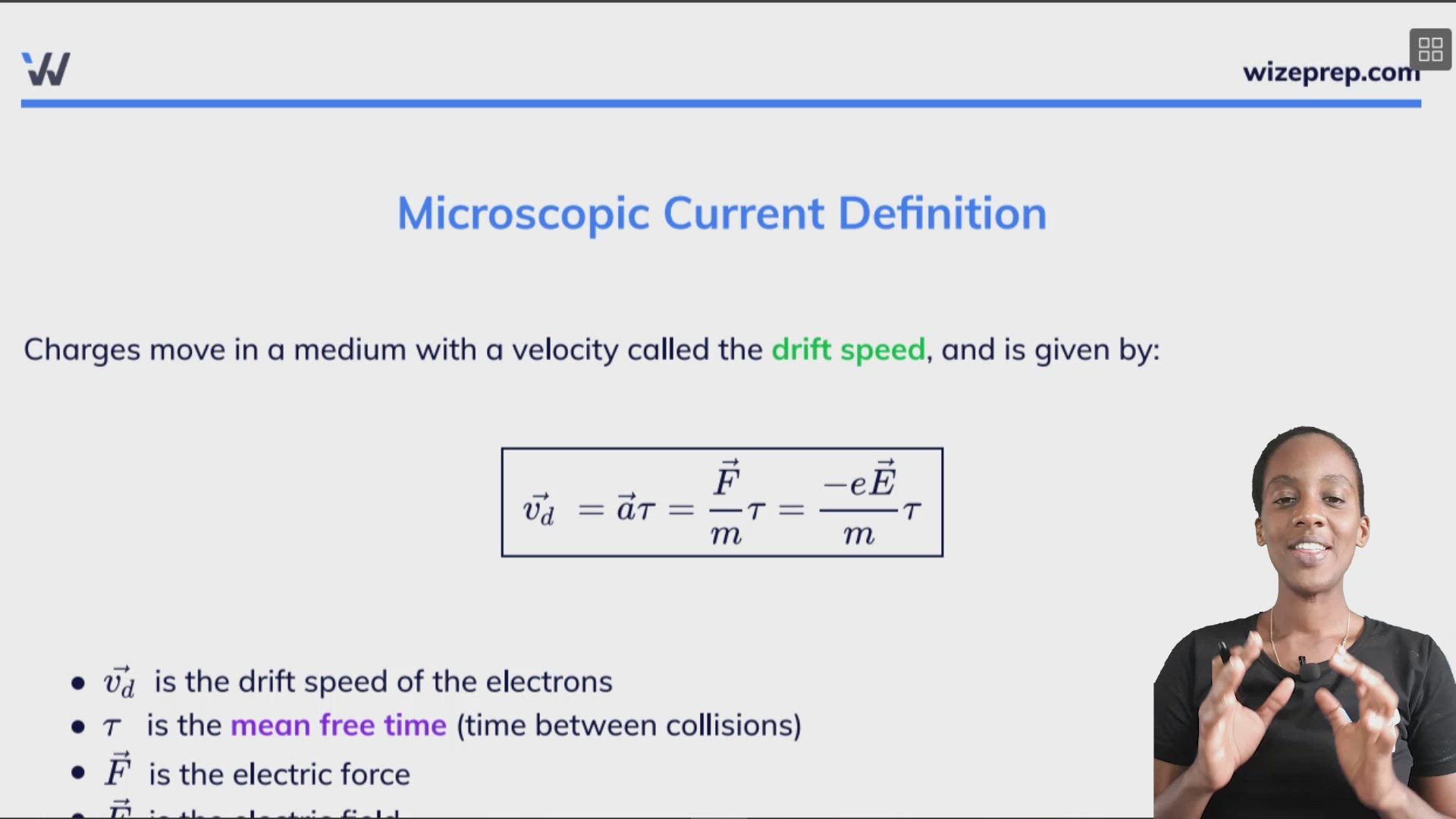
Charges move in a medium with a velocity called the drift speed, and is given by:
- is the drift speed of the electrons
- is the mean free time (time between collisions)
- is the electric force
- is the electric field
- is the mass of the electron
- is the elementary charge,
Wize Concept
The drift speed in any medium depends on:
- the resistance of that medium (due to collisions between electrons and atoms which slows down the electrons)
- the potential difference across the medium (which provides the electromotive force)
The current density is the amount of current going through the cross section of a wire, and is given by:
- is the current density
- is the current
- is the cross-sectional area of the wire
- is the electron density (number of electrons per unit volume)
Wize Concept
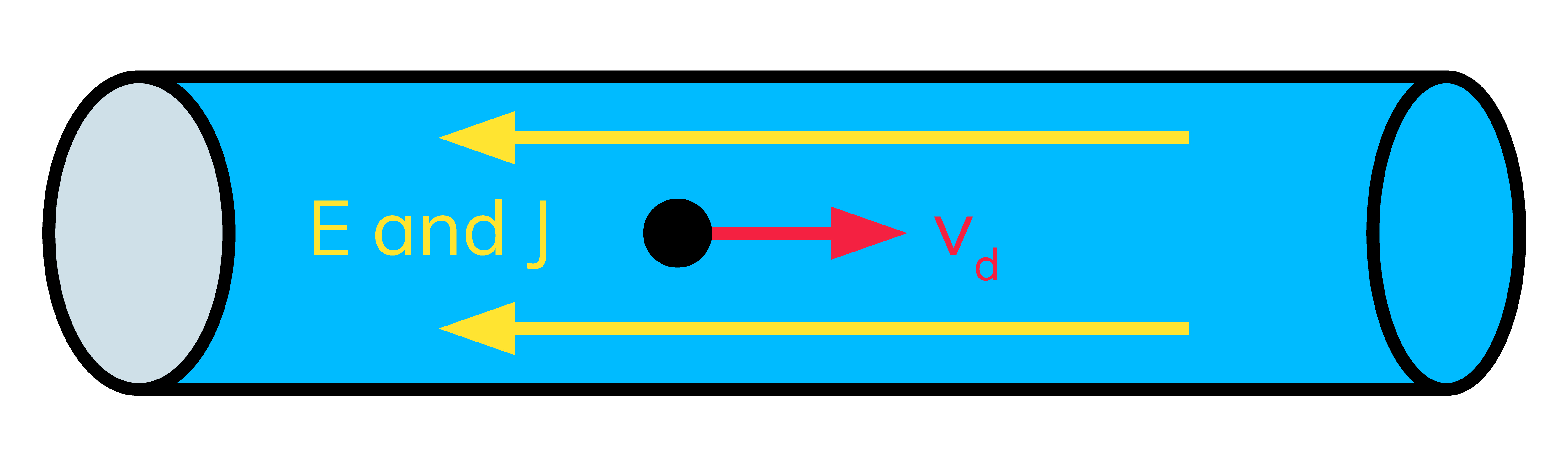
- The electric field and current density always point in the same direction.
- The drift speed of the electrons (negative charges) is in the opposite direction to the electric field and current density.
Wize Concept
Electric current is conserved, which means that the current will be the same at all points in the wire (similar to fluid flow!)
Exam Tip
Current density is inversely proportional to area, which means that:
- the narrow parts have higher current density
- the wider parts have lower current density
0:00 / 0:00
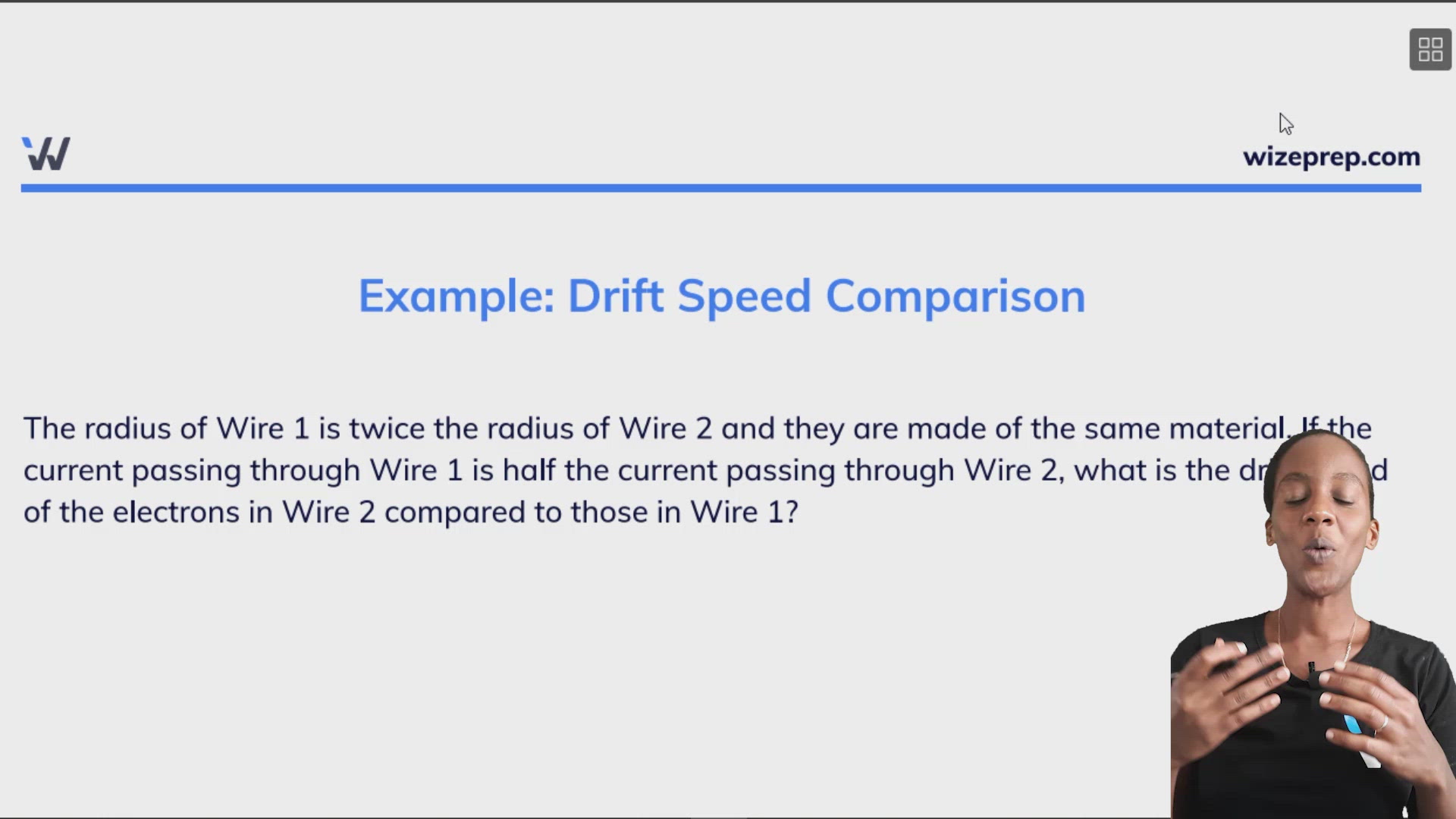
Example: Drift Speed Comparison
The radius of Wire 1 is twice the radius of Wire 2 and they are made of the same material. If the current passing through Wire 1 is half the current passing through Wire 2, what is the drift speed of the electrons in Wire 2 compared to those in Wire 1?
Let's begin with the definition of current:
The charge can be expressed in terms of the number of electrons as . Putting this into the formula above we get:
Now using distance , time can be written as and the formula becomes:
Using volume , the distance can be written as and we have:
Defining the electron number density as we get:
Finally, the cross-sectional area is and we end up with:
Therefore the drift speed is given by:
Write this equation for each of the wires:
For Wire 1 we have:
For Wire 2 we have:
The is an extra factor of in the formula for Wire 1, which means that , or .
Practice: Current Density and Drift Speed
An appliance is connected to a wire of diameter mm , carrying a current of A and a charge density of electrons/m3.
a) What is the current density?
b) What is the drift velocity?
Use C.