
AC Voltage Sources
As their name suggests, alternating current (AC) circuits have properties that change with time. We need to define some terms and tools in order to analyze these systems.
AC Voltage
- The source voltage of an AC circuit must change with time.
- This can be written as a periodic function:
- In this formula:
- is the maximum voltage of the source (sometimes calledor )
- is the angular frequency of the source (in rad/s).
RMS and other definitions
- Usually, AC sources are described by their RMS voltage (root-mean-square):
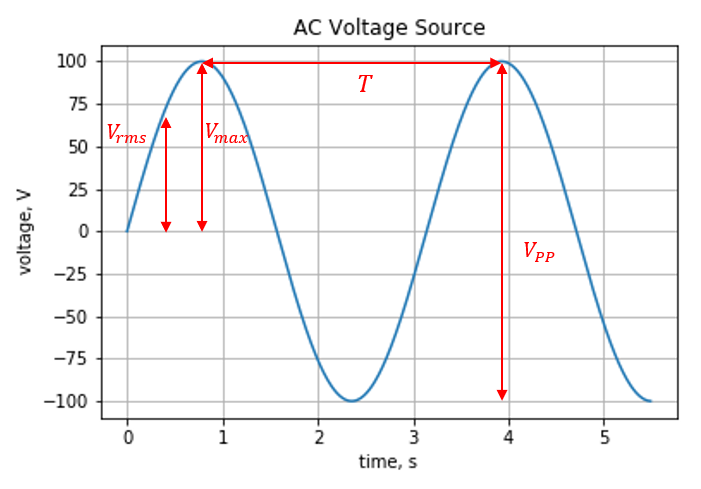
- Peak-to-peak voltageis defined as the voltage difference between the max and min points.
- This is equal to .
- The period (T) can be measured from graphs such as the one above.
- For example, you can measure the time between two peaks (maximums) or two troughs (minimums), or double the time between a peak and a trough.
Example: Household Voltages
In Canada, household voltage sources are delivered at 120 V and 60 Hz.
a) What is the maximum voltage delivered by such a voltage source?
b) What is the average voltage delivered by this source?
c) What are the angular frequency and period of such a voltage source?
Part a)
We use the standard RMS formula to convert from rms to maximum voltage:
Part b)
All AC voltage sources have an average delivered voltage of zero. That's why we use rms!
Part c)
We can convert frequency to angular frequency as follows:
To find the period, we take the inverse of the frequency:

Resistive AC Circuits and AC Current
The simplest type of AC circuit has only an AC voltage source and a resistor.
- Consider an AC source with a maximum voltage of and an angular frequency of connected to a resistance .
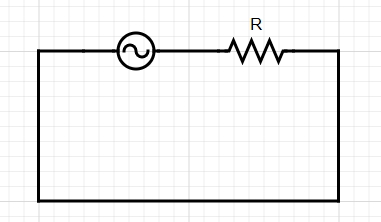
- Let's apply Kirchhoff's Loop Rule (the sum of all voltage drops in a closed loop is zero):
- Because the current is time-varying with the same frequency, we can write the AC current as follows:
- We can also define the rms current:
- The power dissipated also varies in time.
- The average power dissipated can be found with rms current and voltage values: