Create a free account to get started

Unlock full course notes by signing up

  • Video lessons taught by top educators
  • Practice questions with guided solutions
  • Written review notes for reference
  • Expert answers anytime from course tutors

Lenz's Law


While Faraday's Law gives the magnitude of an induced emf, we still need a tool to determine the direction of induced currents.

  • Lenz’s Law states that an induced current due to a change in magnetic flux will be oriented in a direction such that the magnetic field generated by the induced current will oppose the change in magnetic flux.
  • An alternative (and well-known) way of saying it: nature abhors a change in flux.


  • Based on Lenz's Law, Faraday's Law is sometimes re-written with a negative sign as follows:
ε=−ΔΦmΔt\boxed{\varepsilon =-\cfrac{\Delta \Phi_m}{\Delta t}}


Create a free account to get started

Unlock full course notes by signing up

  • Video lessons taught by top educators
  • Practice questions with guided solutions
  • Written review notes for reference
  • Expert answers anytime from course tutors

Example: Lenz's Law


The following magnetic field increases in strength at a constant rate. What is the direction of the induced current in the loop?
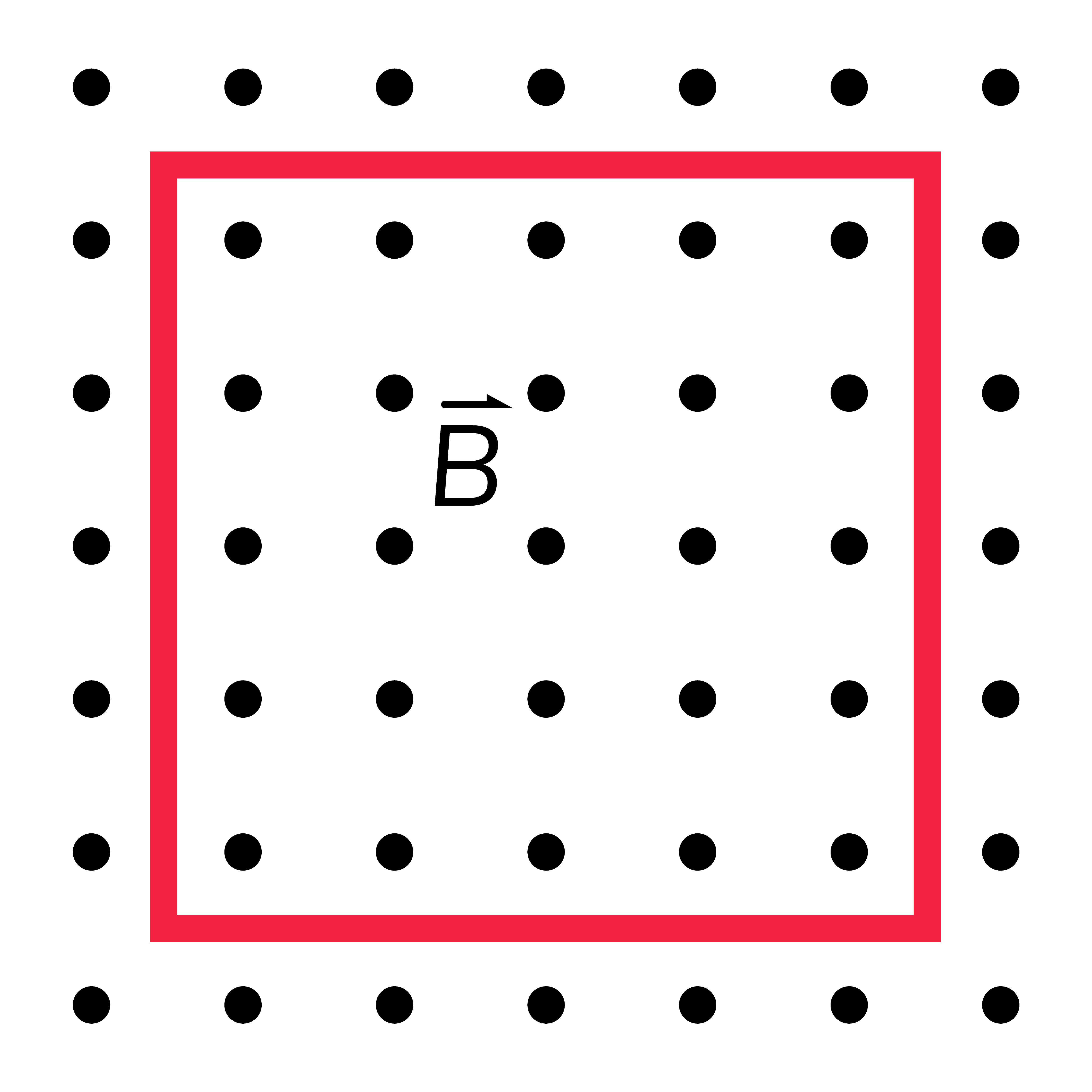

Image illustrating Example: Lenz's Law


The flux is out of the page, and the question says that it is getting stronger.


Lenz's law tells us that the induced current direction will act to "resist the change" - that is, it will try to create a magnetic flux against this increase. So the current will try to produce a magnetic field into the page.


Pointing our right thumb into the page, we see that our fingers curl clockwise. This is the direction of the induced current.

Mark Yourself Question

  1. Grab a piece of paper and try this problem yourself.
  2. When you're done, check the "I have answered this question" box below.
  3. View the solution and report whether you got it right or wrong.

Practice: Lenz's Law


A wire loop of constant area is pulled to the right at a constant speed over a magnetic field that points into the page. The angle of incidence between the loop and field is also constant.


At each point of the loop's motion (shown below), describe the induced current.


Illustration for practice question: Lenz's Law


Create a free account to get started

Unlock full course notes by signing up

  • Video lessons taught by top educators
  • Practice questions with guided solutions
  • Written review notes for reference
  • Expert answers anytime from course tutors

Practice: Terminal Velocity and EM Induction


In the picture below, a conducting rod of mass m=500 gm=500~g with a length of l=1.0 ml=1.0~m and resistance of R=2 μΩR=2\ \mu\Omega is on a wire loop tilted by α=30o\alpha=30^o from horizontal. The rod slides down the wire loop without friction. There is a uniform magnetic field of B=20 mTB=20~mT pointing straight down (this is at an angle into the tilted surface).


The rod is released from rest and reaches a terminal velocity. What is the terminal velocity of the rod?


Illustration for practice question: Terminal Velocity and EM Induction


Hint: If the rod has reached its terminal velocity, then it is no longer accelerating.

Choose an answer

Create a free account to get started

Unlock full course notes by signing up

  • Video lessons taught by top educators
  • Practice questions with guided solutions
  • Written review notes for reference
  • Expert answers anytime from course tutors