Create a free account to get started

Unlock full course notes by signing up

  • Video lessons taught by top educators
  • Practice questions with guided solutions
  • Written review notes for reference
  • Expert answers anytime from course tutors

Dielectrics

A dielectric is an insulator that has the ability to be polarized. When placed inside an electric field, a net dipole moment is created, with each atom or molecule contributing its own dipole moment.


This causes a small electric field that opposes the existing electric field, so the net electric field between the plates of a capacitor will be smaller:


 E=E0κ \boxed{ \ E=\frac{E_0}{\kappa} \ }
  • EE is the effective electric field with the dielectric
  • E0E_0 is the electric field without the dielectric
  • κ\kappa is the dielectric constant specific to the material


This in turn means that the potential difference is reduced:


 V=V0κ \boxed{ \ V=\dfrac{V_0}{\kappa} \ }
  • VV is the effective potential difference with the dielectric
  • V0V_0 is the potential difference without the dielectric


Since the charge on the capacitor is held the same, and capacitance is inversely proportional to voltage, the capacitance increases by a factor of κ\kappa:


 C=κC0 \boxed{\ C=\kappa C_0 \ }
  • CC is the effective capacitance with the dielectric
  • C0C_0 is the capacitance without the dielectric


For a parallel plate capacitor this becomes:

 C=κ ε0Ad \boxed{\ C=\kappa\ \frac{\varepsilon_0A}{d} \ }
  • AA is the area of the plates
  • dd is the distance between the plates
  • ε0\varepsilon_0 is the permittivity of free space, ε0=8.854×10⁻¹²\varepsilon_0=8.854\times10^{-12} F/m


Create a free account to get started

Unlock full course notes by signing up

  • Video lessons taught by top educators
  • Practice questions with guided solutions
  • Written review notes for reference
  • Expert answers anytime from course tutors

Example: Three Dielectrics


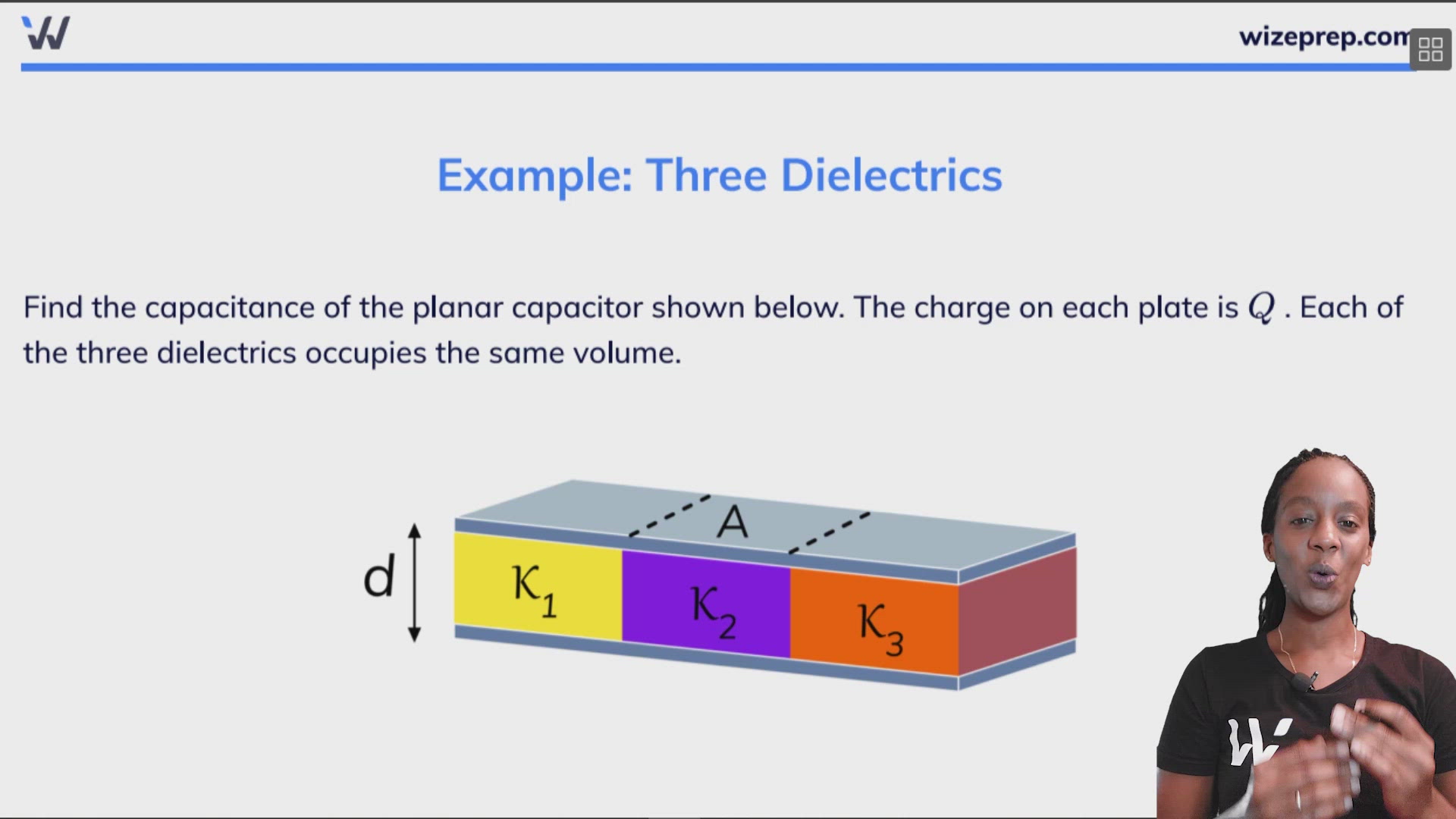
Find the capacitance of the planar capacitor shown below. The charge on each plate is QQ . Each of the three dielectrics occupies the same volume.
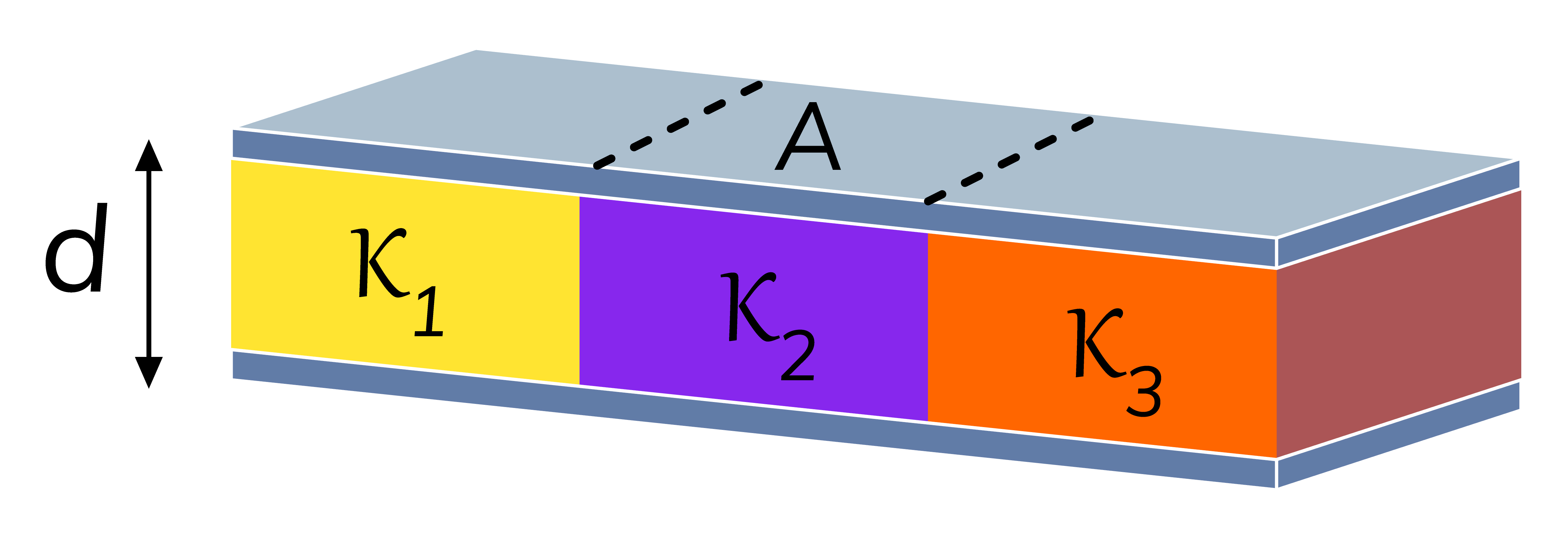


Image illustrating Example: Dielectrics


This is equivalent to having three capacitors in parallel with each other.


The equivalent capacitance is therefore:


Ceq=C1+C2+C3C_{eq}=C_1+C_2+C_3


The capacitance of each is given by C=κ ε0(A/3)dC=\kappa \ \dfrac{\varepsilon_0(A/3)}{d}, so we get:


Ceq=κ1ε0A3d+κ2ε0A3d+κ3ε0A3dC_{eq}=\dfrac{\kappa_1\varepsilon_0A}{3d}+\dfrac{\kappa_2\varepsilon_0A}{3d}+\dfrac{\kappa_3\varepsilon_0A}{3d}


=ε0A3d (κ1+κ2+κ3)=\dfrac{\varepsilon_0A}{3d}\ (\kappa_1+\kappa_2+\kappa_3)


Mark Yourself Question

  1. Grab a piece of paper and try this problem yourself.
  2. When you're done, check the "I have answered this question" box below.
  3. View the solution and report whether you got it right or wrong.

Practice: Three Dielectrics Again


A capacitor is filled with three dielectric materials with different dielectric constants as shown in the picture. The first and the second materials are spread over half the area AA, and have half the thickness dd of the capacitor. The third material is spread over the entire area, and also has half the thickness of the capacitor.


a) Find an expression for the effective capacitance in terms of the dielectric constants and the capacitance CC without any dielectrics inside.


b) Given κ1=2\kappa_1=2, κ2=3\kappa_2=3 and κ3=4\kappa_3=4 , verify that the effective capacitance is larger than CC.


Illustration for practice question: Dielectrics


Create a free account to get started

Unlock full course notes by signing up

  • Video lessons taught by top educators
  • Practice questions with guided solutions
  • Written review notes for reference
  • Expert answers anytime from course tutors