Wize University Physics Textbook (Master) > DC Circuits
Capacitors in Series and Parallel
Popular Courses
MCAT
General Course
PHYSICS 1202A/B
Western University
PHYSICS 1E03
McMaster University
PHYS*1300
University of Guelph
PHYS 223
University of Calgary
PHYSICS 1402A/B
Western University
PHYS 205
Concordia University
PHYS 110
University of Victoria
PHYS 118
University of British Columbia
PHYS 142
McGill University
ENGG 212
University of Calgary
PHY132H1
University of Toronto
PHY132H1
University of Toronto
PHYS-1300
University of Windsor
PHY 1121
University of Ottawa
PHYS 121
University of Waterloo
PHYSICS 1102A/B
Western University
PHYS 227
University of Calgary
SC/PHYS 2020 3.00
York University
PHYS 116
Queen's University
0:00 / 0:00
Capacitors in Series and Parallel
Capacitors in Series
Capacitors are said to be in series if they are wired one after the other along the same piece of wire.
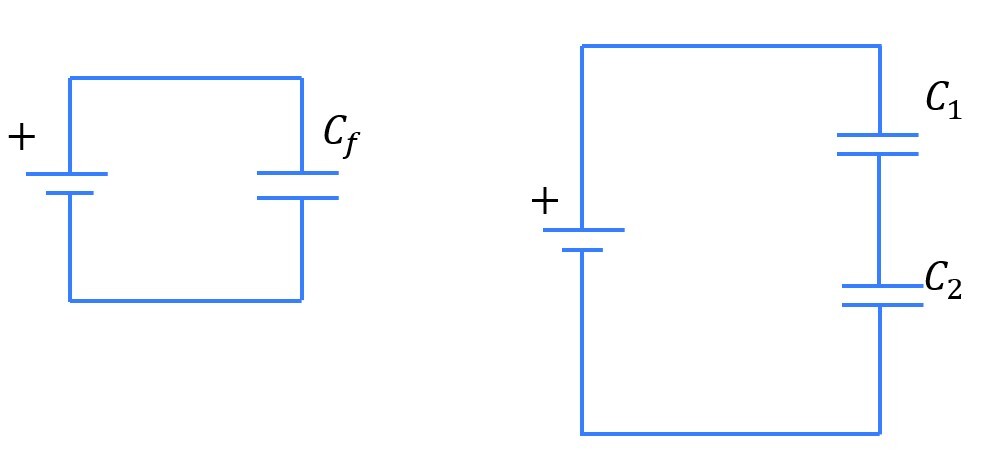
The reciprocal of the equivalent capacitance is the sum of the reciprocals of the individual capacitances:
The charge is the same for all capacitors:
The voltage drops across each capacitor add up to the total voltage:
NOTE: You might see various notations used for the equivalent capacitance: it can also be called net, effective, total etc.
Capacitors in Parallel
Capacitors are said to be in parallel if they are wired as separate branches, so that the charge splits up and recombines at the junctions.
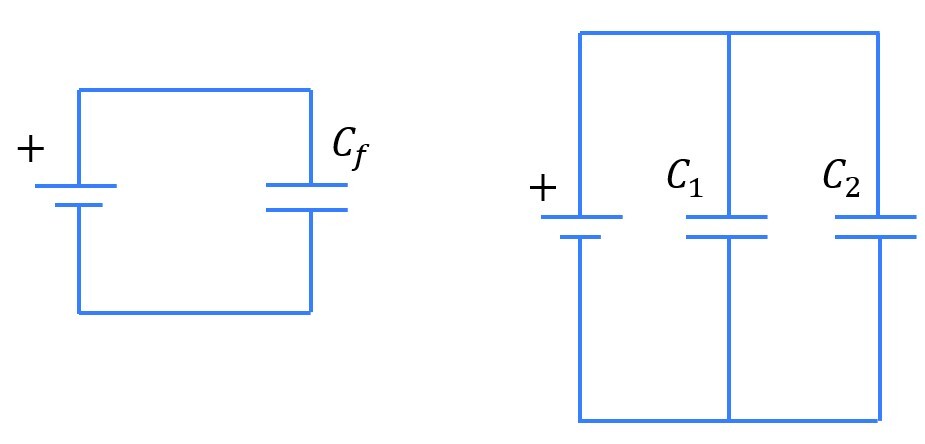
The equivalent capacitance is the sum of the individual capacitances:
The voltage drops are the same for all capacitors:
The charges on each capacitor add up to the total charge:
Wize Concept
- The rules for combining resistors/capacitors are switched for series/parallel setups.
- The charge for capacitors behaves like the current for resistors.
Exam Tip
You might see a combination of series and parallel capacitors in a circuit. If possible, put them together one by one to find the equivalent capacitance of the whole circuit.
0:00 / 0:00
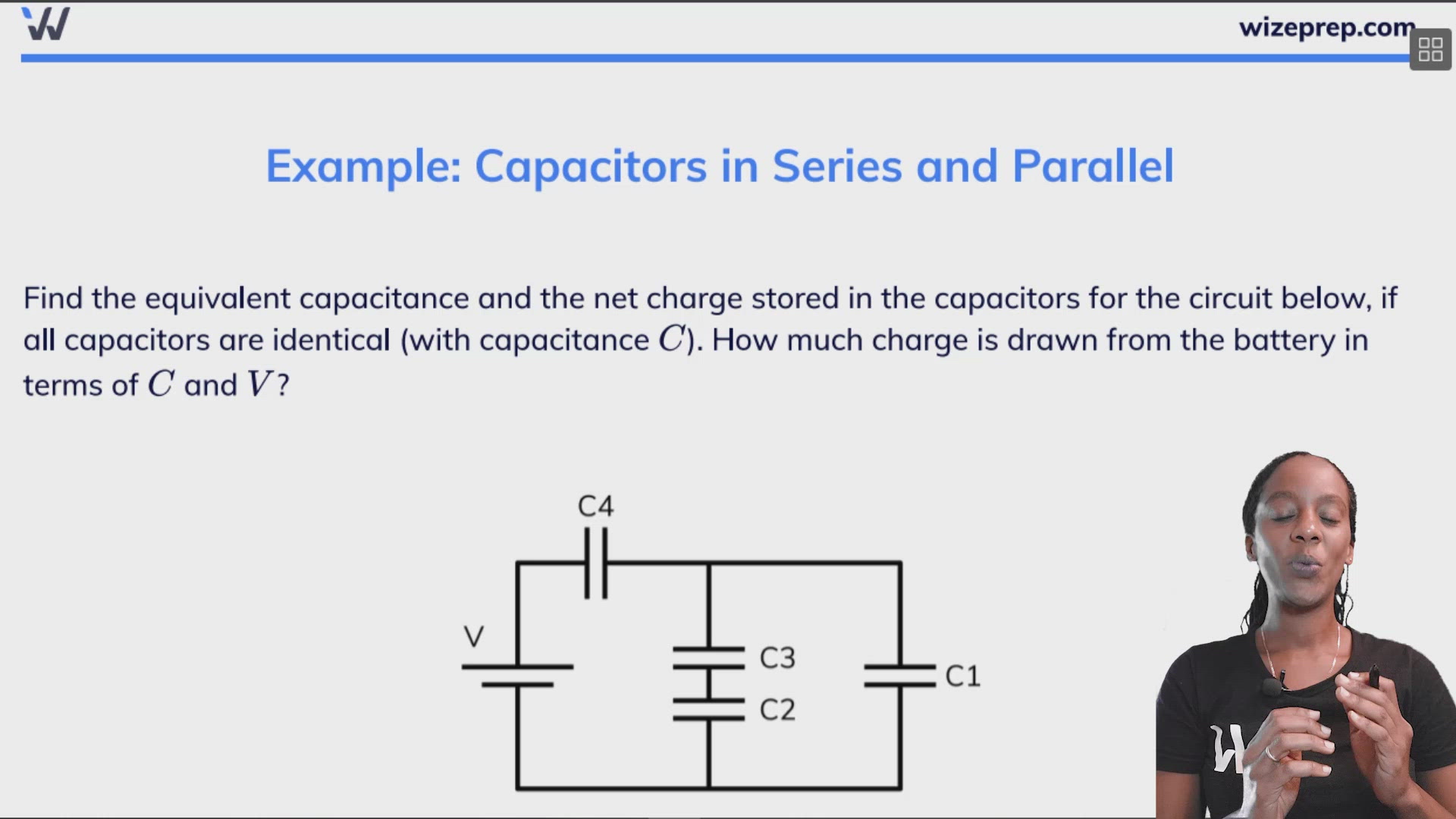
Example: Capacitors in Series and Parallel
Find the equivalent capacitance and the net charge stored in the capacitors for the circuit below, if all capacitors are identical (with capacitance ). How much charge is drawn from the battery in terms of and ?

First we'll combine capacitors 2 and 3, which are in series:
Then this combination is in parallel with capacitor 1:
Finally, this entire combination is in series with capacitor 4:
Let's see what happens when all capacitors are identical (and have capacitance ).
- First combination:
This gives us .
- Second combination:
So we have .
- Third combination:
Now for the charge drawn from the battery we have:

Mark Yourself Question
- Grab a piece of paper and try this problem yourself.
- When you're done, check the "I have answered this question" box below.
- View the solution and report whether you got it right or wrong.
Practice: Circuit with a Switch
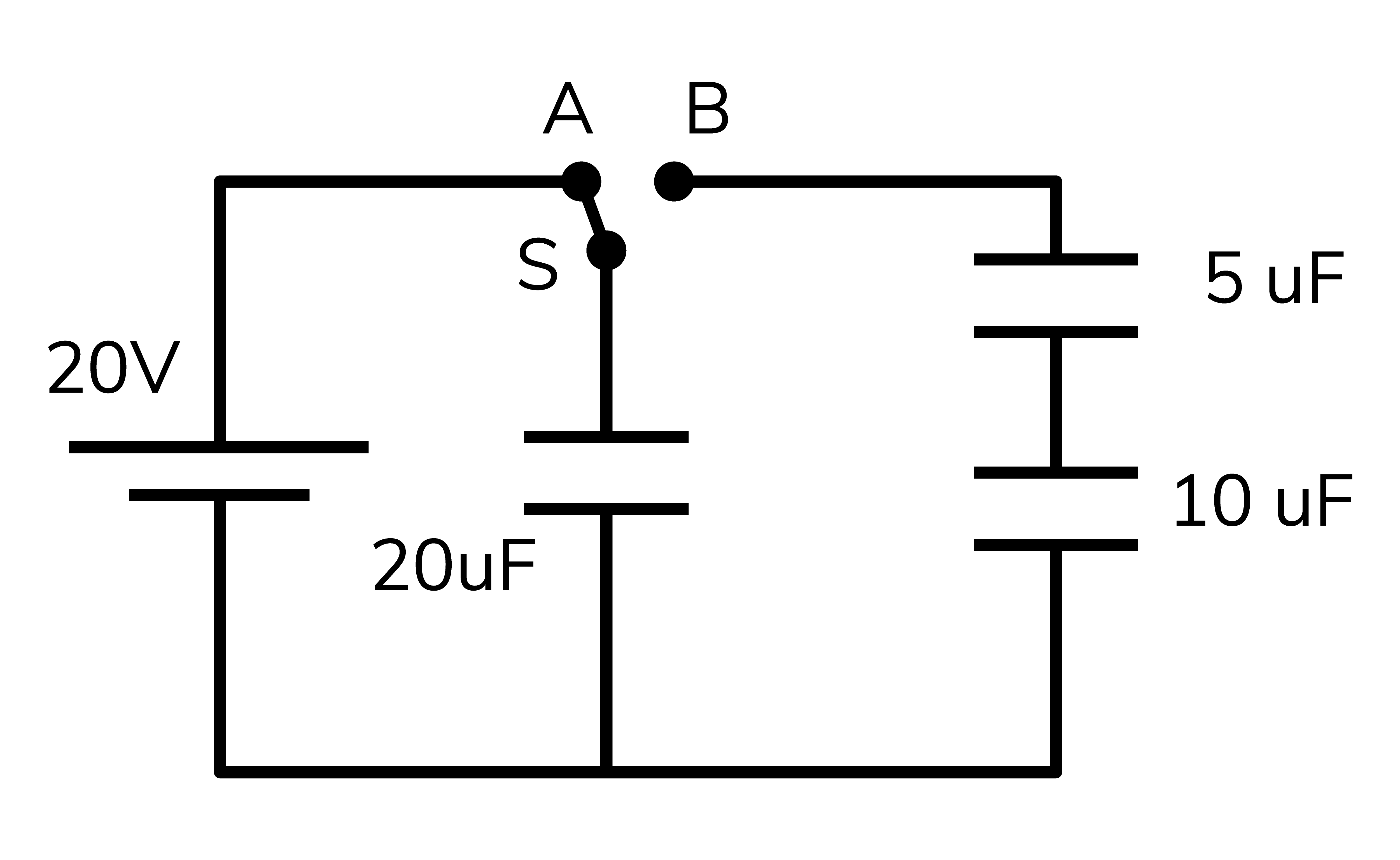
The switch (S) in the circuit below is connected to point A for a long time. What happens when we switch it to point B? Find the charge and voltage across each of the capacitors before and after we change the position of the switch from A to B.