Popular Courses
MCAT
General Course
PHYSICS 1202A/B
Western University
PHYSICS 1E03
McMaster University
PHYS*1300
University of Guelph
PHYSICS 1402A/B
Western University
PHYS 205
Concordia University
PHYS 110
University of Victoria
PHYS 118
University of British Columbia
PHYS 142
McGill University
ENGG 212
University of Calgary
PHY132H1
University of Toronto
PHY132H1
University of Toronto
PHYS-1300
University of Windsor
PHY 1121
University of Ottawa
PHYS 121
University of Waterloo
PHYSICS 1102A/B
Western University
PHYS 227
University of Calgary
SC/PHYS 2020 3.00
York University
PHYS 116
Queen's University
PHY 9B
University of California - Davis
0:00 / 0:00
Dielectrics
A dielectric is an insulator that has the ability to be polarized. When placed inside an electric field, a net dipole moment is created, with each atom or molecule contributing its own dipole moment.
This causes a small electric field that opposes the existing electric field, so the net electric field between the plates of a capacitor will be smaller:
- is the effective electric field with the dielectric
- is the electric field without the dielectric
- is the dielectric constant specific to the material
Wize Concept
For vacuum we have . For other materials we have .
This in turn means that the potential difference is reduced:
- is the effective potential difference with the dielectric
- is the potential difference without the dielectric
Since the charge on the capacitor is held the same, and capacitance is inversely proportional to voltage, the capacitance increases by a factor of :
- is the effective capacitance with the dielectric
- is the capacitance without the dielectric
For a parallel plate capacitor this becomes:
- is the area of the plates
- is the distance between the plates
- is the permittivity of free space, F/m
Wize Concept
- The dielectric strength is the maximum electric field intensity that can be produced in the dielectric (it can be around a million volts per meter).
- If the applied voltage becomes too large, dielectric breakdown will occur.
Exam Tip
- If you have layers of dielectric materials parallel to the plates, consider each as a capacitor in series.
- If you have layers of dielectric materials perpendicular to the plates, consider each as a capacitor in parallel.
0:00 / 0:00
Example: Three Dielectrics
Find the capacitance of the planar capacitor shown below. The charge on each plate is . Each of the three dielectrics occupies the same volume.
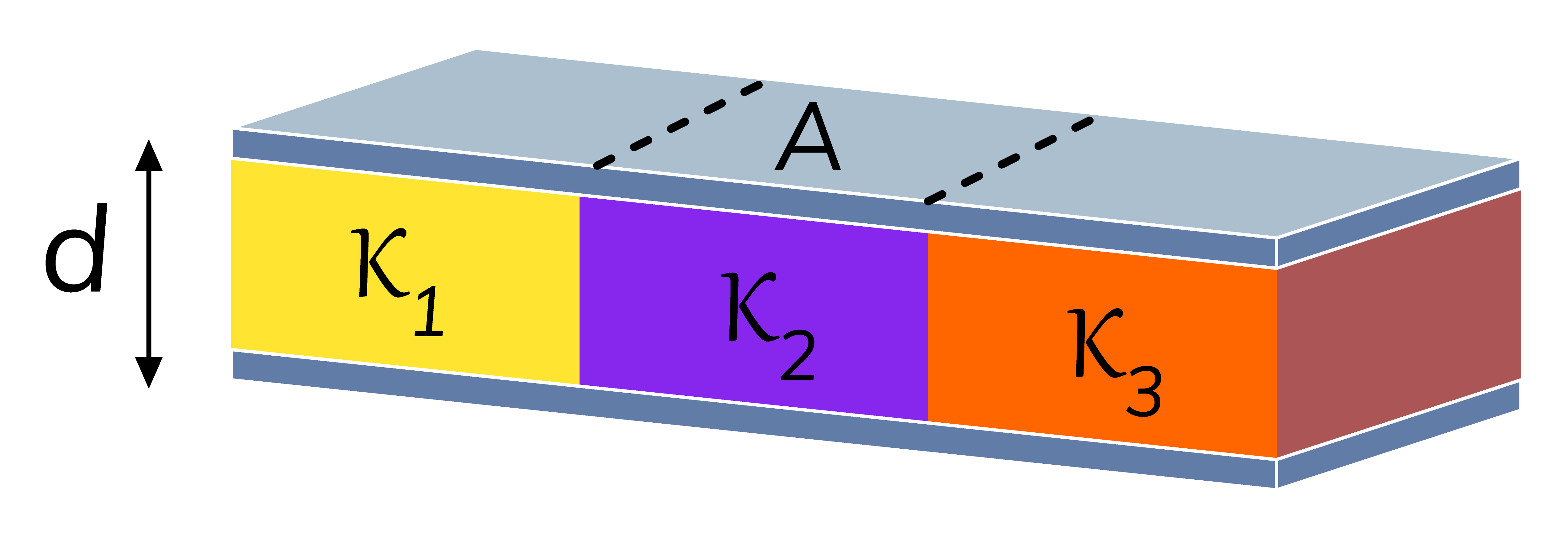
This is equivalent to having three capacitors in parallel with each other.
The equivalent capacitance is therefore:
The capacitance of each is given by , so we get:

Mark Yourself Question
- Grab a piece of paper and try this problem yourself.
- When you're done, check the "I have answered this question" box below.
- View the solution and report whether you got it right or wrong.
Practice: Three Dielectrics Again
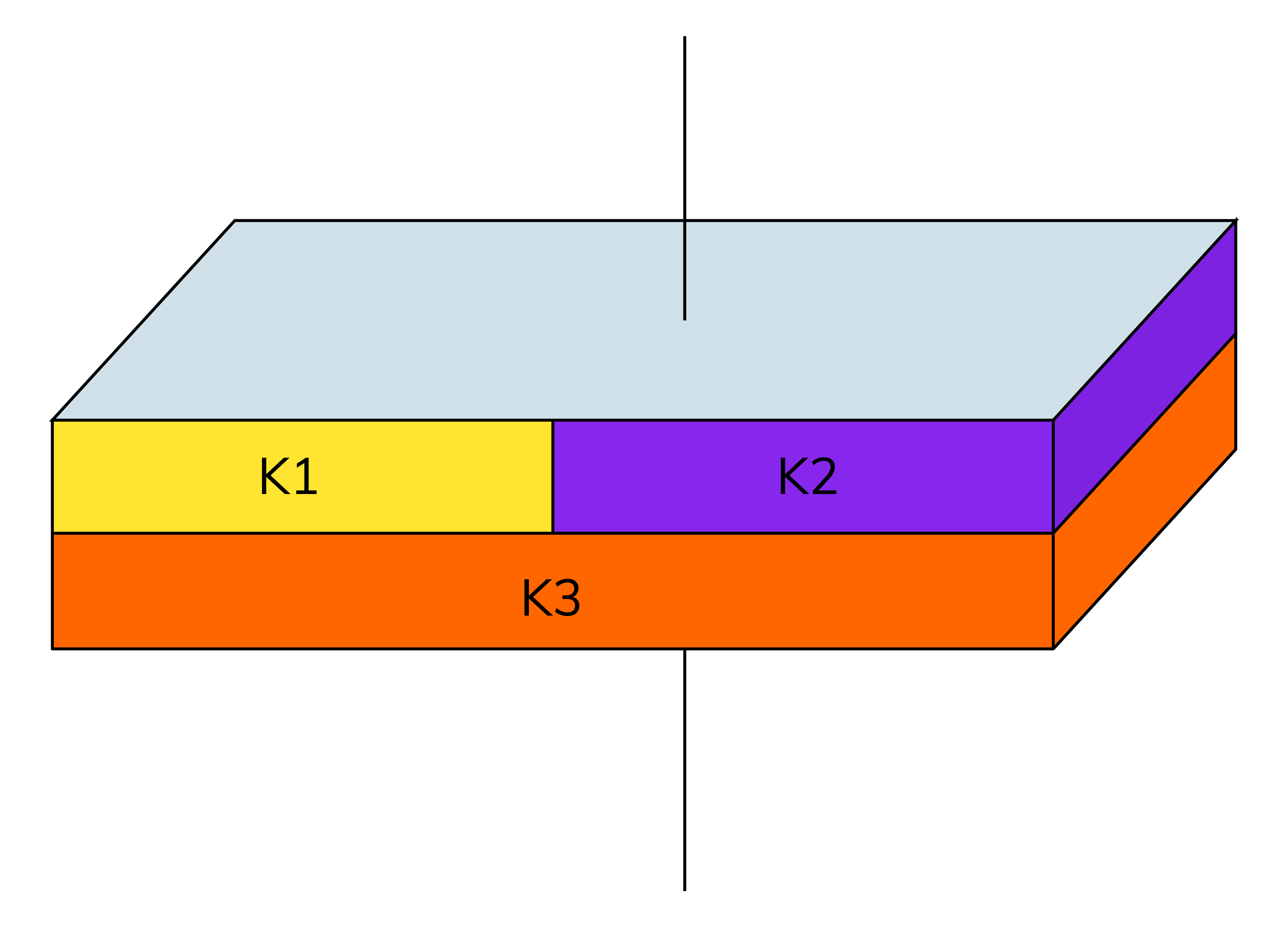
A capacitor is filled with three dielectric materials with different dielectric constants as shown in the picture. The first and the second materials are spread over half the area , and have half the thickness of the capacitor. The third material is spread over the entire area, and also has half the thickness of the capacitor.
a) Find an expression for the effective capacitance in terms of the dielectric constants and the capacitance without any dielectrics inside.
b) Given , and , verify that the effective capacitance is larger than .