Wize University Physics Textbook (Master) > DC Circuits
Energy Stored in a Capacitor
Popular Courses
MCAT
General Course
PHYSICS 1202A/B
Western University
PHYSICS 1E03
McMaster University
PHYS*1300
University of Guelph
PHYSICS 1402A/B
Western University
PHYS 205
Concordia University
PHYS 110
University of Victoria
PHYS 118
University of British Columbia
PHYS 142
McGill University
ENGG 212
University of Calgary
PHY132H1
University of Toronto
PHY132H1
University of Toronto
PHYS-1300
University of Windsor
PHY 1121
University of Ottawa
PHYS 121
University of Waterloo
PHYSICS 1102A/B
Western University
PHYS 227
University of Calgary
SC/PHYS 2020 3.00
York University
PHYS 116
Queen's University
PHY 9B
University of California - Davis

0:00 / 0:00
Energy Stored in a Capacitor
When charging a capacitor, charges are transferred to the two plates of the capacitor. The work done on these charges is stored as electric potential energy, which is given by:
The stored electric potential energy changes when charging or discharging the capacitor.
Exam Tip
A charged capacitor can act as the source of the energy in the circuit (discharging capacitor)
0:00 / 0:00
Example: Double the Energy
Consider a parallel-plate capacitor that is connected to a battery. You want to double the energy stored in the capacitor by changing the spacing between the capacitor plates. How do you change the spacing?
The voltage is the same before and after since the capacitor is always connected to the battery.
The capacitance is given by:
Let's substitute this into the energy formula:
Therefore, the energy and the distance an inversely proportional. So if we want double the energy, we should have half the distance:

Mark Yourself Question
- Grab a piece of paper and try this problem yourself.
- When you're done, check the "I have answered this question" box below.
- View the solution and report whether you got it right or wrong.
Practice: Changing Area and Spacing
Consider a parallel plate capacitor that is connected to a battery. The plate separation is , the area each plate is . The capacitor has charge , capacitance , energy , and voltage .
You cut the area of each plate in half, and then reduce the spacing to a third of the original value. What effect does this have on:
a) the voltage across the capacitor?
b) the capacitance?
c) the charge stored by the capacitor?
d) the energy stored by the capacitor?
e) Repeat parts (a) to (d) if the capacitor is first disconnected from the battery and then its area and spacing change the same way.
0:00 / 0:00
Electric Energy Density
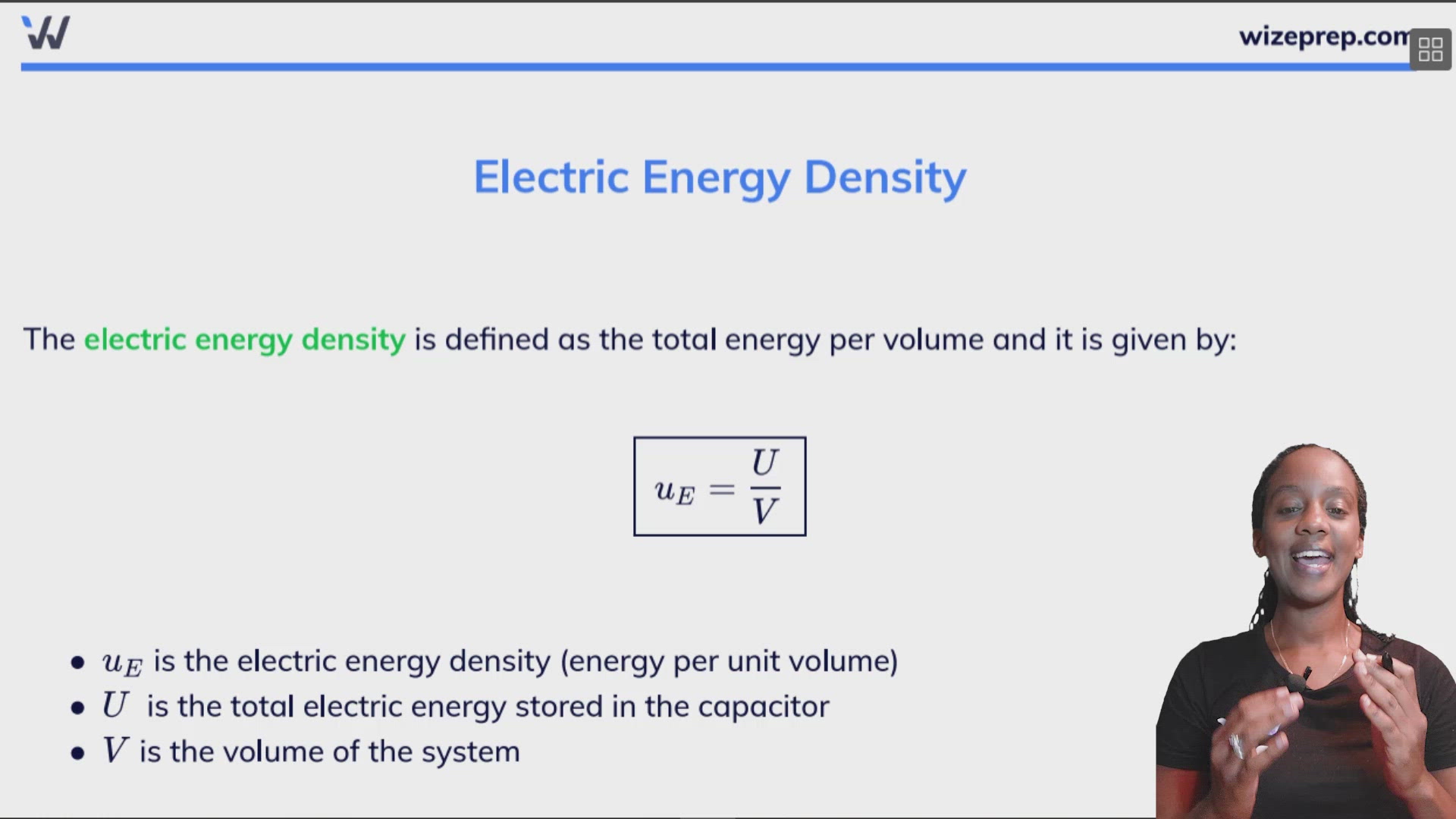
The electric energy density is defined as the total energy per volume and it is given by:
- is the electric energy density (energy per unit volume)
- is the total electric energy stored in the capacitor
- is the volume of the system
For a planar capacitor this becomes:
- is the area of the plates
- is the distance between the plates
- is the permittivity of free space, F/m
- is the electric field inside the capacitor
Practice: Electric Energy Density
A capacitor has a charge of µC stored on its plates. The area of each plate is mm2. Find the electric energy density for this capacitor.