Wize University Physics Textbook (Master) > DC Circuits
Capacitors and Capacitance
Popular Courses
MCAT
General Course
PHYSICS 1202A/B
Western University
PHYSICS 1E03
McMaster University
PHYS*1300
University of Guelph
PHYSICS 1402A/B
Western University
PHYS 205
Concordia University
PHYS 110
University of Victoria
PHYS 118
University of British Columbia
PHYS 142
McGill University
ENGG 212
University of Calgary
PHY132H1
University of Toronto
PHY132H1
University of Toronto
PHYS-1300
University of Windsor
PHY 1121
University of Ottawa
PHYS 121
University of Waterloo
PHYSICS 1102A/B
Western University
PHYS 227
University of Calgary
SC/PHYS 2020 3.00
York University
PHYS 116
Queen's University
PHY 9B
University of California - Davis

0:00 / 0:00
Capacitors and Capacitance
Capacitance is a measure of the ability to store charge, and thus electric energy, for later use.
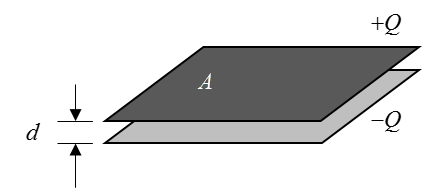
Capacitors consist of two electrical conductors (one positively and one negatively charged) which are separated by an insulating material (dielectric).
The maximum charge that can be stored on the plates of the capacitor depends on the capacitance and the potential difference between the plates:
- is the capacitance, measured in Farads (F)
- is the charge on each plate
- is the potential difference between the plates
Capacitors can have any shape. The capacitance depends on their geometry and the material between the two conductors.
Exam Tip
- For capacitors connected to a battery, the voltage remains constant, but the charge will change if the capacitance changes.
- For capacitors not connected to a battery, the charge remains constant, but the voltage will change if the capacitance changes.
Parallel Plate Capacitor
This capacitor is made of parallel conducting plates. It stores the positive charges on one plate, and the negative ones on the other plate.
The capacitance of a parallel plate capacitor is given by:
- is the area of the plate
- is the separation between the plates
- is the permittivity of free space, F/m
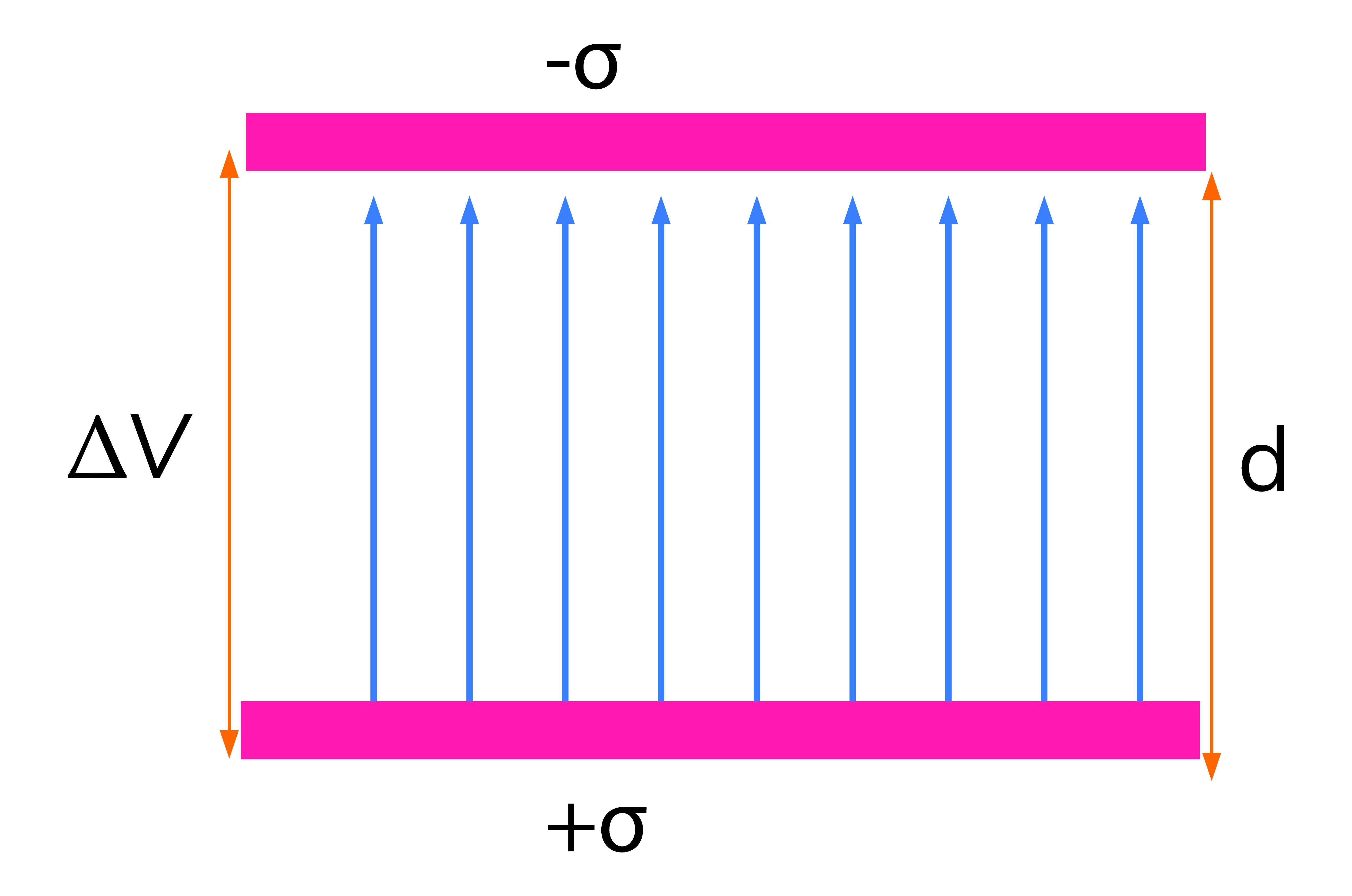
The electric field inside an ideal capacitor (infinitely large metal plates) is uniform and constant:
- is the electric field
- is the surface charge density (charge per unit area)
The electric field outside an ideal capacitor is zero.
0:00 / 0:00
Different Types of Capacitors
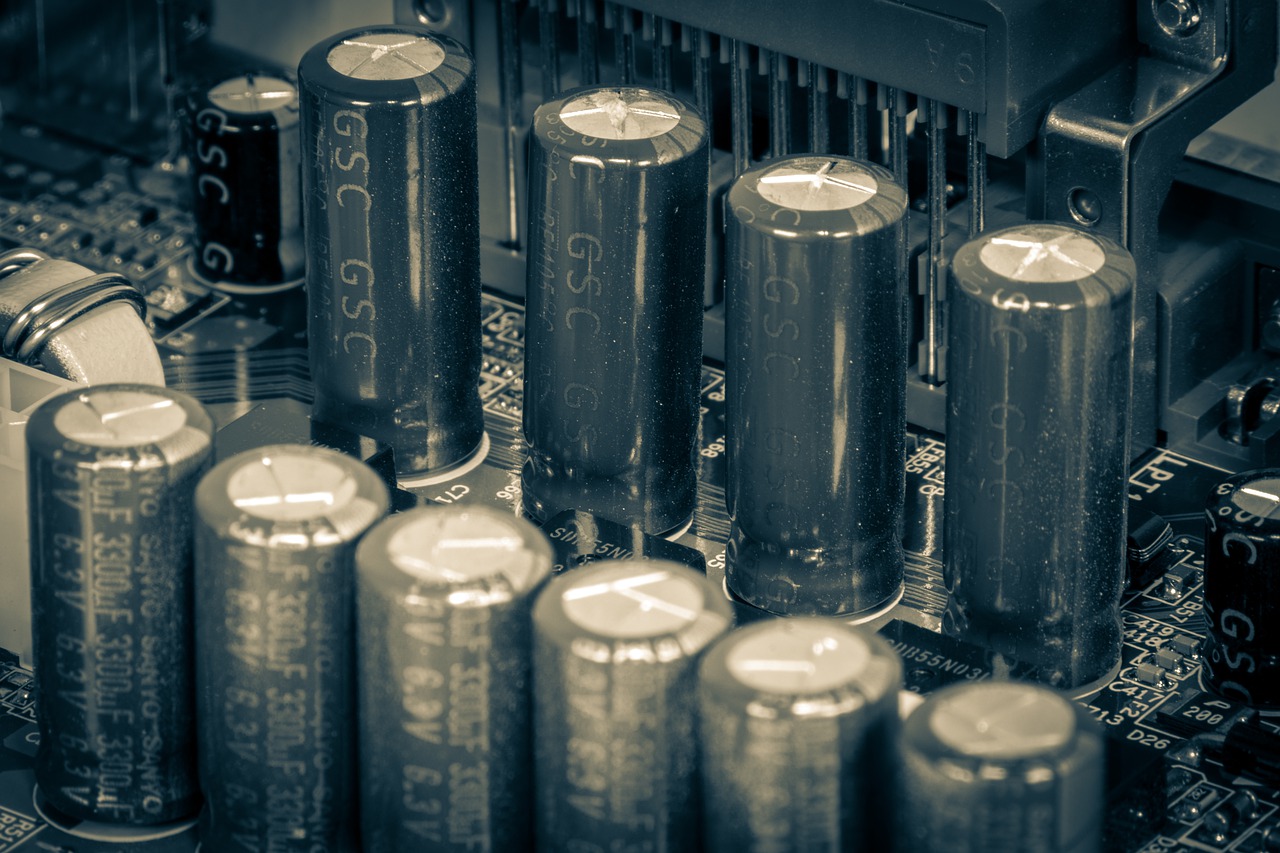
Planar Capacitors
The capacitance of a planar (parallel-plate) capacitor is:
- is the area of the plate
- is the separation between the plates
- is the permittivity of free space, F/m
- is the dielectric constant of the material between the plates
Cylindrical Capacitors
The capacitance of a cylindrical capacitor is:
- is the length
- is the inner radius
- is the outer radius
Spherical Capacitors
The capacitance of a spherical capacitor is:
- is the inner radius
- is the outer radius
0:00 / 0:00
Example: Parallel-Plate Capacitor
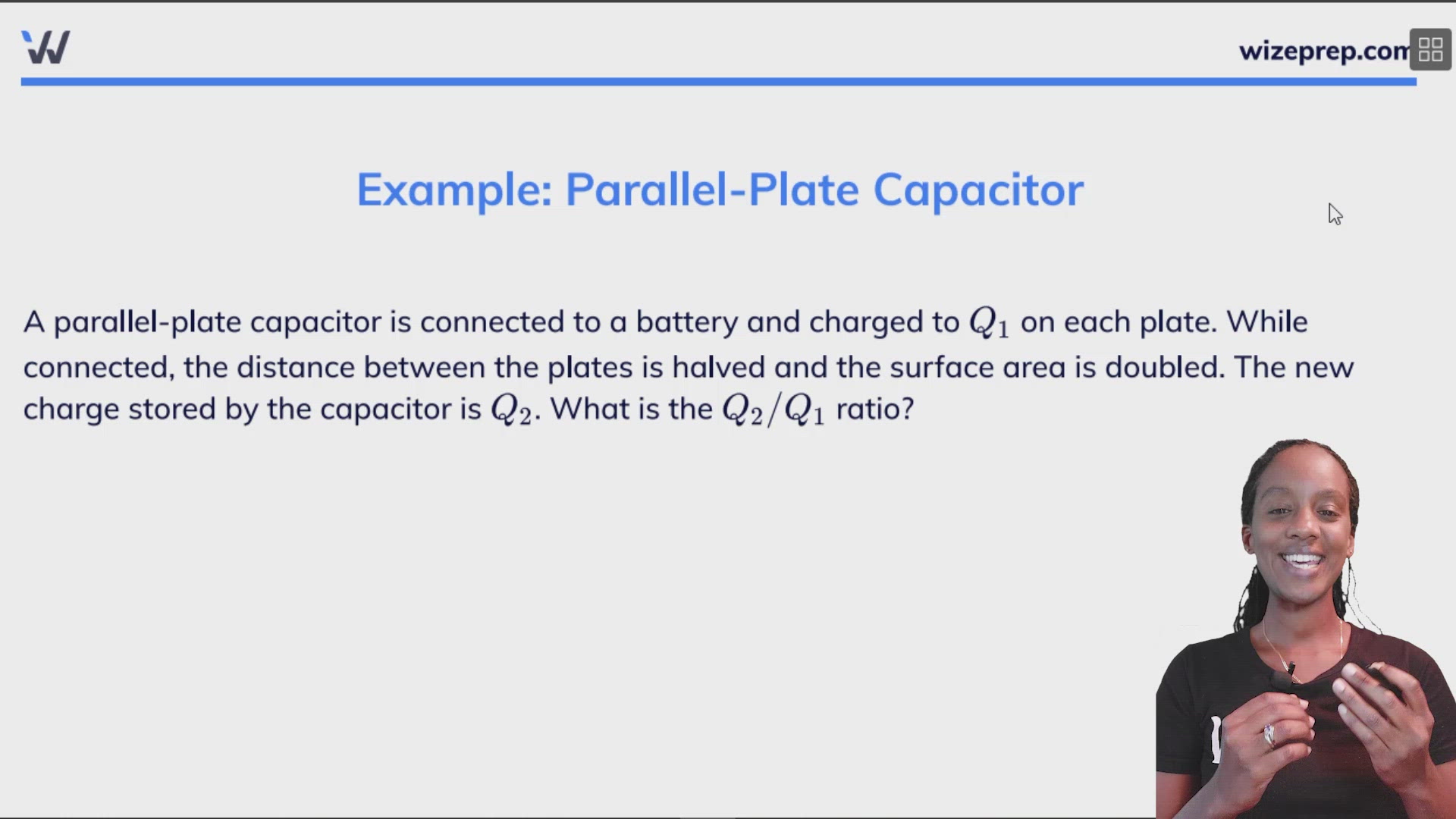
A parallel-plate capacitor is connected to a battery and charged to on each plate. While connected, the distance between the plates is halved and the surface area is doubled. The new charge stored by the capacitor is . What is the ratio?
Let's write the equations we have for capacitance:
and
Combining them we get the charge expressed as:
Let's write this equation for the charges before (1) and after (2). Because the capacitor is still connected to the battery, the voltage is the same before and after.
Before:
After:
Now we have to replace distance and area by :
Therefore the ratio of the charges is
Practice: Charging a Capacitor with Another Capacitor
Consider a V battery hooked up to a nF capacitor. The battery charges this capacitor completely. Then, this capacitor is disconnected from the battery and connected to another (uncharged) nF capacitor. What is the final charge on the new capacitor? Answer in nanoCoulombs.