Wize University Physics Textbook (Master) > DC Circuits
Real Batteries
Popular Courses
MCAT
General Course
PHYSICS 1202A/B
Western University
PHYSICS 1E03
McMaster University
PHYS*1300
University of Guelph
PHYS 223
University of Calgary
APSC 112
Queen's University
PHYSICS 1402A/B
Western University
PHYS 205
Concordia University
PHYS 110
University of Victoria
PHYS 118
University of British Columbia
PHYS 142
McGill University
ENGG 212
University of Calgary
PHY132H1
University of Toronto
PHY132H1
University of Toronto
PHYS-1300
University of Windsor
PHY 1121
University of Ottawa
PHYS 121
University of Waterloo
PHYSICS 1102A/B
Western University
PHYS 227
University of Calgary
SC/PHYS 2020 3.00
York University
0:00 / 0:00
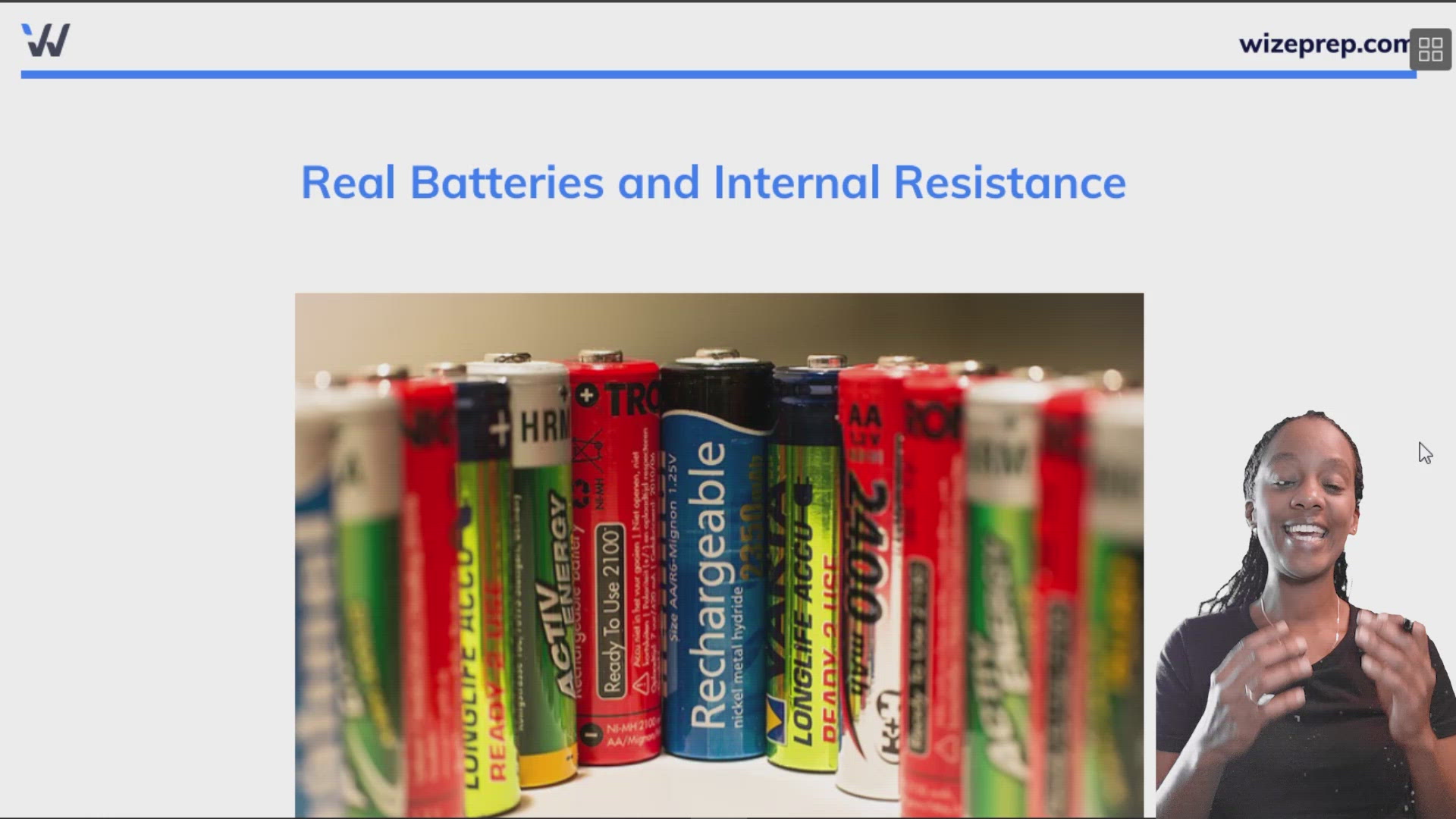
Real Batteries and Internal Resistance

In reality, there is an internal resistance associated to batteries.
- The voltage provided by the battery is known as the electromotive force and it is shown as or . It is the potential difference across the battery with no current present.
- The terminal voltage is the actual voltage across the battery, and is usually less than the electromotive force because of the voltage drop across the internal resistance.
The terminal voltage is given by:
where is the internal resistance, and is the current passing through the battery.
Exam Tip
To account for internal resistance, add it as a separate resistor in series with the battery.
Using Ohm's Law we get:
where is the total resistance of the entire circuit, given by (all the resistors combined) plus (the internal resistance of the battery, in series with it).
0:00 / 0:00
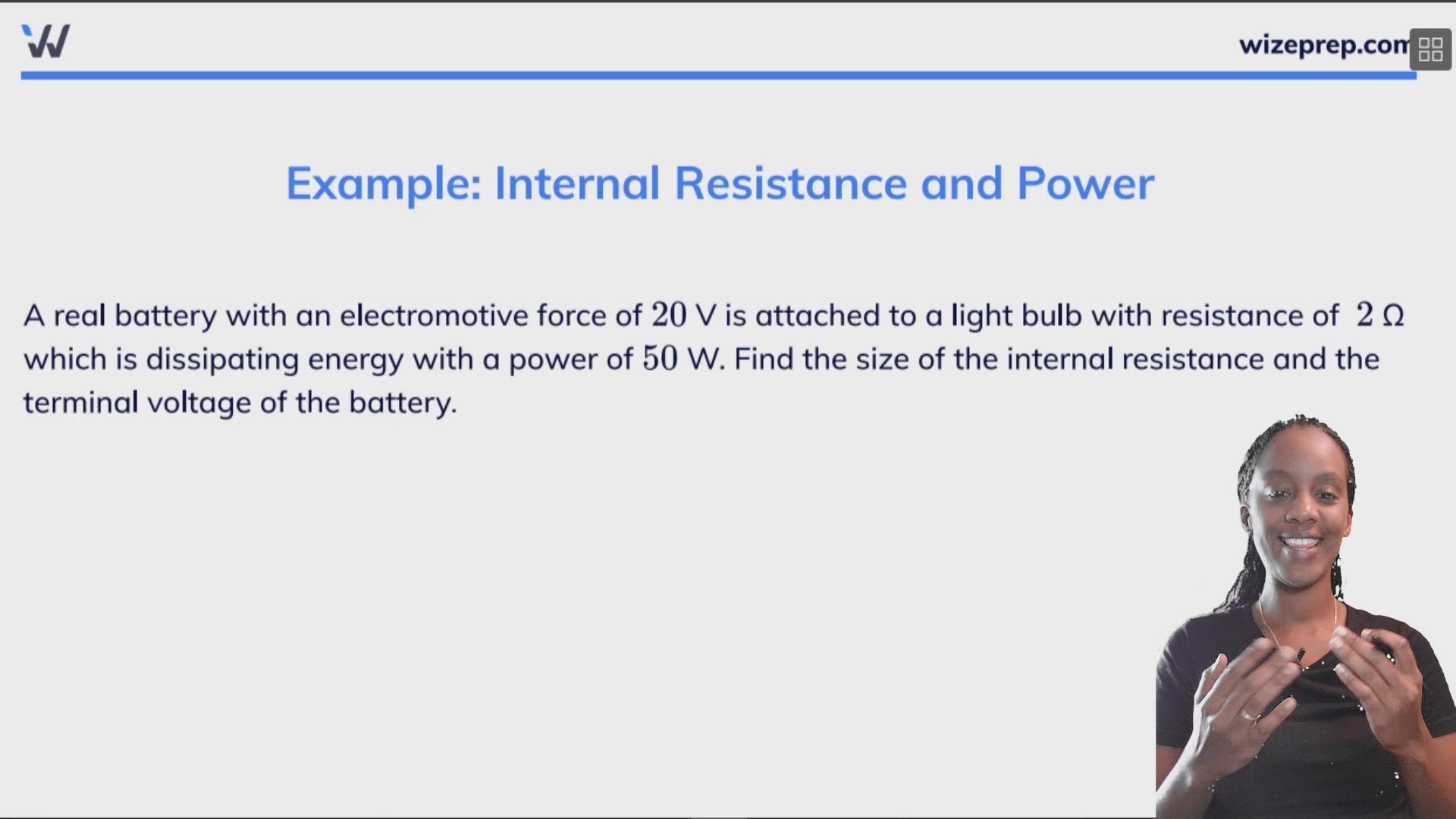
Example: Internal Resistance and Power
A real battery with an electromotive force of V is attached to a light bulb with resistance of Ω which is dissipating energy with a power of W. Find the size of the internal resistance and the terminal voltage of the battery.
Use the power of the resistor to find the current through it, which must be the current going through the whole circuit:
This the current can be written as:
Solving for the internal resistance we get:
Substitute the current from above to get:
(Ω)
The terminal voltage is:
(A)
Practice: Internal Resistance vs. Voltage and Current
What is the internal resistance of a voltage source if its terminal potential drops by V when the current supplied increases by A?