Create a free account to get started

Unlock full course notes by signing up

  • Video lessons taught by top educators
  • Practice questions with guided solutions
  • Written review notes for reference
  • Expert answers anytime from course tutors

Relative Velocity


Velocities are always measured relative to a reference frame. This reference frame could be a moving car or someone standing still in street. The concept of relative velocity lets us consider speeds from different frames of reference. We use vectors representing the velocity of the reference frame.


  • The relative velocity of an object A with respect to another object B is the velocity of object A from the point of view of someone sitting on object B. This velocity is usually shown by v⃗A/B\vec{v}_{A/B}.


  • Relative velocity is essentially the vector difference of the two velocities v⃗A\vec{v}_A and v⃗B\vec{v}_Bwhere these two velocities are measured from a same reference frame such as ground.


vA/B⃗=vA⃗−vB⃗\boxed{\vec{v_{A/B}}=\vec{v_A}-\vec{v_B}}


General strategy

  1. Write out your velocities with the subscripts in the order of object-respect to-frame of reference.
  2. Write out the relation between them using the above equation.
  3. Sometimes we can draw a diagram showing velocity vectors to guess what the relationship between the velocities described in the problem are
  4. Solve for what you want.


Create a free account to get started

Unlock full course notes by signing up

  • Video lessons taught by top educators
  • Practice questions with guided solutions
  • Written review notes for reference
  • Expert answers anytime from course tutors

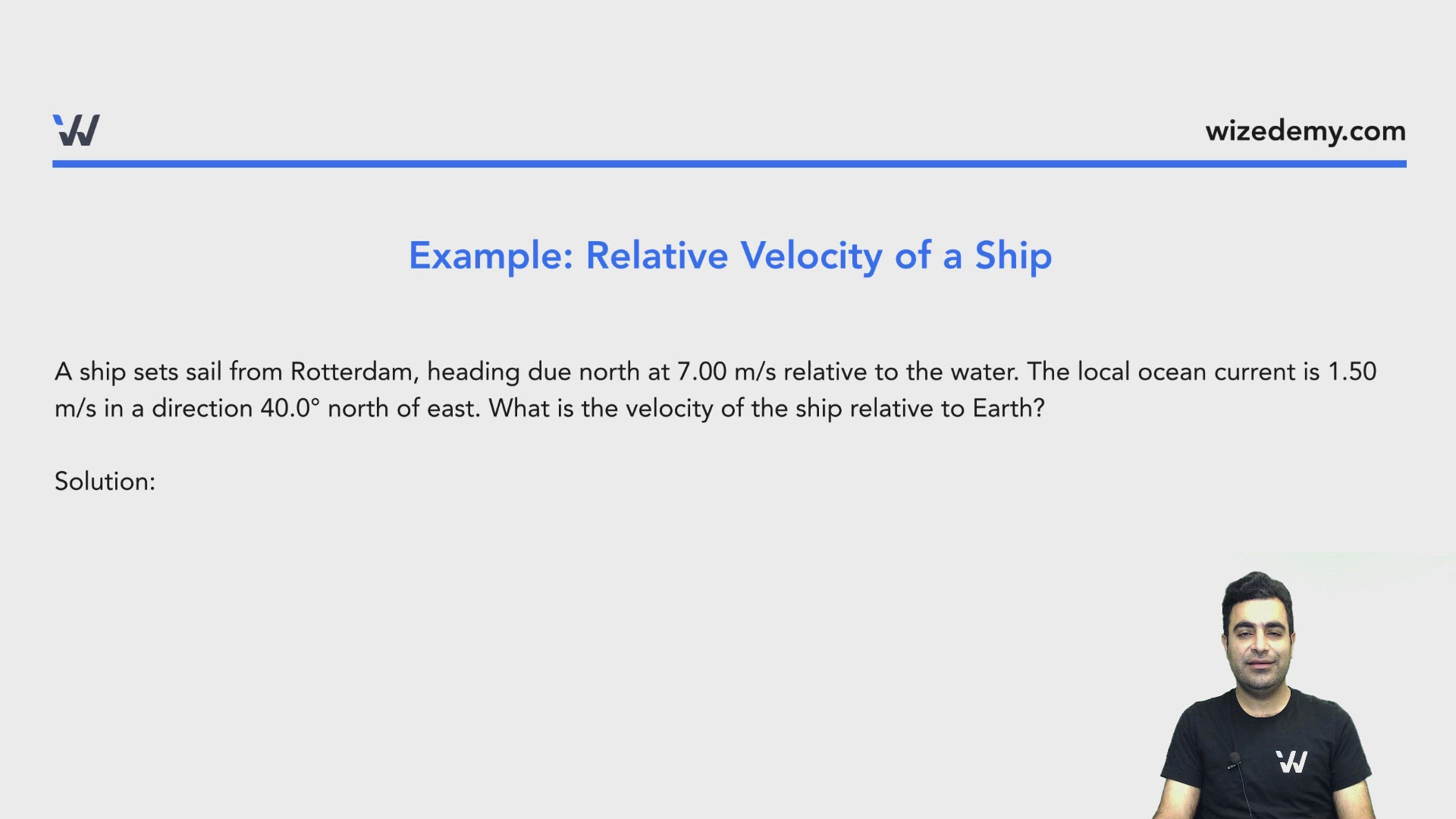
Example: Relative Velocity of a Ship


A ship sets sail from Rotterdam, heading due north at 7.00 m/s relative to the water. The local ocean current is 1.50 m/s in a direction 40.0° north of east. What is the velocity of the ship relative to Earth?


Solution:


It is good to draw a diagram and show velocities given in this problem and label them properly:

Image illustrating Example:


V⃗SE=V⃗SW+V⃗WE\vec{V}_{SE} = \vec{V}_{SW}+\vec{V}_{WE}


We can write down above vector equation in terms of its components:


(VSE)x=(VSW)x+(VWE)x({{V}_{SE}})_x = ({{V}_{SW}})_x+({V}_{WE})_x

(VSE)x=0+(1.50)cos(40)=1.15m/s({{V}_{SE}})_x= 0+ (1.50)cos(40)= 1.15m/s


(VSE)y=(VSW)y+(VWE)y({{V}_{SE}})_y = ({{V}_{SW}})_y+({V}_{WE})_y

(VSE)y=7+(1.50)sin(40)=7.96m/s({{V}_{SE}})_y = 7+ (1.50) sin (40)=7.96m/s


To find the speed of ship respect to earth we have to find the magnitude of velocity vector


VSE=(VSE)x2+(VSE)y2{{V}_{SE}} = \sqrt{({{V}_{SE}})_x^2+({{V}_{SE}})_y^2}

VSE=(1.14)2+(7.96)2=8.04m/s{{V}_{SE}} = \sqrt{(1.14)^2+ (7.96)^2}= 8.04m/s


In addition, the direction of velocity vector could be found using below equation:


tan(θ)=(VSE)y(VSE)x=7.961.15tan(\theta) = \dfrac{(V_{SE})_y}{(V_{SE})_x}= \dfrac{7.96}{1.15}


θ=81.78°\theta= 81.78\degree


This angle is measured counter-clockwise respect to positive x-axis. So, this vector is 81.78 degrees north of east.


A pilot in a Boeing 747 is beginning a 1500km flight. The plane's speed is 1000km/h and air traffic control says that he will have to head 15o15^owest of south to maintain a southward course. If the flight takes 100min, what is the wind speed?

Choose an answer

Create a free account to get started

Unlock full course notes by signing up

  • Video lessons taught by top educators
  • Practice questions with guided solutions
  • Written review notes for reference
  • Expert answers anytime from course tutors

Extra Practice