Popular Courses
MCAT
General Course
PHYSICS 1201A/B
Western University
Intro to Physics
University Study Guides
PHYSICS 1D03
McMaster University
AP Physics C: Mechanics Exam Prep Course
AP Exam Prep
Physics
General Course
PHYSICS 1401A/B
Western University
PCS 211
Toronto Metropolitan University
PHYS 204
Concordia University
Intro to Physics
University Study Guides
PHYS*1300
University of Guelph
PHYS 100
University of British Columbia
PHYS*1080
University of Guelph
PHY 1321
University of Ottawa
PHYS 131
McGill University
APSC 111
Queen's University
APSC 111
Queen's University
PHYS 102A
University of Victoria
PHYS 110
University of Victoria
LE/PHYS 1800 3.00
York University
0:00 / 0:00
Kinematic Graphs
Position-time and velocity-time graphs are graphical representations of kinematic data. Valuable information can be gathered by evaluating the slop of these graphs or by determining the area under a curve. These graphs can often be easily converted to data sets but may require some analysis when using the equations of motion.
Here is some useful information we can get from these graphs:
- The slope of a position-time graph gives velocity.
- The slope of a velocity-time graph gives acceleration.
- The area under a velocity-time graph gives the displacement of the object in that amount of time.
- The area under an acceleration-time graph gives the change in the velocity of the object.
- A flat line indicates constant velocity or displacement.
- If the velocity changes suddenly (e.g. a runner changes direction and starts going backward), we model this as short spikes in the acceleration versus time plot.
Watch Out!
Positive velocity and positive acceleration does not necessarily indicate a positive displacement.
- In the following diagrams you can find displacement as a function of time for a few different type of motions:


0:00 / 0:00
Example: Kinematic Graphs
The position-time graph of a rolling marble is shown below. Which statement(s) is/are correct?
A. The marble has a positive velocity at t=0 sec.
B. The marble is slowing down at t=1 sec.
C. The marble is speeding up at t=3 sec.
D. The marble has a positive acceleration at t=2 sec, but its velocity is zero.

Correct statements are:
A. is wrong. Remember that slope of a line tangent to position vs time graph is the particle's velocity. This slope is negative at t=0 which means that velocity is negative at this point.
B. is correct. Close to t=1 s, the tangent line to the curve gets less steep when time passes which means that the size of velocity or speed is getting smaller. So, we have a slowing down motion.
C. is correct. Similar to statement B., here, close to t=3 s, the tangent line is getting more steep which means that speed is rising. So, we have a speeding up motion.
D. is correct because if you look at moments before t=2 sec, at those points, velocity is negative and it gets smaller is size until it reaches zero right at t=2 sec (slop of the tangent line is zero). Since the size of velocity is decreasing, there is a slowing down motion for which velocity and acceleration should have opposite directions and since velocity is negative, acceleration should be positive.
A drone was controlled as follows:
I. At , the drone was stationary on the surface of the ground ()
II. At , it started to raise up at a constant speed of
III. After rising for , it suddenly changed its vertical velocity to and kept moving upward with this constant velocity
IV. When it reached the height of above the ground it suddenly gained a downward acceleration with a magnitude of while it was moving upward
V. After changing direction at a higher altitude , It got back to the ground level with the same acceleration
Note: This motion is not a free fall because the drone acceleration and velocity are controlled by the electric motors inside it.
At what time did the drone raise its speed to ?
Enter your answer in s, do not include units.
A ball moves according to the following v-t graph. (The graph ends at t=110s.)
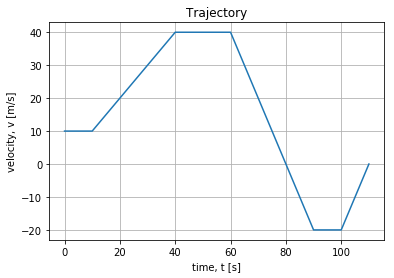
Find the final displacement of the object.