
Projectile Motion
When an object is launched in the air at an angle, its motion is two-dimensional and if it is only affected by gravity, this motion is known as Projectile Motion.

- If we are given a velocity with angle of respect to horizontal direction:
- We can find time of flight to maximum height, maximum height and range of motion using the following equations respectively:
Some Useful Notes about Projectile Motions
− Find the time to reach the ground from the y-component calculations.
− Find the horizontal distance (or range) from the x-component calculations.
− The velocity along the y-axis changes. at maximum height.
− Projectile motion is completely symmetric. For example, time to go up from a certain height equals time to come back down to that same height.
− Maximum range (horizontal distance) is obtained when the launch angle is 45°.
Example: A Ball in Projectile Motion
A ball is shot at an angle of 30° from the horizontal. If the ball had an initial speed of 20m/s, how long was it in flight before it hit the ground?
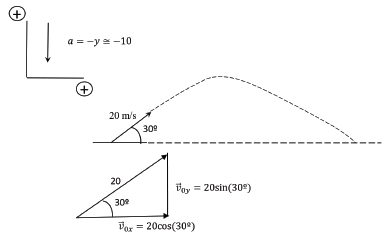
In y-direction: