Diffraction as the Spreading of Light
Diffraction is the spreading out of light as it passes through a small opening.
But why does this happen? Why does light "spread" in the first place?
According to Huygen's Principle, waves can be modeled as a bunch of little wavelets. That is, every point on a wave front can be considered a point source, generating secondary waves spreading away from it. As a wave spreads out, each wavelet is spreading out and interfering with all the others.
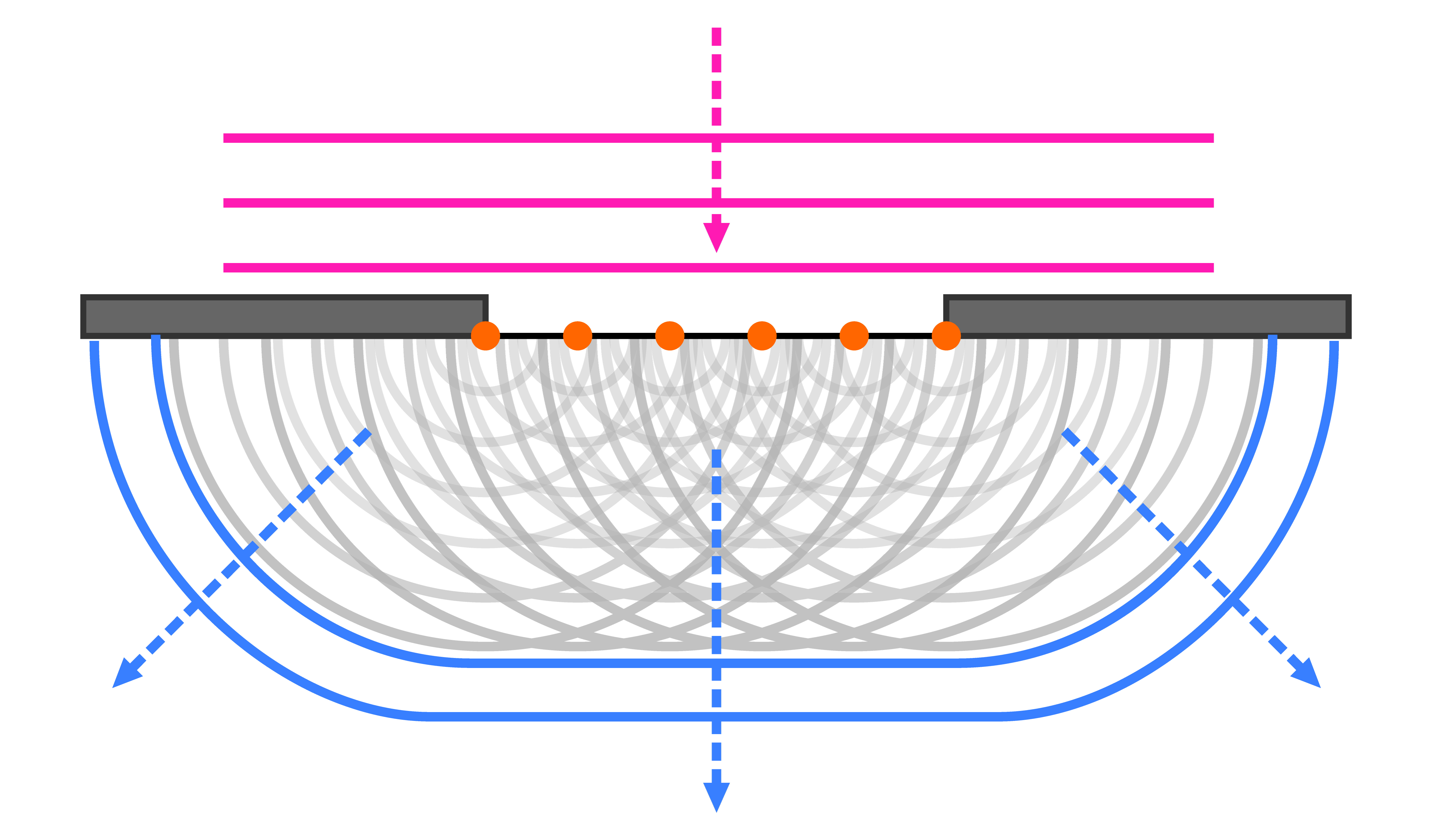
Actually, light can be described as either waves, or as particles called photons.
The fact that light can be accurately described either way is why we talk about the wave-particle duality.
Single Slit Diffraction
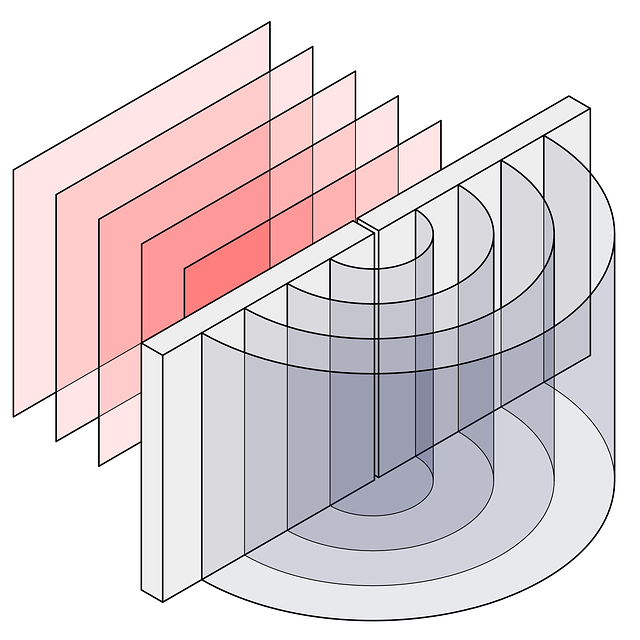
Light passing through a single slit can be viewed as an infinite number of point sources.
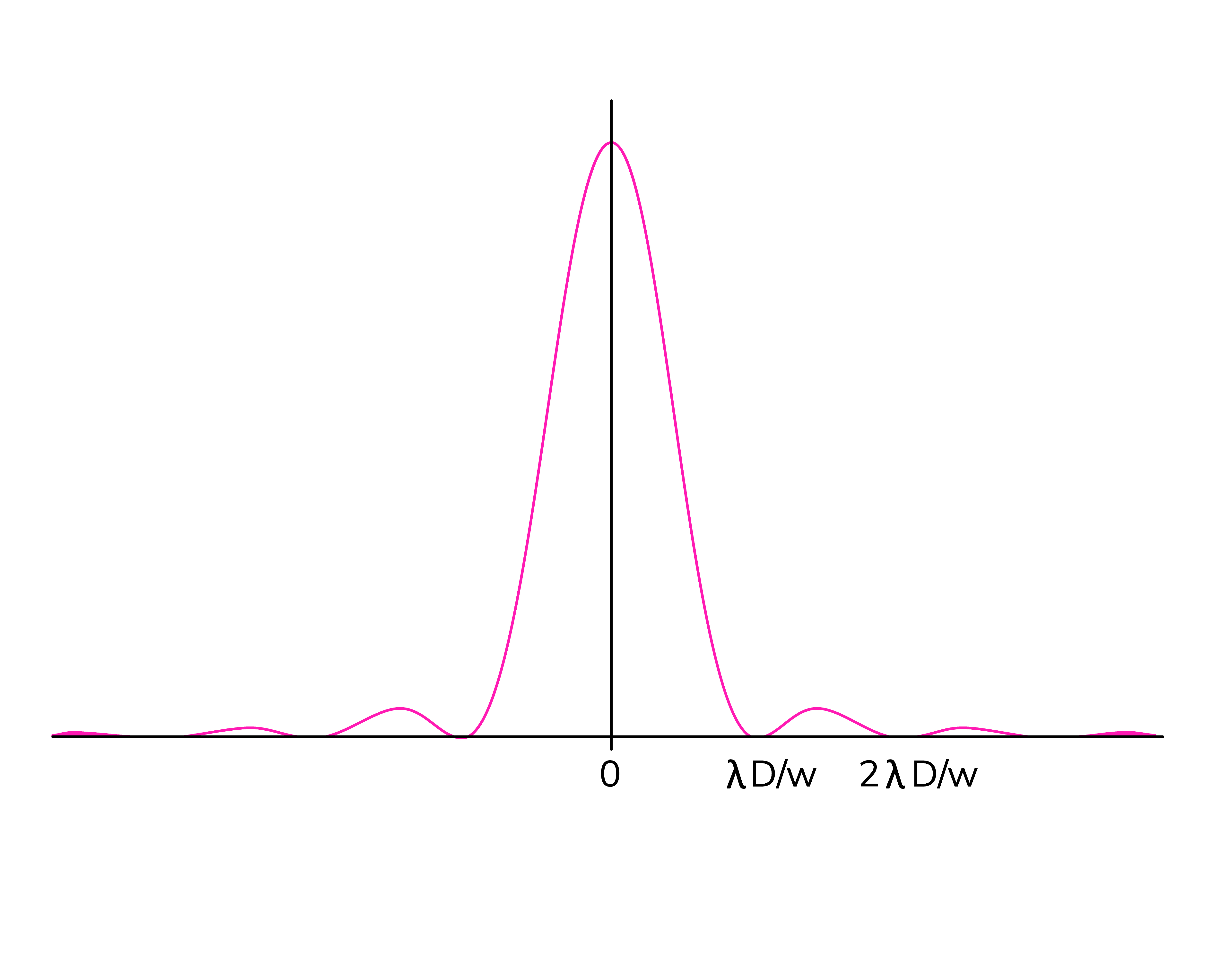
The resulting pattern shows a wide central maximum, followed by smaller bright fringes on either side.

Dark fringes on the screen correspond to destructive interference. The path difference is given by:
where is the width of the slit.
Bright fringes on the screen correspond to constructive interference. The path difference is given by:
Small Angle Approximation:
For we can use the small angle approximation, which gives us:
Therefore we have the angle and position on the screen for dark fringes:
and
for
Example: Single vs. Double Slit
A two-slit apparatus with slits a distance of mm apart is illuminated by an Argon laser (wavelengthnm). Then, in a separate experiment a single slit of width mm is illuminated. The two intensity patterns are shown below. Which one is the single-slit?
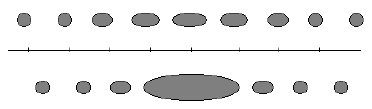
The lower one is the single slit because it has a much wider central max.