Create a free account to get started

Unlock full course notes by signing up

  • Video lessons taught by top educators
  • Practice questions with guided solutions
  • Written review notes for reference
  • Expert answers anytime from course tutors

Bernoulli's Principle


If we have an ideal and incompressible fluid flowing at a steady rate, we have the Bernoulli's principle.


P+ρgh+12ρv2=constant\boxed{P+\rho gh+\frac{1}{2}\rho v^2=\text{constant}}

where

  • PP is the internal pressure
  • ρ\rho is the fluid density
  • gg is the gravitational acceleration (9.81 m/s2)
  • hh is the height of the point in the fluid, relative to some defined reference point
  • vv is the flow speed


So for any two points inside of our flow, we have:


P1+ρgh1+12ρv12=P2+ρgh2+12ρv22\boxed{P_1 + \rho g h_1 + \frac12 \rho v_1^2 = P_2 + \rho g h_2 + \frac12 \rho v_2^2 }


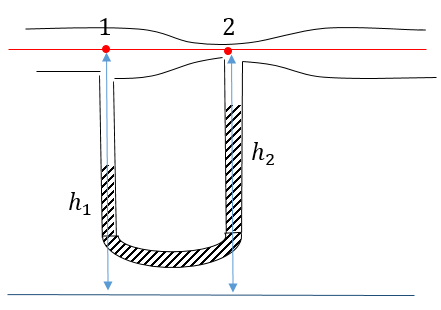
Image illustrating Bernoulli's Principle


Now let's look at two points in the flow at the same height but with different cross sectional area (Points 1 an 2 in the upper pipe)
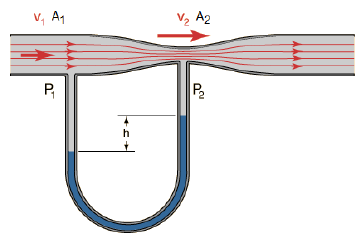

Image illustrating Bernoulli's Principle


Flow Rates and Continuity


To talk about moving fluids, we are going to define some flow rates, which will tell us how much fluid is moving per unit time.


Flow rate is usually defined as the rate of change in volume and it is shown by QQ:


Flow Rate=Q=ΔVΔt\boxed{\text{Flow Rate}=Q=\dfrac{\Delta V}{\Delta t}}


where VVis the volume of fluid.


If we assume that we have a steady flow and incompressible fluid, flow rate is constant and could be written in the following form:


Q = Av\boxed{Q\ =\ Av}


where AAis the cross-sectional area of the fluid (perpendicular to the flow direction), and vvis the flow speed.


Image illustrating Flow Rates and Continuity


Now by comparing any two points in the flow and putting their flow rates equal to each other we can find continuity equation:


A1v1=A2v2\boxed{A_1v_1=A_2v_2}


Example: Venturi System


A Venturi flow-meter for a tube of water is shown below. There is stationary mercury in the U-tube, shown by the blue color, with density ρHg=13600\rho_{Hg}=13600 kg/m3 , and flowing water on the top pipe with density ρw=1000\rho_w=1000kg/m3 . We know that A1A2=5\dfrac{A_1}{A_2}=5 and v1=2v_1=2m/s. What is the difference in the height of mercury in the U-tube?
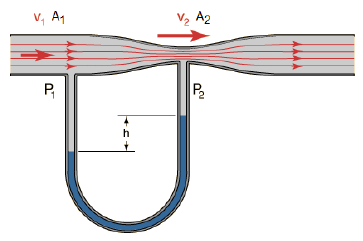

Image illustrating Example: Venturi System


Note that P1>P2P_1>P_2 because P1P_1 has pushed down the mercury more compared to P2P_2.


Image illustrating Example: Venturi System


→\to Here we have a static fluid (mercury) and a flowing fluid (water).

→\to So, we can use Pascal's principle for Mercury and Bernoulli's equation for water.


Write Bernoulli's Equation for the flow of water at points #1 and #2.


Here h1=h2h_1=h_2 no matter where the reference height is (it could be the bottom of the picture, or the line passing through these points, or any other horizontal line).


P1+12ρwv12+ρwgh1=P2+12ρwv22+ρwgh2P_1+\dfrac{1}{2}\rho_wv_1^2+\cancel{\rho_wgh_1}=P_2+\dfrac{1}{2}\rho_wv_2^2+\cancel{\rho_wgh_2}


Then the difference in pressures is given by:


P1−P2=12ρw(v22−v12)P_1-P_2=\dfrac{1}{2}\rho_w(v_2^2-v_1^2)


Let's use the continuity equation A1v1=A2v2A_1v_1=A_2v_2 to sub in v2=A1v1A2v_2=\dfrac{A_1v_1}{A_2} and get:


P1−P2=12ρw[(A1v1A2)2−v12]P_1-P_2=\dfrac{1}{2}\rho_w\bigg[\bigg(\dfrac{A_1v_1}{A_2}\bigg)^2-v_1^2\bigg]


=12ρw (A12A22−1) v12=\dfrac{1}{2}\rho_{w\ }\bigg(\dfrac{A_1^2}{A_2^2}-1\bigg)\ v_1^2


Write Pascal's principle for the stationary mercury: at point A at the surface of the lower branch on the left, and point B at the same level on the right branch.


PA=PBP_A=P_B


ρwgh+P1=ρHggh+P2\rho_{w} gh+P_1=\rho_{Hg}gh+P_2


where we have ignored the columns of water above the surface of the higher branch, since they're the same for both branches and so the pressure from them cancels out.


The difference in pressures is then:


P1−P2=ρHg gh−ρw ghP_1-P_2=\rho_{Hg}\ gh-\rho_{w} \ gh


=(ρHg−ρw) gh=(\rho_{Hg}-\rho_w)\ gh


Let's equate the two expressions we have for the pressure difference:


12ρw (A12A22−1) v12=(ρHg−ρw) gh\dfrac{1}{2}\rho_{w\ }\bigg(\dfrac{A_1^2}{A_2^2}-1\bigg)\ v_1^2=(\rho_{Hg}-\rho_w)\ gh


Isolate the height:


h=v12ρw2 (ρHg−ρw) g(A12A22−1)h=\dfrac{ v_1^2\rho_{w}}{2 \ (\rho_{Hg}-\rho_w)\ g}\bigg(\dfrac{A_1^2}{A_2^2}-1\bigg)


Put the numbers in:


=22×10002(13600−1000)(9.81)×(52−1)=\dfrac{2^2\times1000}{2(13600-1000)(9.81)} \times(5^2-1)


=0.388=0.388 (m)


Practice: Leaking Tank


A large cylindrical container is filled with water to a height hh and it is open to air on top. The density of the liquid is ρ\rho.

1) Find the velocity of the emerging fluid from the hole at the base of the container. (Assume that the cross sectional area of the container is much larger compared to the size of the hole)

Choose an answer

Create a free account to get started

Unlock full course notes by signing up

  • Video lessons taught by top educators
  • Practice questions with guided solutions
  • Written review notes for reference
  • Expert answers anytime from course tutors