Popular Courses
MCAT
General Course
Intro to Physics
University Study Guides
Physics
General Course
PHYSICS 1A03
McMaster University
PHYS 115
Queen's University
PHYS 211
University of Calgary
PHYS 131
University of British Columbia
Intro to Physics
University Study Guides
PHYS*1080
University of Guelph
PHY 1321
University of Ottawa
PHYS 102A
University of Victoria
PHYS 221
University of Calgary
PHYS-1400
University of Windsor
PHY 1331
University of Ottawa
PHY 1122
University of Ottawa
PHYS 142
McGill University
PHYC 1190
Dalhousie University
ENGG 212
University of Calgary
ENGG 212
University of Calgary
PHYS 1050
University of Manitoba

0:00 / 0:00
Buoyancy
Buoyant force is an upward force exerted on an object either partially submerged or completely submerged in a fluid due to pressure differences between top and bottom of the object.
Archimedes's Principle
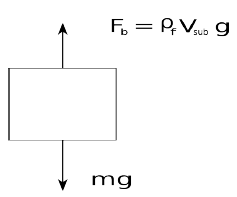
Archimedes' principle says that the amount of buoyant force equals to the weight of the liquid that the object displaces while floating/sinking.
Hence, buoyant force has the following equation:
- is the density of fluid
- is the submerged volume of the object
- is the gravitational acceleration
Wize Tip
When an object is only partially submerged, it is only displacing part of its own volume. So the buoyant force only depends on the part of the object that is in water. Note that is the same as .
Watch Out!
Buoyant force is also shown by or .
Usually there is a competition between buoyant force and gravity. At static equilibrium condition when the object doesn't move, the net force on the object is zero. So:
- Whereis the density of the object and is the volume of the object
Wize Concept
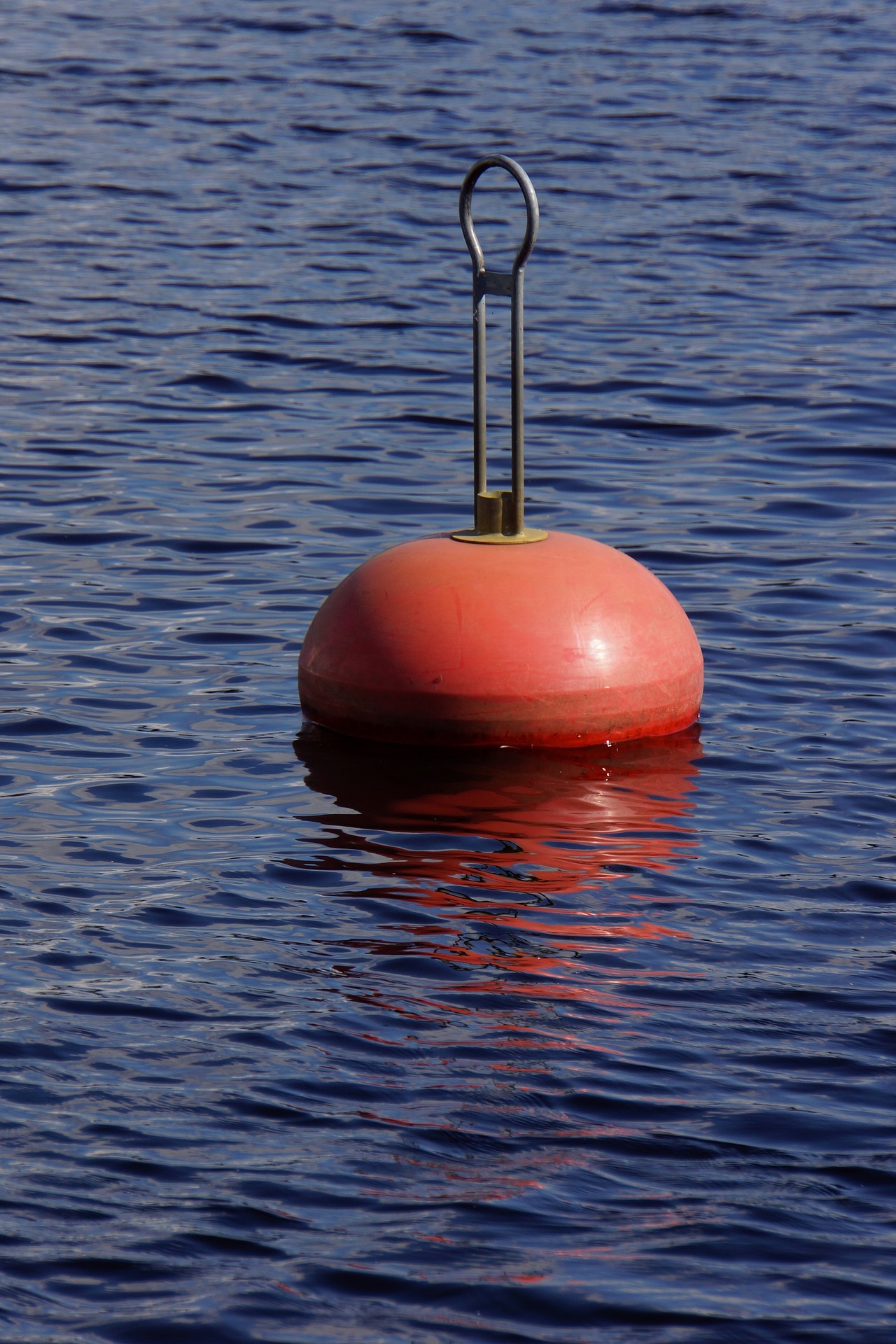
If the object is fully immersed in water and then it is released:
- If , then and the object sinks
- If , then and the object floats on the surface of the fluid
Exam Tip
For a floating object, the fraction of its volume submerged in the fluid is given as:
Watch Out!
The apparent weight is the force of gravity minus the buoyant force.
Example: Hanging Boxes in Water
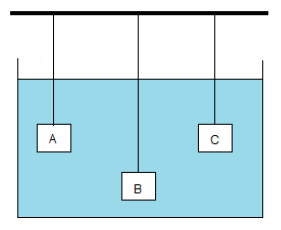
Boxes , and have the same size. and are located at the same level but is deeper in water. If , compare:
a) Buoyant force
b) Force exerted by the water on top of each box
c) Tension in the rope
d) Apparent weight
Part a)
The buoyant force is always:
All blocks have the same size and therefore the same , which means that the buoyant forces are all equal:
Part b)
The force exerted by the water on top of each box is due to the pressure of the column of water:
Therefore we have:
because
Part c)
To find tension, we need to look at the free body diagram of each box.
For each box we have:
We know that is the same for all boxes (from part a).
Therefore we have:
because
Part d)
The apparent weight is the real weight minus the Buoyant force:
Again, we know that is the same for all boxes (from part a).
Therefore we have:
because
Example: Wooden Cylinder Floating in Oil and Water
A cylindrical block of wood cm high is submerged partly in water and partly in oil. It is submerged so that the flat circular face is facing vertically upwards, and completely covered by the oil. Oil, with a density of kg/m3 floats on water. The density of wood is kg/m3. At what position from the bottom of the block is the water-oil interface?
Let's draw the free body diagram for the cylinder:
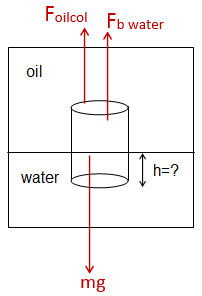
At equilibrium, the net force on the cylinder should be zero:
Let's define the fraction of the volume in water as:
and the fraction of the volume in oil as:
Substituting these in, and using , the force equation becomes:
Now, the fractions submerged in oil and water should add up to one, that is .
This means that and our equation becomes:
Let's solve for the fraction in water:
Put the numbers in:
Therefore the height in water is of the total height:
(cm)
Practice: Floating Helium Balloon
A large Helium balloon has a volume of m3. The density of air is kg/m3 and the density of Helium is kg/m3. The mass of the balloon material is kg.
a) What is the buoyant force acting on the balloon?