Wize University Physics Textbook (Master) > Fluid Mechanics
Hydraulic Systems
Popular Courses
MCAT
General Course
Intro to Physics
University Study Guides
Physics
General Course
PHYSICS 1A03
McMaster University
PHYS 211
University of Calgary
PHYS 131
University of British Columbia
Intro to Physics
University Study Guides
PHYS*1080
University of Guelph
PHY 1321
University of Ottawa
PHYS 221
University of Calgary
PHYS-1400
University of Windsor
PHY 1331
University of Ottawa
PHY 1122
University of Ottawa
PHYS 142
McGill University
PHYC 1190
Dalhousie University
ENGG 212
University of Calgary
ENGG 212
University of Calgary
PHYS 1050
University of Manitoba
PHYS 101
Simon Fraser University
PHYS-1300
University of Windsor
0:00 / 0:00
Hydraulic Systems
The Pascal's principle and the incompressibility of liquids make hydraulic systems suitable for manipulating and transmission of forces.
In these hydraulic systems, the volume of fluid moved in the right and left sides are the same
where is the cross-sectional area of each side and is the displacement of each side.

Now imagine pistons of both arms are at the same height. Thus, due to Pascal's principle, the pressure on both sides should be equal. this implies:
Exam Tip
Above formula could be used to find the force needed one one piston to keep a load on the other piston at the same height .
Example: Hydraulic Lift
In the hydraulic lift, a large piston supports a car. The radius of the large piston is cm and that of the smaller piston is cm. The total mass of car and piston is kg.
What force must be applied to the smaller piston to support the car (assuming the two pistons are at to be kept at the same height)?
The pressure applied at the small piston can be used to support the car. Since they are at the same level, each pressure is given by . The force on the large piston is the weight of the piston and car:
Put the numbers in:
N

Mark Yourself Question
- Grab a piece of paper and try this problem yourself.
- When you're done, check the "I have answered this question" box below.
- View the solution and report whether you got it right or wrong.
Example: Lifting a Car by a Hydraulic System
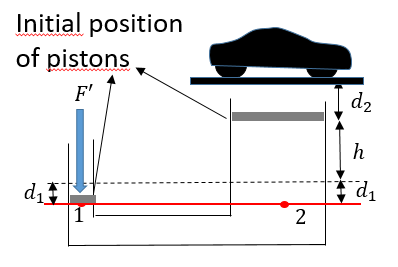
Consider a car of mass on a hydraulic lift, as shown. Initially, it is at height above the dotted line, which requires applying force on the left piston. Then, we want to raise the car by a distance . We accomplish this by pushing down on the left side of the tube by a distance , with new force .
a) What was the initial force required to keep the car at a distance above the dotted line? (Answer in terms of the areas of the two pistons, and .)
b) Compared to that point, how much extra force do we need to raise the car by the extra distance ? (Answer in terms of the areas of the two pistons and the distance .)